
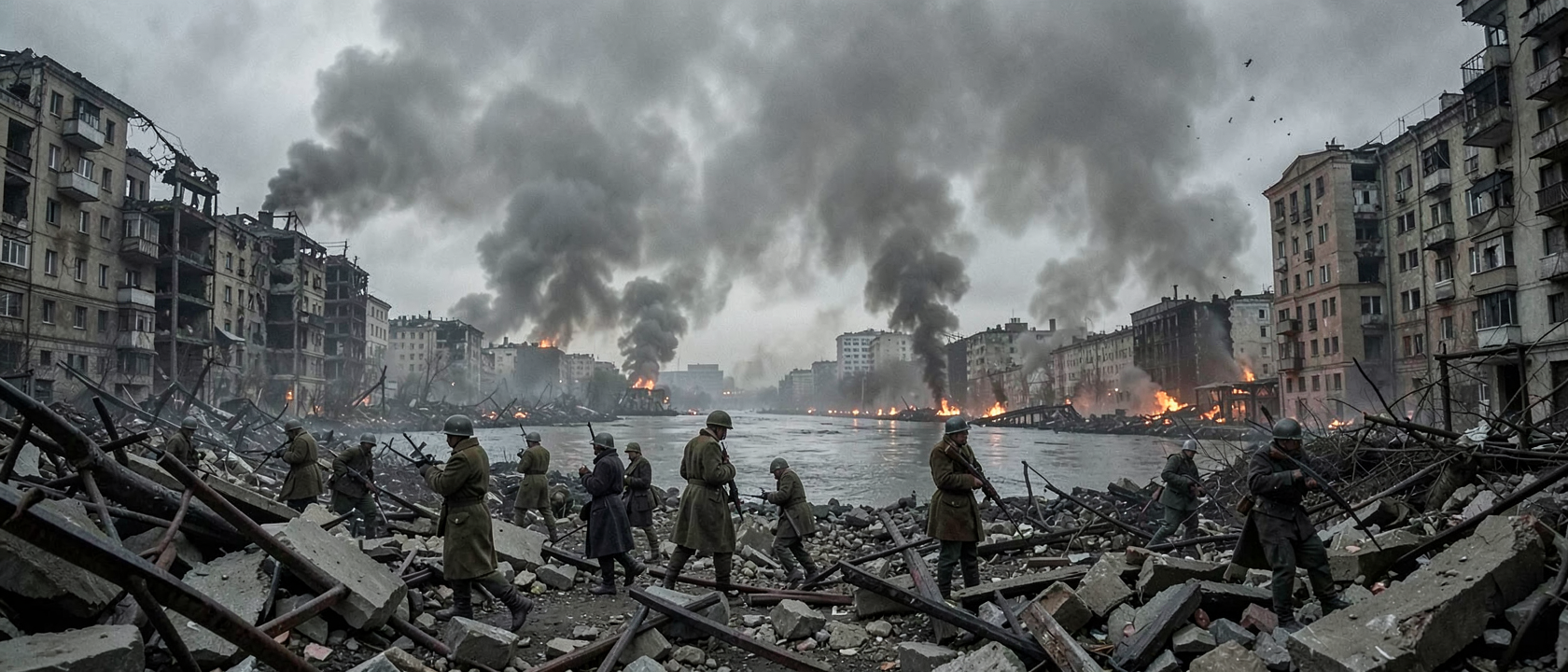
A Darkening Sky, Mistaken for Weather
Maria Chuprina was thirteen years old on August 23, 1942. According to an account published by History Today, which has not been independently verified, she was at home in Stalingrad (now Volgograd, Russia) that day, together with her mother and her uncle. The morning passed without incident. At 15:18 that afternoon, Luftflotte 4 opened its mass bombing raid on the city. Before the first bombs fell, she noticed the sky above Stalingrad beginning to darken. She took it, at first, for cloud cover.
The detail has stayed in the record for a reason. A change in the sky, read as weather. The account does not say how long the interval was between that darkening and the first explosion, and nothing in the surviving testimony tells us what happened in between.
More Than a Year of Ordinary Life
On June 22, 1941, Germany launched Operation Barbarossa, its invasion of the Soviet Union. Stalingrad, sitting on the western bank of the Volga River, was a major industrial city and a central transport point on the southern Volga. Its pre-war population stood at an estimated 445,000 to 500,000 people. And yet, through the summer of 1941, the autumn, the winter, and well into 1942, no bombs fell on it.
The war was not unfelt in the city. Maria’s father was serving with Soviet forces against the Wehrmacht in Ukraine, away from home and unreachable. Her mother worked as a nurse. Those facts alone describe a household already shaped by the conflict. But shaped is not the same as struck. More than fourteen months separated the opening of Barbarossa from August 23, 1942, fourteen months in which Stalingrad functioned as a city rather than a battlefield. That span is the measure of what the afternoon of August 23 ended.
23 August 1942: The Assault Opens
No warning reached Stalingrad’s civilian population before the bombing began. Luftflotte 4, commanded by Generaloberst Wolfram von Richthofen, flew approximately 1,600 sorties on August 23 alone, dropping an estimated 1,000 metric tonnes (roughly 1,100 short tons) of high explosives and incendiaries. The aircraft were Heinkel He 111s and Junkers Ju 88s, operating at altitudes of approximately 2,000 to 3,000 metres (roughly 6,600 to 9,800 feet). That single day was not an exception; Luftflotte 4 averaged approximately 1,000 sorties per day from August 23 through November 22, 1942. On August 24, the city’s central water supply was destroyed. Fires damaged or destroyed an estimated 95 percent of the buildings in the central district.
The abruptness of the assault is itself a fact of consequence. A civilian population has no way to orient itself to violence it did not see coming, no framework for deciding quickly what is happening or what to do. The bombing did not build; it arrived.
What the Record Holds
The civilian death toll from August 23 alone is frequently cited at 40,000, but that figure is disputed. Historians have described it as possibly inflated, and it cannot be stated as settled. The overall civilian death count within Stalingrad across the full battle period carries an even wider range: some estimates place it at around 40,000, while others run as high as 235,000. No consolidated figure has been confirmed.
What the History Today account does supply, through Maria Chuprina’s testimony and subject to the caveat that it has not been independently corroborated, is something more specific than a number: a child not yet fourteen, a father at the front in Ukraine, a mother working as a nurse as the city around her was being destroyed. The source characterizes the months that followed as a period of extreme suffering. It does not quantify that suffering in aggregate terms, and nothing in this evidence base makes that quantification possible. The absence of a definitive count is not a gap in the argument; it is simply what the record provides.
Resolve, or the Memory of Resolve?
Maria Chuprina’s account also carries a broader claim: that very few among Stalingrad’s residents doubted the city was worth defending. It is a striking assertion. Whether it reflects the genuine conviction of a population living through bombardment and siege, or whether it reflects the retrospective framing of that experience by someone who survived, saw the Soviet victory, and recalled those months in a specific political and commemorative context, the evidence cannot determine.
One testimony cannot establish a collective state of mind across a city of up to half a million people. The pressures of Soviet commemoration after the war were real, and memory produced under those conditions is not automatically false, but it is not automatically transparent either. A survivor who remembers certainty may be reporting what they felt, or may be organizing the past into a shape that makes sense of how it ended.
None of that dismisses what Maria Chuprina described. Personal testimony is a category of evidence, and her account is the only ground-level record of this opening moment available in the source examined here. It establishes, concretely, that a thirteen-year-old was in that city on August 23, 1942, that her family was separated by the war, and that what followed cost months of her life in conditions the record does not hesitate to call extreme. What it cannot establish is whether the resolve she describes was shared widely, or whether it was her own, remembered and then extended across a city she had survived.
The battle ran 199 days, from August 23, 1942, to the final surrender of Axis forces on February 2, 1943. The city held. The question of how many of its people held it willingly, and what willingness means when the alternative is not clear, is one the available evidence leaves open.