
A Line in the Weekly Tally
In mid-June 1725, a London newspaper called the Weekly Journal or British Gazetteer published its routine list of notable deaths from the week before: three Londoners drowned, one died falling from a cart, one was killed with a sword, and an infant was recorded as “overlain,” the period’s word for a baby accidentally smothered while sleeping beside an adult. Then came one entry that did not belong with the rest.
Someone had been pressed to death by the crowd at the execution of the pirates, and was buried at St John’s of Wapping, a parish church by the river. No name was given, no explanation offered, just the same flat notation used for the drownings and the sword death.
That sentence is close to the only documentary trace that survives of what happened that day. Everything else about the crush has to be built around it.
A Mutiny Off the Iberian Coast
The story behind that line began on November 3, 1724, aboard a merchant ship called the Caroline, sailing from Santa Cruz de la Palma in the Canary Islands toward Genoa. Her second mate, a Scotsman named John Gow, led a mutiny that night, killing the captain, Oliver Ferneau, and several officers; sources put the toll at three or four dead. The crew elected Gow captain and renamed the ship Revenge.
Through the winter, the Revenge raided merchant shipping off Portugal and Spain. By January 1725, Gow had renamed it again, the George, and sailed into Stromness, in Orkney, posing as a merchant called “Mr. Smith.” In February his men raided the Hall of Clestrain and tried to rob Carrick House on nearby Eday, home to James Fea, someone Gow had known since boyhood. The ship ran aground near the Calf of Eday soon after, and Gow surrendered to Fea on February 17, 1725. The crew was shipped to London aboard HMS Greyhound, reaching Woolwich on March 26, 1725, and held at Marshalsea Prison.
How many men took part in the mutiny, or remained aboard when the ship was taken, is not recorded in what survives. By the spring of 1725, though, piracy was no abstraction to Londoners. It was a running story, and the Revenge was its leading case.
A Trial Built for an Audience
A murder at sea off the coast of Spain fell, in law, under Admiralty jurisdiction, which claimed authority over crimes committed anywhere on the water, however far from England. Trying the case in London meant parading a distant crime through the city’s own streets.
The trial opened at the Old Bailey on May 8, 1725. Gow refused at first to enter a plea, risking the old penalty of being pressed under weights until he did; his thumbs were bound with cord and squeezed to change his mind, and he relented, pleading not guilty. The delay stretched his trial to a day and a half. Gow and several of his crew, including James Williams, were convicted of murdering the ship’s officers and sentenced to death. The rest were acquitted, the court accepting that they had been forced into piracy rather than choosing it. Accounts differ on the final number condemned: eight by some counts, ten by others.
None of this needed introducing to London readers by June. When the Weekly Journal or British Gazetteer later reported the crush, it assumed its audience already knew whose execution had drawn the crowd: the capture and trial of the Revenge’s crew, it noted in passing, had been followed for weeks. That same brief report gives no date for the hanging itself, only that it had happened shortly before the paper went to press.
The Crowd That Proved Fatal
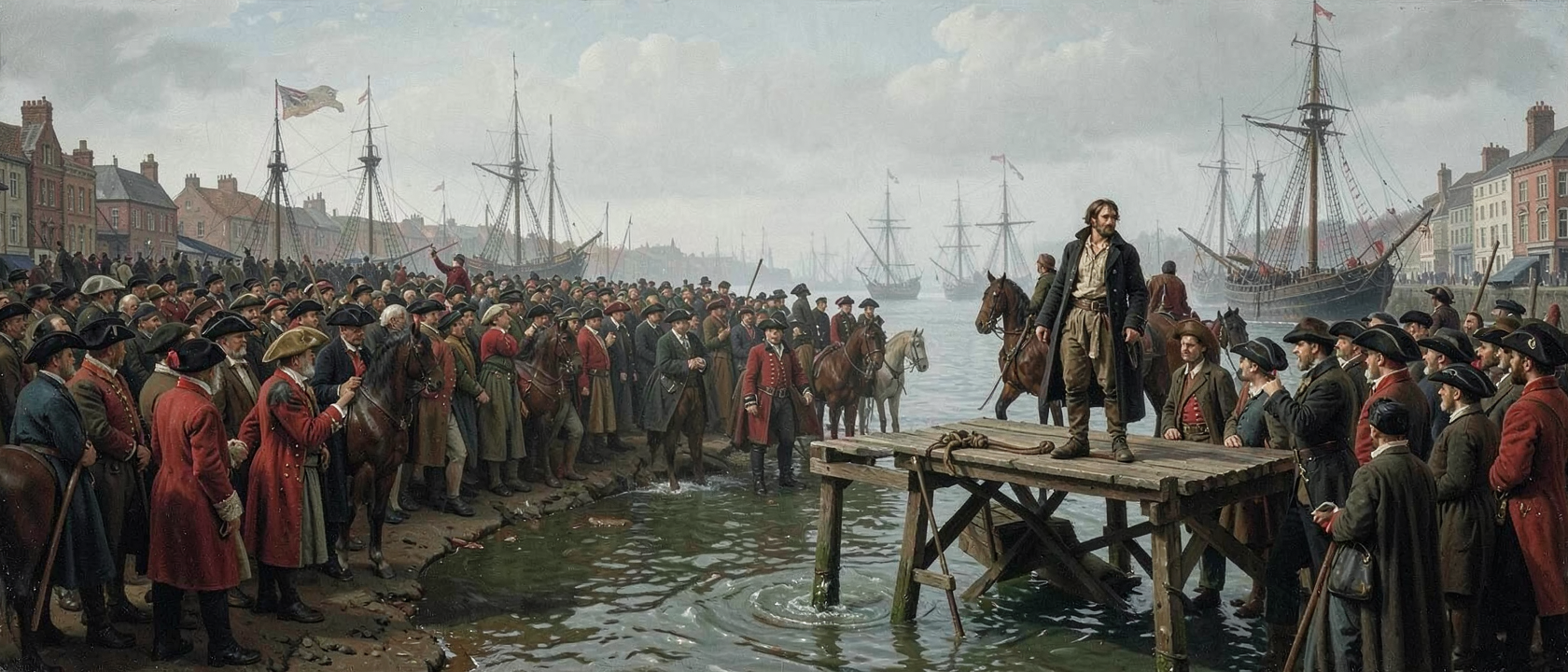
Court and Admiralty records fill that gap: the executions took place on June 11, 1725, at Execution Dock in Wapping, on the Thames. The dock stood just past the low-tide mark, placing the hangings technically within the water and inside Admiralty jurisdiction rather than the city’s ordinary courts. Pirates, smugglers, and mutineers had been put to death there for more than four hundred years. Condemned prisoners were customarily marched from Marshalsea Prison, over London Bridge and past the Tower of London, led on horseback by the High Court Marshal.
Executions at the dock routinely drew crowds in the thousands, pressed close along the riverbank for a clear view. Gow’s own hanging did not go cleanly: the rope broke as he was turned off the gallows, apparently under the weight of people pulling at his legs, and he had to be strung up a second time. None of that was especially unusual for the period. What made this execution different is the one fact that survives in print: somewhere in that packed crowd, the press of bodies killed a bystander who had come only to watch.
One Name Missing
The men hanged at Wapping are, for the period, unusually well documented. We know the date, several of their names, the charge against them, and what was done afterward to the bodies of Gow and the other ringleaders: left at the water’s edge until three tides had washed over them, then tarred and hung in chains as a warning to other sailors. Gow’s story outlived him in print. Daniel Defoe published an account of his mutiny and capture within the year, and nearly a century later Sir Walter Scott used him as the model for a character in his 1822 novel The Pirate.
That Londoner, crushed in the crowd that came to watch them die, has no such record: no name, no age, no account of how the crush happened or who else was hurt. Only a cause of death, a parish, and a week in which a newspaper went to press. The hanging had drawn thousands eager to see justice done to men who had mutinied an ocean away, and it took, without record, one of the very subjects that justice was meant to protect.