
A Stone With Two Dates
In Richmond, Texas, a small gray marker stands in Morton Cemetery, placed there by the Texas Historical Commission in 1992. It gives Walter Moses Burton’s birth year as 1840, the same year the Texas State Historical Association’s own handbook uses. At least one other account, from BlackPast, puts his birth in 1829. No one has settled which is right.
That kind of gap runs through Burton’s whole life. He is easier to trace by what he built, land bought, offices won, a Senate seat held for years, than by anything private. There is no surviving description of his childhood, his voice, or his final years. What follows is the outline the paper trail allows.
A Skill Taught Against the Law
Burton was born enslaved in North Carolina. At some point before the Civil War, his enslaver, recorded as Thomas Burke Burton or Thomas B. Burton, taught him to read and write. Teaching an enslaved person literacy was illegal in both North Carolina and Texas at the time. Whoever did it was taking a real legal risk.
The skill had no use yet. It would matter once Burton could read a contract, keep a ledger of his own, or follow the text of a bill on a Senate floor, none of which was possible before 1865.
Land From His Former Enslaver
After emancipation, Thomas Burton sold Walter several large plots of farmland for roughly $1,900, an estimated $37,655 in 2025 dollars. The sale made Burton one of the wealthiest landowners in Fort Bend County, Black or white, before he held any office at all.
In Reconstruction-era Texas, land carried political weight. A man with property had standing a man without it did not. Burton had both before he ever ran for anything.
Sheriff, 1869
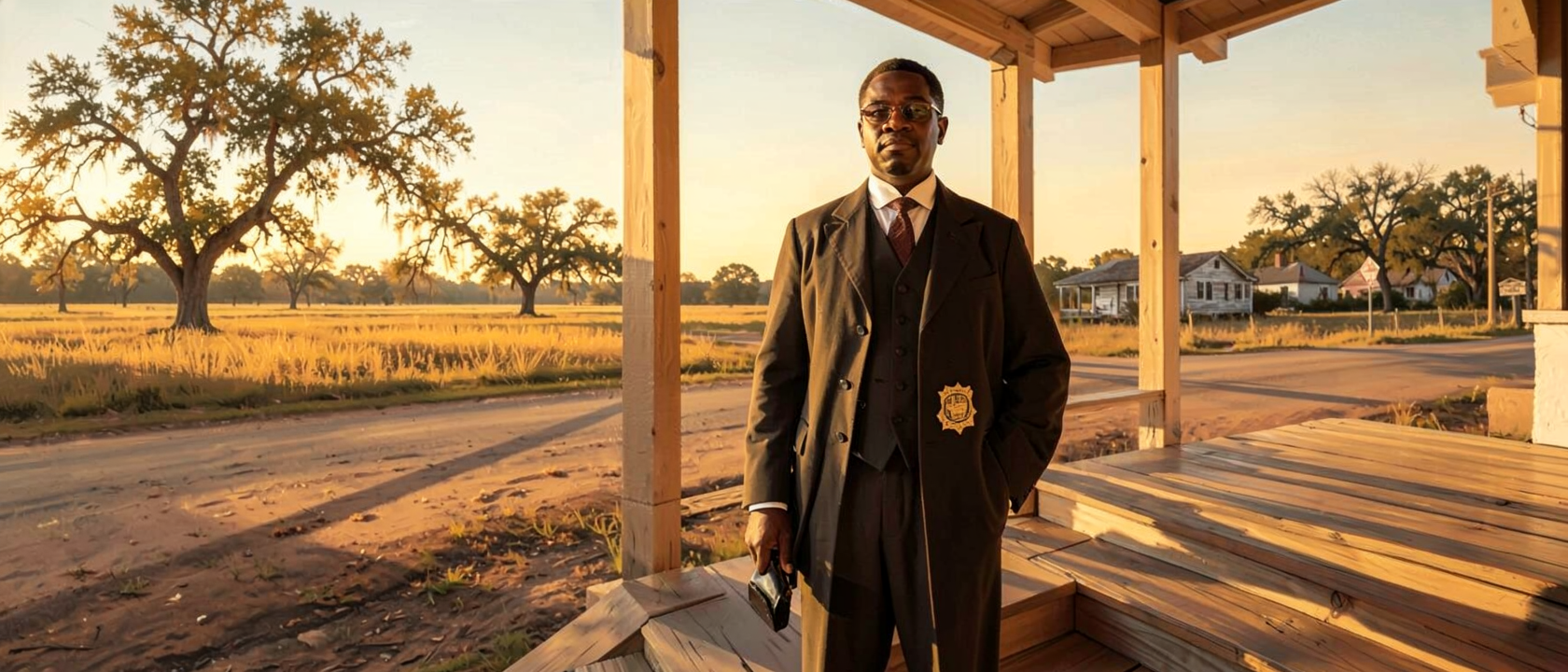
In 1869, Burton was elected sheriff and tax collector of Fort Bend County. Wikipedia, the Texas State Historical Association, the Texas Historical Commission, and the Texas Association of Counties all document him as the first Black sheriff in the United States. (County sheriff records separately list his term as 1870 to 1873, a discrepancy with the 1869 election date that no source has reconciled.) He served four years.
Some historians believe he was not permitted to arrest white residents, and that the task fell to a white deputy instead. The claim comes from a single source and is unconfirmed elsewhere. If accurate, it shows the limit built into the breakthrough even as he held the office.
Four Terms in the Senate
From 1874 until early 1883, Burton served in the Texas state senate, first for the 13th district, then the 17th. Sources disagree on whether to call this four terms or seven years of service; the span itself, 1874 to 1883, is not in dispute. He sat alongside at least 52 Black legislators who served Texas before 1900, among them Matthew Gaines and George Ruby.
He was not there to fill a seat. During the 15th legislative session he opposed expanding the county convict law, which let local courts put men convicted of minor offenses to work on public projects, arguing it resembled slavery, and he presented a petition from Fort Bend citizens against the practice. He also pushed for firearms regulation and for funding that would reach Black schools.
The Bill That Outlasted Him
In 1876, a bill backed by Burton and fellow legislator William H. Holland became law, converting a struggling school called Alta Vista into what would grow into Prairie View Normal School. When enrollment collapsed in 1878, Burton and Holland worked again to save it, this time reorganizing it as a training school for Black teachers. It still operates, as Prairie View A&M University.
A Gold-Headed Cane
When Burton left the Senate in January 1883, a white colleague arranged for him to receive an ebony cane with a gold head, a gesture of respect from the men he had served beside. The Texas State Library and Archives Commission also remembered him as the best-dressed man in the chamber. His personal fortune by then was estimated at $50,000.
What the Record Doesn’t Say
Burton stayed active in Republican Party politics for the rest of his life: on the party’s state executive committee in 1873, a vice president of its conventions in 1878 and 1880, a member of its platform committee in 1892. He died on June 4, 1913, in Richmond, Texas, at age 72. Past that, the record goes quiet. There is no account of his last decades, no cause of death, nothing to say how the man who once sat in the state senate spent his final years.
Ninety Years
Burton was the last Black Texan elected to the state senate until Barbara Jordan won her seat in 1966, roughly 90 years after Burton’s generation first served. The gap was not one lost election. It tracked a longer unwinding, across the South, of the voting rights and officeholding that Reconstruction had briefly opened up. The sheriff’s badge is the part of Burton’s story that survives as trivia. The ninety years that followed it rarely do.
What’s Left
Some of it has come back slowly. In 1996, Fort Bend Independent School District named an elementary school in Fresno, Texas, after him. The Fort Bend Museum keeps material on his life. In 2020, Fort Bend County elected its first Black sheriff since Burton himself, and on February 26, 2021, Sheriff Eric Fagan and Tax Assessor Carmen Turner unveiled his portrait at the county courthouse. A campaign led by Captain Paul Matthews is pushing to rename a Sugar Land street, one that currently honors a plantation owner, after Burton instead. It has not happened yet.