
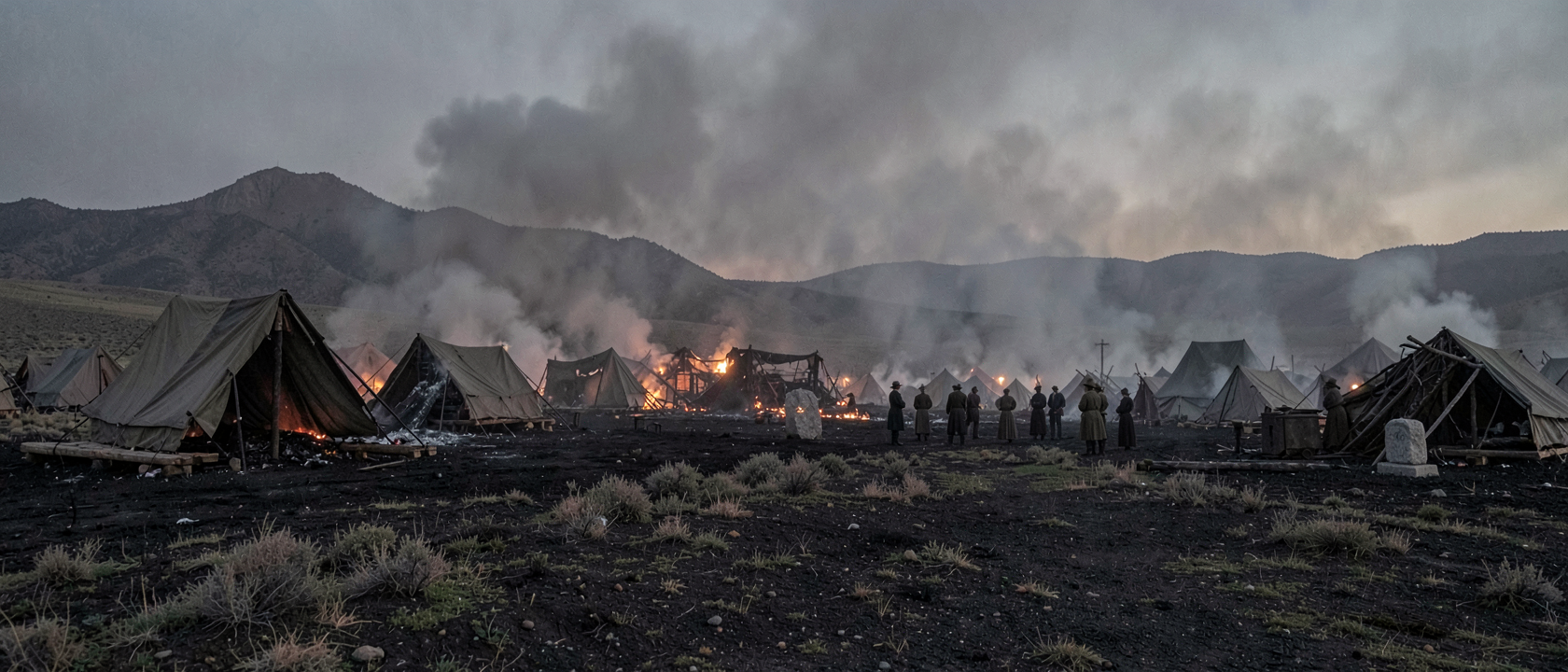
The Colony on the Plain
Half a mile north of the rail depot at Ludlow, in Las Animas County, Colorado, several hundred canvas tents stood in rows on bare ground. From September 1913 through April 1914, the tent colony held an estimated 1,200 people, mostly immigrant families from Greece, Italy, Mexico and Eastern Europe. They had been evicted from company housing in Las Animas and Huerfano counties after walking off the job, and the United Mine Workers of America (UMWA) rented the land they now lived on.
The tents were not improvised shelters thrown up overnight. Each sat on a wood platform and held a small cast-iron stove. Gunfire into the camp was not new by the spring of 1914. One family had dug a pit beneath the floor of their tent, a place to go when shooting started. It was there that a group of women and children would later die, a toll sources count differently, ranging from eleven to thirteen. The company at the center of the dispute was Colorado Fuel & Iron (CF&I), controlled by the Rockefeller family, whose mines the strikers had left.
What the Strike Was About
The strike had begun in September 1913, variously dated by different sources to September 13 or September 23. The miners’ demands were specific: an eight-hour workday, enforcement of mining laws already on the books, the right to shop and live outside company stores and company housing, and recognition of the UMWA as their union. Estimates of how many miners walked out range from roughly 9,000 to 12,000.
CF&I refused every demand and brought in the Baldwin-Felts Detective Agency to guard its mines and press the strikers, including a machine-gun-equipped armored car the miners called the Death Special. This is why historians treat what happened at Ludlow as more than a local labor dispute. It sat at the center of a fight over whether a private company could run entire towns, control what miners earned, where they lived, and whether they could organize at all.
April 20, 1914
On April 19, 1914, Guard troops under Major Patrick J. Hamrock placed a machine gun on a ridge above the colony. The next morning, a standoff between the Colorado National Guard and the striking miners turned into gunfire. Nobody knows who fired first; the event is remembered as a massacre because the miners and their families absorbed most of the casualties, not because the sequence of blame is settled.
The fighting lasted through the day. At some point during or after it, the tent colony caught fire. Whether the Guard set it deliberately or whether it caught by accident in the chaos remains disputed among historians to this day. In the pit beneath that one tent, women and children had gone to hide from the gunfire; sources differ on the exact count, with figures ranging from eleven to thirteen women and children. They suffocated before the fire reached them, and their bodies were not found until the following morning. Louis Tikas, a Greek-born strike leader, was taken into custody by Guard officers and killed, a killing that later investigations described as an execution rather than a casualty of combat.
The Ten Days’ War and the Bill
Armed miners responded by attacking mine properties across a roughly 225-mile (362 km) stretch of southern Colorado, from Trinidad to Louisville, for about ten days. At the Forbes Mine south of Ludlow, strikers killed ten men and burned buildings. The violence ended only when President Woodrow Wilson ordered federal troops into the coalfields on April 29, 1914, and both sides were disarmed.
The full bill is still argued over. Counting from the strike’s start in September 1913 to the federal intervention, estimates for total deaths across the whole Colorado Coalfield War run from 69 to 199. At Ludlow itself, death counts from serious sources range from about 19 to 25, depending on who is counted and how. No company official was ever convicted for the deaths at Ludlow. The union called off its strike on December 10, 1914, winning no recognition, though the UMWA added roughly 4,000 members nationally. A congressional investigation that followed produced a 1915 report credited with advancing child labor laws and enforcement of the eight-hour workday.
What the Record Still Can’t Settle
Even sympathetic histories disagree on basic numbers: the National Park Service puts Ludlow’s dead at 21, Britannica at 25, the Colorado Encyclopedia at a minimum of 19, and a popular account pushes the figure as high as 24. Who fired the first shot is unknown. Whether the fire was set on purpose is unresolved. Even the exact population of the colony on April 20, 1914, shifts slightly from source to source around the figure of 1,200.
Historian Howard Zinn called Ludlow the culminating act of what he considered perhaps the most violent struggle between corporate power and working people in American history. That is a historian’s reading, not a measurement, and worth noting as such, even though Ludlow’s standing as a hinge point in American labor history is now repeated so often that it reads as settled fact.
The Podcast’s Version
On May 20, 2024, The Atlas Obscura Podcast released an episode on the Ludlow site, part of a format the outlet runs Monday through Thursday: audio guides under 15 minutes, hosted by cofounder Dylan Thuras with contributors from across Atlas Obscura. The episode presents Ludlow as a notable, significant place without attaching a single date, name, number, or cause to it. Its importance is asserted, not shown.
The gap is worth noticing, not scolding. The site today is a National Historic Landmark owned by the UMWA, which erected a granite monument there in 1918. In July 2024, the National Park Service announced more than $150,000 for its preservation under the American Battlefield Protection Program, including a $91,260 grant to the UMWA for a project titled “War in the Coalfields: The Ludlow Massacre and its Impact on the Eight-hour Workday.” The record of what happened at Ludlow is still being actively documented and funded. A listener who wants that record has to look past the fifteen minutes and go find it.