
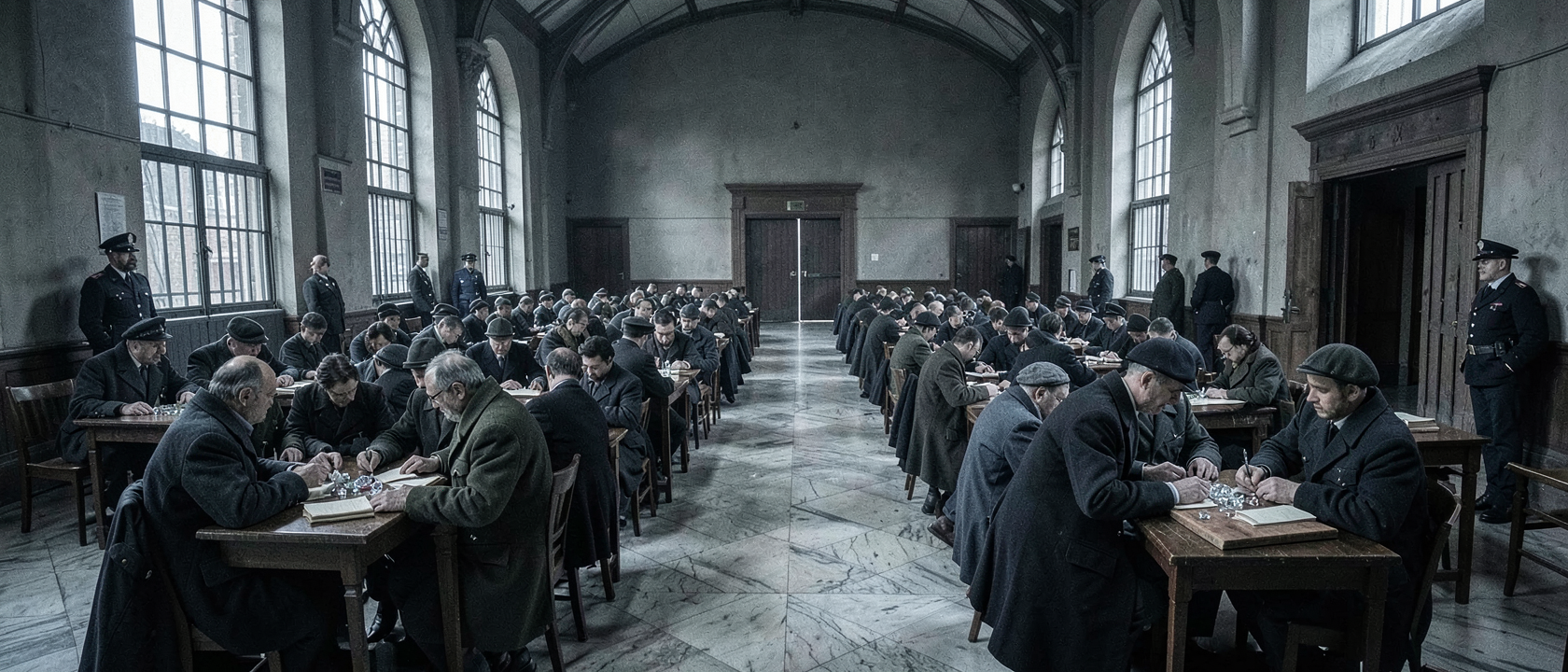
The Call to the Exchange
On April 16, 1942, diamond merchants across Amsterdam received the same instruction: report at midday to the Amsterdam Diamond Exchange (Diamantbeurs) on the Weesperplein, and bring the complete stock of their firms. The notice, they were told, was for registration and valuation, nothing more. Jewish and non-Jewish dealers were summoned alike; nothing in the order singled out one group over another.
By that spring, the Netherlands had lived under German occupation for nearly two years, since the invasion of May 10, 1940. Such summonses had become common under the occupation, so the merchants who closed up shop that morning and carried their stones to the Exchange had little reason to suspect anything beyond a day of paperwork.
An Asset Worth Controlling
The order did not come from nowhere. Under an earlier decree, every entrepreneur in the diamond trade had already been required to register with the Rijksbureau voor Diamant, the German-controlled authority set up to run the Dutch diamond industry, and to file a declaration of stock. Without its written permission, no one could buy, sell, or process a diamond. Belgium had already gone through something similar: by late 1941, German occupiers there had forced dealers to hand their stones over to a body called the Diamantcentrale.
What set April 16 apart was who turned up alongside the Rijksbureau’s paperwork. Present that day was the head inspector of the SS Devisenschutzkommando, the Foreign Exchange Protection Unit, an outfit built around currency and asset control, not commercial regulation. His presence marked the diamonds as a reserve of value rather than a commodity to be sorted and taxed. None of that showed in the summons itself. The document merchants expected, covering quantity, quality, and market price, was exactly what a legitimate valuation would have produced.
Inside the Hall
Once the merchants had filed into the main hall with their stock, the exits were barricaded. Carl Hanemann, head of the Rijksbureau voor Diamant, walked in with the German mineral dealer Arthur Bozenhardt, the head inspector of the SS Devisenschutzkommando, officers of the Amsterdam police, and the Dutch detective Willem Klarenbeek, who was working with the occupation authorities. The next day, April 17, Klarenbeek returned to the Exchange, this time leading the Crisis Controledienst, the Crisis Control Service, for a follow-up check.
Officials sat down at small wooden desks. The crowd was lined up and forced, one by one, to hand over every carat in their possession. A photographer for the NSB, the Dutch Nazi party, named Bart de Kok, recorded the scene: rows of traders standing at the tables as diamonds were emptied from their pockets. What was collected was sorted into two piles, recorded in the paperwork as “Aryan” and “non-Aryan” stock, a line drawn regardless of what anyone had believed he was walking in to do that morning.
How much was seized is reported two different ways. One account puts the day’s haul at 23,000 carats. Another describes it as roughly 80 percent of the entire Dutch diamond stock, taking in the biggest names in the trade. The two figures have never been reconciled, and both are treated here as estimates, not settled totals.
The Gaps in the Account
Beyond those competing numbers, the record thins out quickly. No source states how many merchants actually stood in that hall, or what share of them were Jewish as against non-Jewish. The summons had gone to both groups, and the stock was divided along that line once collected, but no tally of who was present, or in what proportion, survives.
What happened to the gems in the weeks right after is also not spelled out in full. It is known that the confiscated diamonds eventually sat in vaults in Arnhem for the rest of the war, and that in 1943 a representative of the German firm Bozenhardt & Co began buying up large quantities of diamonds from Jewish firms in Amsterdam for export to Germany, on the German government’s account. But nothing in the surviving record traces the path from the afternoon of April 16, 1942, to those later transactions, step by step. Where the paper trail stops, historians have not been able to fill it in with certainty.
Cutters in the Camps
The confiscated stones fed a larger plan. Historians differ on the details, but agree that Heinrich Himmler wanted a German diamond industry built on Dutch soil. In 1942 he ordered cutting equipment installed at Concentration Camp Vught, intended for disabled SS soldiers. The aim was threefold: work for wounded troops, industrial diamonds for German war and aircraft production, and finished gems that could be sold abroad for currency Germany needed.
Because the work was judged essential, Jewish diamond workers were, for a time, treated differently from other Dutch Jews. In July 1942, as deportations from the Netherlands began that summer, 545 of them applied for an exemption known as the Sperre on behalf of themselves and their families, 1,230 people in total, and were allowed to remain in their homes and workplaces. The exemption held into January 1943 by one account, or into the middle of that year by another, before the Nazis began cutting the exemption lists. Most of the remaining diamond merchants and cutters were deported to Westerbork or Vught by September 1943, and from there, in transports running through 1944, to Bergen-Belsen; the final transport out of Amsterdam left in September 1944. In the camps, diamond workers faced fewer roll calls and were spared the heaviest forced labor, to keep their hands fit for the trade, even as food grew scarce. In December 1944 the men were moved again, to Sachsenhausen, the women to Beendorf. Nearly all the deported men died. Some of the women survived.
Most of the stones taken from Dutch hands that April afternoon were never traced back to an individual owner.