
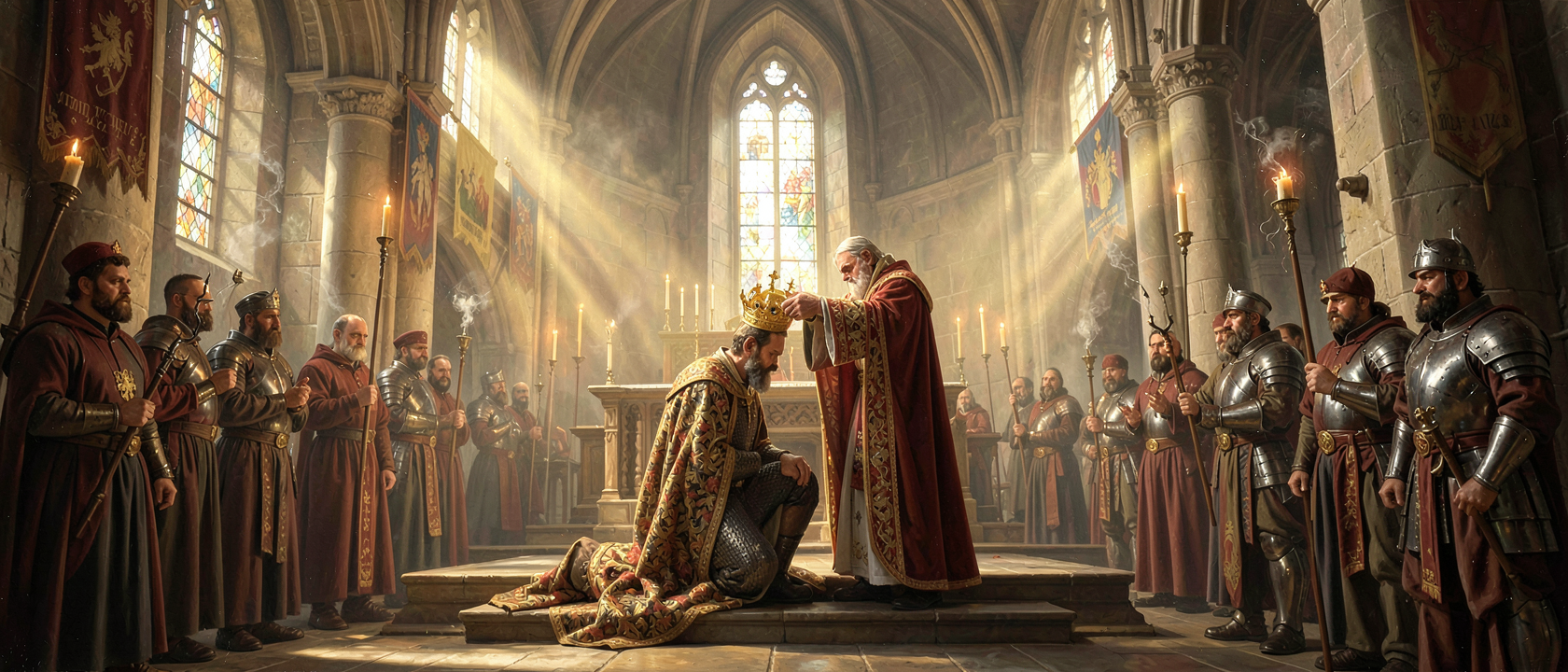
Gniezno, March 1000
In March 1000, Holy Roman Emperor Otto III traveled to Gniezno, then the capital of the young Polish duchy, for what chroniclers called an amicable meeting with Duke Bolesław I, soon known as Bolesław the Brave. On March 11, Otto acknowledged Bolesław’s sovereignty and set a diadem on his head. He also granted Poland its own church province, with a metropolitan seat at Gniezno, independent of the archbishopric at Magdeburg.
Bolesław had succeeded to the duchy in 992, inheriting a state his father, Mieszko I, had built and converted to Christianity only a generation before. What Otto offered at Gniezno was imperial recognition: real, and useful, but not everything. Historians still disagree about exactly what else was pledged that day, including whether Otto promised Bolesław a royal crown outright. What he could not do, acting alone, was make Bolesław a king in the eyes of the church. That required Rome.
A Crown That Wasn’t Quite One
An emperor’s gesture carried weight, but it was not a coronation. In this period a king’s crown came from the pope, or through a rite the pope authorized. That was the mechanism that turned a ruler’s actual power into a title other Christian kingdoms had to respect. Without it, Bolesław remained, on parchment, a duke who happened to control a large and growing territory, one whose standing a rival ruler, or a bishop answering to Rome rather than to him, could still contest.
The gap mattered more because of what he had inherited. Mieszko I had converted Poland to Christianity a generation before Bolesław took power, leaving behind a state too new to have any old claim on its neighbors’ deference. Surviving among the older Christian monarchies of Europe meant acquiring the paperwork of legitimacy as much as the territory itself.
Three Failed Embassies
Bolesław tried to close the gap almost immediately. Within months of the meeting at Gniezno, he sent a delegation to Rome asking for papal approval of a full coronation. It failed. He tried again in 1003, and once more in 1004. The record does not explain in detail why each mission collapsed, beyond naming one recurring obstacle: a change of emperor had turned Rome’s politics against him.
Otto III had died in January 1002. His successor, Henry II, took a different view of Poland, and the renewed appeals of 1003 and 1004 ran straight into that hostility. By 1004, four years after Gniezno, Bolesław had a diadem an emperor had placed on his head and nothing from Rome to turn it into a crown. It was the first stretch of a wait that would run to twenty-five years.
Henry II’s Wars
What followed was not diplomacy: it was fighting. In the years after the failed embassy of 1004, Henry II attacked Poland repeatedly, at one point allying with the Luticians, a pagan tribal confederation, against a Christian neighbor. The alliance drew criticism even from within the empire’s own church. Bruno of Querfurt, a missionary writing at the time, asked what kind of agreement could exist between Christ and the devil, condemning an emperor who armed pagans against a fellow Christian ruler.
The sources give no numbers for any of this: no tally of campaigns, no casualty counts, no troop strengths. What survives is the shape of a long war, renewed more than once across roughly a decade and a half, and a contemporary’s judgment on one of its tactics. For Bolesław the stakes had doubled. He was no longer fighting only for a title Rome might someday grant. He was fighting to keep the realm that title was meant to crown.
The Peace of Bautzen
The fighting ended, on paper, on January 30, 1018, with the Peace of Bautzen. The treaty confirmed Bolesław’s hold on Lusatia and Upper Lusatia, the territories the war had been fought over, and the settlement was sealed with a marriage: Bolesław took Oda of Meissen as his wife.
A German chronicler, usually identified as Thietmar of Merseburg, recorded the peace without much warmth, noting that its terms were not what anyone would have chosen, only what circumstances allowed. That is not the language of a clean victory; it reads like a German recorder making the best of a settlement that favored the other side. Eighteen years after Otto III had set a diadem on his head at Gniezno, Bolesław held more land by treaty than before, and still no crown that Rome had blessed.
The Door Opens
Henry II died in July 1024. He had blocked the coronation for the better part of two decades, through failed embassies and then through war, and his death removed that obstacle at a stroke. Bolesław moved quickly to press his case again.
A new pope granted the approval Rome had withheld since that first failed delegation after Gniezno. The record does not name which pope, and it does not give the date the approval arrived. It states only that it came, and that it came soon enough for Bolesław to be crowned within the year.
Easter Sunday, April 18, 1025
On April 18, 1025, Easter Sunday, Bolesław was crowned king of Poland at Gniezno Cathedral, the same place where Otto III had set a diadem on him twenty-five years before. This time the church supplied what an emperor alone could not: a coronation Rome itself had sanctioned. Some historians, among them Wacław Uruszczak, treat it as a second coronation in the strict sense, one that finally added the ecclesiastical anointing the Gniezno ceremony had lacked.
However it is read, the arithmetic does not change. Bolesław had been pursuing this since the year 1000: three failed embassies, roughly a decade and a half of intermittent war, a treaty his own era’s chronicler called merely workable. In the spring of 1025, it was finally done.
Two Months
By the end of June 1025, Bolesław was dead. One source gives the date as June 17; others record only “by the end of June.” Either way, the span from his coronation runs to roughly two months, not even a full change of season. No cause of death survives in the record. There is no diagnosis, no account of an illness, no description of his final weeks at all. Twenty-five years of embassies, war, and one uneasy peace are documented in detail. The ending is not.
Put the two spans side by side: twenty-five years to win the crown, about two months to wear it. His son, Mieszko II, was crowned king in the same cathedral at Gniezno on December 25, 1025, five months after his father’s death.