
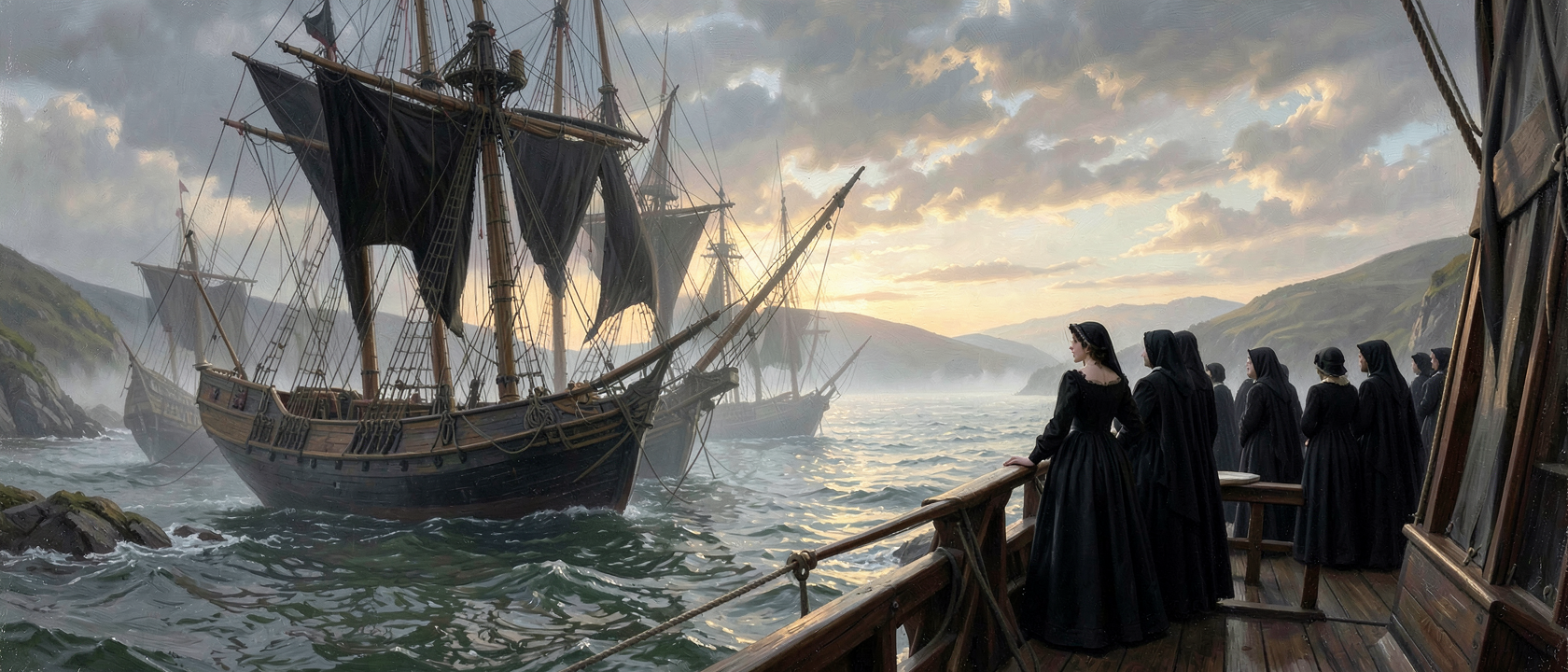
The Ship from Calais
On August 14, 1561, a young widow boarded ship at Calais for a country she had not set foot in since she was a small child. Mary, Queen of Scots, was 18 years old. She had held the crown since she was six days old, had been sent to France at age five to keep her out of English hands, and had become Queen of France at fifteen when she married the Dauphin, Francis II. Francis died on December 5, 1560, after little more than a year and a half on the throne, leaving Mary an 18-year-old widow with no reason left to stay in the only court she knew. According to one account, the fleet that carried her north was commanded by James Hepburn, Earl of Bothwell, a name that would return later in her story under darker circumstances. She left behind the language, the household, and the life she had lived for thirteen years.
A Kingdom She Didn’t Know
Scotland had changed without her. In 1560, its Protestant reformers, led by John Knox, broke with Rome and built a church with no place for the Mass Mary had practiced her whole life. Knox had already stated his view of female rulers in 1558, in a pamphlet titled The First Blast of the Trumpet Against the Monstrous Regiment of Women, written originally against Mary Tudor of England but easily turned against any queen. Scotland’s nobles, meanwhile, answered to no single authority; power moved between great families through shifting feuds and alliances, not through the crown. Mary arrived to rule over both. She was also something London could not ignore: by blood, she stood close to the English throne, and French diplomats argued her claim was stronger than Elizabeth I’s own. That alone meant England would watch every move she made.
Landing at Leith
The crossing took less time than anyone in Scotland had planned for. Mary landed at Leith, the port below Edinburgh, on August 19, 1561, days ahead of expectations, and no one was ready for her. There was no royal lodging prepared at the harbor, so she spent her first hours in a merchant’s house. Lord James Stewart, her illegitimate half-brother, arrived soon after to escort her up to Edinburgh. That first night, a crowd of amateur musicians gathered beneath her window to serenade their new queen; by most accounts the playing was rough, and by most accounts again, Mary took it in good humor. Her formal, ceremonial entry into Edinburgh waited until September 2.
A French Court at Holyrood
Mary settled into Holyroodhouse (Holyrood Palace), the home her father, James V, had rebuilt in the 1530s. Her rooms in the northwest tower, a presence chamber, a bedchamber, a small supper room, and a dressing room, were the same ones he had used. Around her she kept a household staffed largely with French attendants and run in French style, even though she also spoke Scots. She heard Mass privately inside the palace and told the Scottish lords, publicly, that she would not interfere with the reformed church they had built in her absence. To the pope, by a separate channel, she gave a different assurance. The grounds held a deer park for hunting and a small bathhouse, the ordinary fittings of a royal residence rather than decoration. In every visible way, it was a French court set down inside a Protestant kingdom.
The Darnley Marriage
On July 29, 1565, at Holyroodhouse, Mary married her cousin Henry Stewart, Lord Darnley. She was 22; he was 19. The marriage carried no sanction from the Protestant lords who had been managing Scotland’s politics around her, and it reordered the balance of power overnight: the next day, Darnley was proclaimed King of Scots, and his family, the Lennox Stewarts, rose from a minor noble house to the center of the kingdom. Her own half-brother, Lord James Stewart, now Earl of Moray, read the marriage as a direct threat to his standing and to the Protestant settlement he had helped manage. Within a month he was in open rebellion, raising arms against his sister in what became known as the Chaseabout Raid. Mary rode out from Edinburgh on August 26 to confront him; Moray entered the city four days later but failed to take the castle, and the revolt collapsed almost as quickly as it had started. It was the first time a Scottish noble had taken up arms against her directly.
What the Marriage Cost
The marriage did not end with one summer’s failed rebellion. It set off a chain of events this piece will not narrate in full, only name. On March 9, 1566, Mary’s secretary, David Rizzio, was murdered inside Holyroodhouse in her presence. On June 19, 1566, she gave birth to a son, the future James VI. On February 10, 1567, Darnley himself was killed at Kirk o’ Field in Edinburgh. By July 24, 1567, Mary had been forced to abdicate. She fled to England seeking Elizabeth I’s protection and instead spent years in custody. On February 8, 1587, at Fotheringhay Castle, she was executed on Elizabeth’s order. Twenty-two years separate the wedding at Holyroodhouse from the scaffold at Fotheringhay. The marriage alone did not cause every link in that chain, but it is where the noble support she needed first broke, and it never fully came back.
What the Record Won’t Settle
Four questions in this story still have no clean answer. Whether Mary remained chaste between Francis II’s death in December 1560 and her arrival in Scotland the following August is something historians have long assumed rather than proven; the sources call it probable, not certain. Whether she ever bathed in white wine at Holyrood is a story still repeated, but it traces only to the writings of the antiquarian John Pinkerton, around 1776, more than two centuries after Mary’s death, and most historians now think the bathhouse was a garden pavilion rather than a bathing house at all. Why her crossing from Calais reached Leith faster than anyone expected is simply not recorded; no account of winds, distance, or timing survives to explain it. And how much of Lord James Stewart’s rebellion in 1565 was about religion, and how much was about his own path toward the throne, remains argued over, since the man who led the revolt against his sister stood to gain the most from her fall.