
A Wheelbarrow Full of Gin
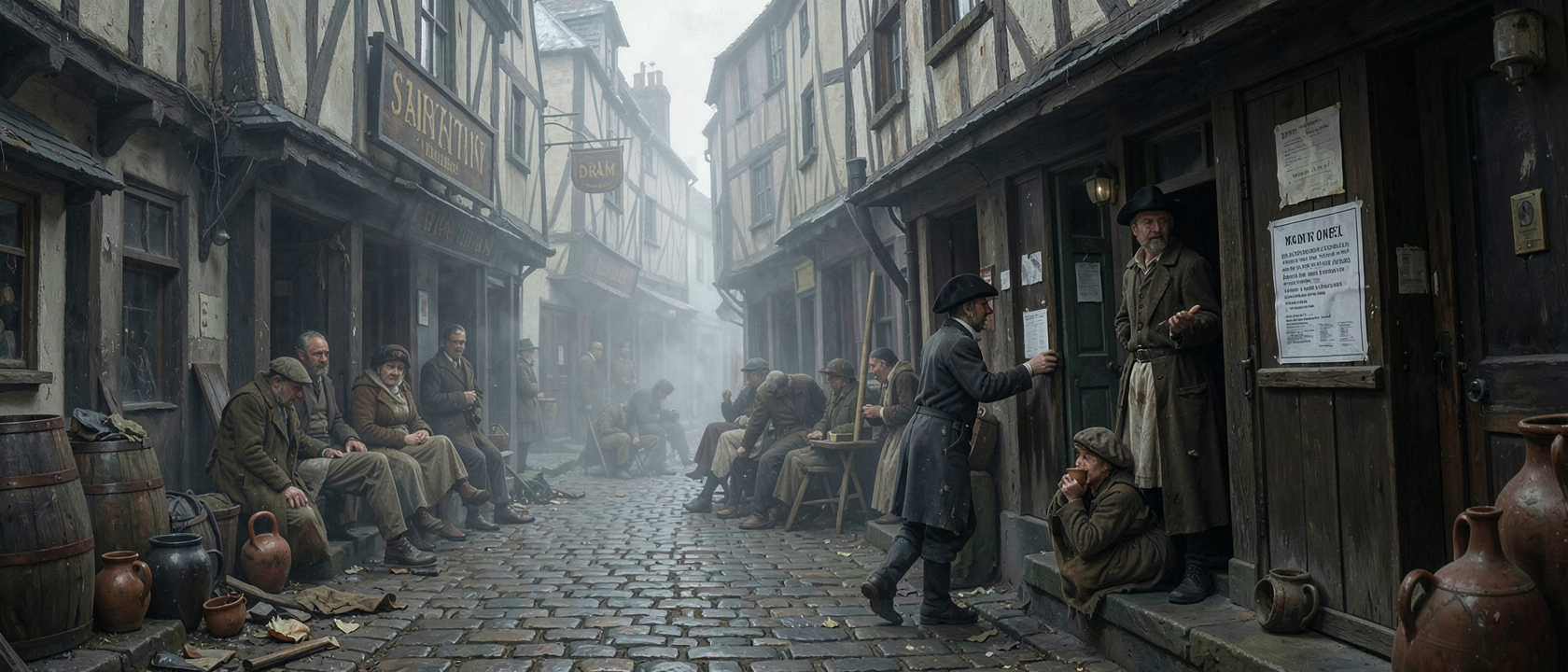
London, around 1735. By one estimate, some 1,500 stills were running across the city, turning out more than six million gallons (approximately 27,276,000 liters) of raw spirit a year, and none of it needed to pass through a licensed tavern to reach a drinker.
Gin moved through the city from street stalls, wheelbarrows, cellars, and attic rooms. Ordinary tradesmen sold it on the side: dyers, carpenters, barbers, and bootmakers kept a jug behind the counter alongside their regular trade. In the poorer parishes, an estimated one house in every four or five doubled as an informal dramshop, no sign over the door, no excise officer ever seeing the till. The trade even had a nickname for its product: Madam Genever.
How a Dutch King Changed What London Drank
The flood had a political cause. William of Orange’s accession to the English throne in 1688 cut the country off from its old habit of importing an estimated two million gallons (approximately 9,092,000 liters) of French brandy a year, now suspect as the drink of a Catholic rival. Between 1689 and 1697, Parliament loosened the rules on home distilling, and in 1690 it broke the London Guild of Distillers’ monopoly outright, opening the trade to almost anyone who could set up a still.
The intent was simple: replace French brandy with genever, the juniper spirit that had arrived with the new king from the Dutch Republic. Which single year in that stretch mattered most to what followed is not settled in the record. That something followed is not in doubt.
Drunken Children and a Hangman Who Couldn’t Stand
By the 1720s and into the 1730s, London had reports that alarmed the people who read them. One claimed that girls of twelve and thirteen drank gin “like fishes.” Another said the spirit “never fails to produce a strong aversion to work and labour.” Neither comes with a named author. Both survive as the kind of thing contemporaries repeated to one another, not as counted evidence.
One story was told with more specific detail than most, though it rests on a single period anecdote and was never independently confirmed: an executioner, too drunk to manage his own job, is said to have come close to hanging the priest attending a condemned prisoner instead of the prisoner he was meant to hang. No date survives for it, but the story traveled as proof that gin had reached past the poor and into the institutions meant to keep order.
Four Tries, Four Failures
Parliament did not sit on its hands. Acts followed in 1729, 1736, and 1743, with a fourth, the Distillers Act, in 1747. None of them worked for long.
The 1736 Act tried to price the trade out of business: a license cost £50 a year, on top of a 20-shilling-per-gallon excise tax. It is said that only two licenses were ever actually bought. Everyone else kept selling without one, and the law became a public joke, mocked with public mock funerals for the gin trade. The 1743 Act swung the other way, cutting both the tax and the license fee so far that there was barely anything left worth evading.
June 25, 1751: Two Levers at Once
The fifth attempt, officially the Sale of Spirits Act, received royal assent on June 25, 1751, and took effect on July 1 of that year. It has been remembered ever since as the Gin Act of 1751.
What changed was the design, not just the numbers. Instead of relying on duty alone, as in 1743, or licensing alone, as in 1736, Parliament raised the tax and tightened licensing together. Distillers could now sell only to licensed premises, and a retailer had to operate from a building renting for at least £10 a year to qualify for a license at all. A wheelbarrow could not meet that test. Neither could a back room or an attic still. For the first time, the law did not just tax the gin trade; it decided which parts of it were allowed to keep existing.
What “Abated” Actually Meant
The record gives no death toll for the gin craze and no financial reckoning of what it cost London’s poor. What survives instead is anecdote: forty weavers in Bethnal Green said to be selling gin to their own employees, tradesmen folding spirits into their regular work, children reported drinking heavily enough to worry the authorities. What became of the people who had built a living on wheelbarrows and back-room stills after July 1751, the source does not say.
Historians also note that the law was not working alone. Rising grain prices, driven by a growing population and poor harvests, made the raw material for gin more expensive at the same time licensing made it harder to sell. By 1757, one account states the craze was “all but dead.” One contemporary report even describes a final mock funeral for Madam Genever after the Act took hold, her eulogy calling her, with heavy irony, “the most truly beloved and universally admired.”
The fix did not last forever. In 1825, Parliament cut spirit duty by nearly 40 percent to fight smuggling, and gin consumption climbed again, this time behind the counters of what became known as gin palaces. But in 1751, after four Acts that had each leaned on a single lever, Parliament finally built one that used both at once, and for the better part of a century, it held.