
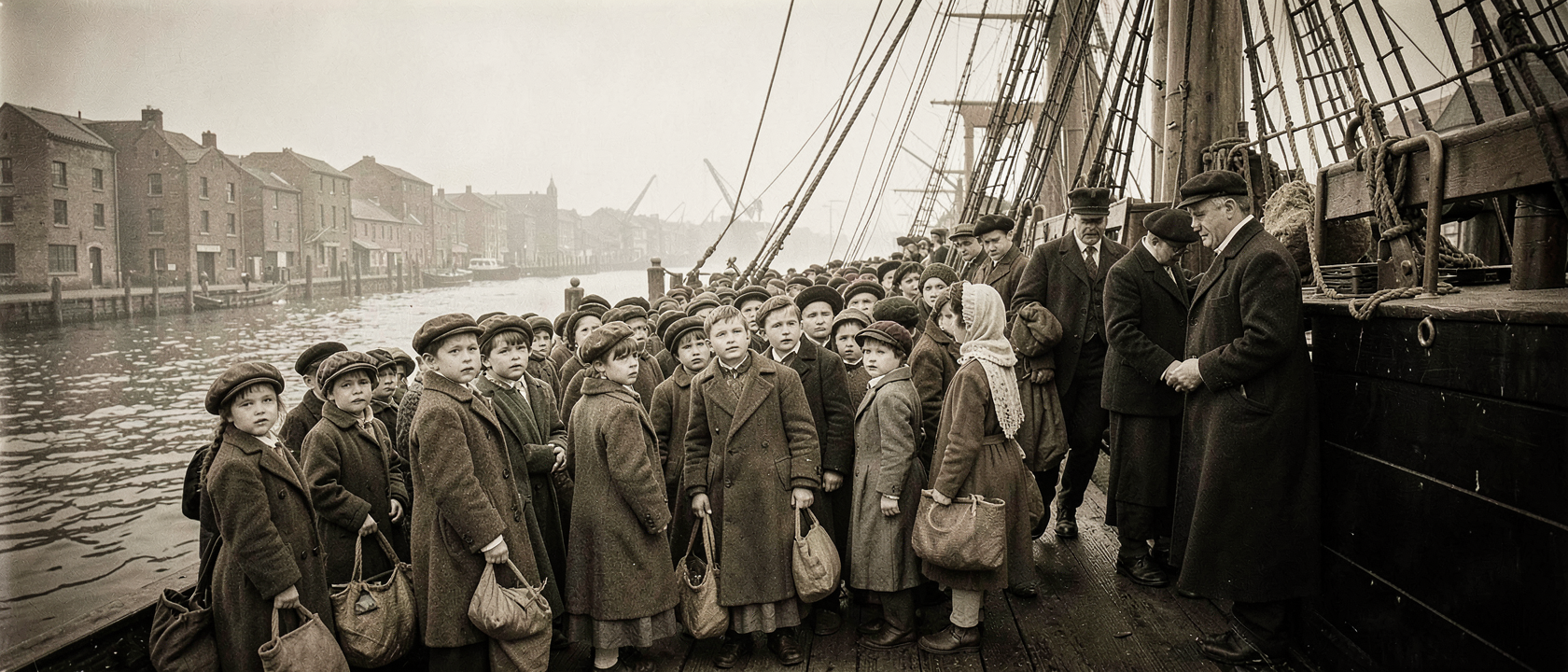
London, 1866
In 1866, cholera returned to London for a fourth time. It would be the last major outbreak of its kind the city saw. By the time it burned out, an estimated 5,500 people had died, most of them in the crowded, poorly drained streets of East London.
The epidemic did not create the poverty behind it, but it made that poverty impossible to ignore. Newspapers that had treated the East End as someone else’s problem now described neighborhoods living on top of each other. Out of that attention came money, committees, and a handful of people determined to act.
Four Answers to the Same Crisis
Three charitable bodies working those same streets would end up at the center of this story: the Salvation Army, Dr. Barnardo’s Juvenile Mission, and Annie Macpherson’s Home of Industry. Macpherson, a Scottish evangelical, had been appalled by children working the matchbox trade. In 1868 she bought a large warehouse in Spitalfields, a building the Sisters of Mercy had used as a cholera hospital only two years earlier, and turned it into a home that could hold up to 200 children.
Thomas Barnardo arrived in London around the same years, an Irish evangelical who had come to train as a doctor. He never opened a practice. He opened a boys’ home instead, then a home for infants he called Babies’ Castle, after meeting Macpherson and working alongside her.
A fourth figure worked apart from this network. Maria Rye had been placing women emigrants in Canada since 1867, before Macpherson’s or Barnardo’s homes took the shape they later held. None of the four coordinated with the others. Each arrived, independently, at the same idea: that Canada was the answer to London’s poverty.
The First Ships, 1869
The sailings began in 1869. Rye went first, arriving at Niagara-on-the-Lake, Ontario, with 68 children taken from the poorhouses of London and Liverpool, 50 of them from Liverpool alone. She had already bought a former jail with her own money and renamed it Our Western Home, a receiving house where children stayed before being placed with farm families.
Macpherson followed that same summer, sending 500 children to Montreal, who were then distributed to farms in Quebec and near Belleville, Ontario. Sources differ slightly on the exact timing of that first shipment, placing it either in the summer of 1869 or simply in the fund’s first year of operation, but the scale is not in dispute. The following year she sent another 100 boys. Boys were placed as agricultural labor, girls as domestic servants, the two roles that would define the scheme for the rest of its history.
Barnardo was not part of any of this yet. His own emigration program did not start until 1882, after years of working beside Macpherson. By then, smaller agencies in Liverpool, Glasgow, Edinburgh, and Dublin had begun sending children of their own. None of it was casual. Every sailing was arranged in advance, with a receiving home waiting on the Canadian side and a placing agent already lined up to meet the ship.
Fifty-Six Years of Traffic
From 1869 to 1925, one widely cited estimate puts the number of children sent from Britain to Canada at around 80,000. That is not a handful of pilot placements. It is a system that ran for fifty-six years, carried out in parallel by Macpherson, Barnardo, Rye, and, over time, roughly fifty other sending agencies across Britain and Ireland.
The figure is argued over. Other institutions put the total above 100,000 and stretch the practice into the 1930s, since record-keeping varied between agencies. What is not disputed is who these children were: mostly between 7 and 14 years old, though some were barely out of infancy. About 70 percent were settled in Ontario, the rest in Quebec, Manitoba, the Maritime provinces, and British Columbia.
Not Orphans
The organizers called this rescue, and called the children they sent orphans, abandoned, in need of saving. The claim does not hold up against the numbers. Only around one in three of the roughly 80,000 children sent to Canada had actually lost both parents. The other two out of three had a mother or father still living, usually too poor to feed or educate them, not absent and not necessarily willing to let them go.
Some children were sent without their parents’ consent at all. No record says what choice, if any, the rest were given once an agency had decided a child would go. Placement came with a price attached. A family taking in a child under 10 received $5 a month from the agency, to cover food, lodging, clothing, and schooling, in exchange for light chores. A child between 11 and 14 received no payment at all, only board, clothing, and some schooling, in exchange for a full share of farm or household labor.
What the Record Doesn’t Say
In 1874, a British government inspector named Andrew Doyle traveled to Canada to see what had become of children already placed. He found almost no follow-up once a child had gone to a farm family: no routine visits, no way to know whether a placement had turned out well or badly. His report, published in 1875, did not question Macpherson’s or Rye’s intentions, but its criticism was sharp enough to slow migration for a time. Demand from Canadian farms did not slow with it, and the sailings resumed.
What happened to any individual child after that, which households were decent and which were not, was never systematically tracked. Nor is there a clear account of how a child was chosen for the scheme, or whether anyone asked the child what they wanted. The sources state the intent plainly: Christian rescue, children lifted out of poverty and given a chance on open land. The sources also state the outcome plainly: families split, most of them not by death but by a decision made somewhere else. The two statements sit side by side. Nothing in the record reconciles them.
Many of the children did go on to build lives in Canada, as farmers, tradespeople, teachers, and soldiers in two world wars. An estimated 11 percent of Canadians today are thought to descend from one of them. What has not survived is any record of what the children themselves would have chosen, had anyone asked, in the way their parents mostly were never asked either.