
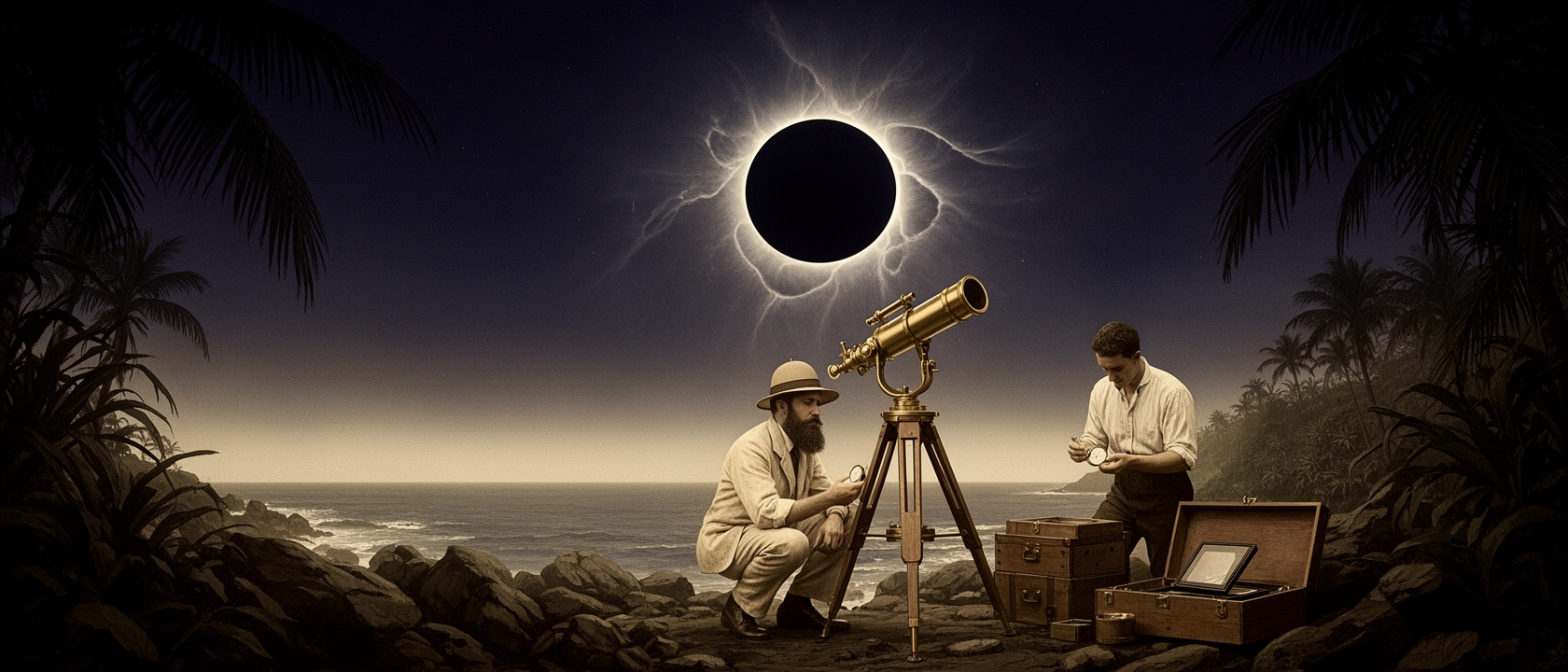
The Measurement
On May 29, 1919, two British expeditions set up telescopes on opposite sides of the Atlantic: one at Sobral, in northern Brazil, and one on the island of Príncipe, off the west coast of Africa. A total solar eclipse would cross the equator that day, and the astronomers needed to photograph the Hyades star cluster in Taurus while the moon blocked the sun long enough for those stars to appear in daylight. Sources disagree on the exact duration of totality, with Royal Observatory Greenwich citing almost six minutes and the Linda Hall Library putting it at almost seven.
The measurement was straightforward in principle. Stars appearing close to the sun during an eclipse should look slightly displaced from their cataloged positions if Einstein’s general theory of relativity was correct: the sun’s mass would curve the path of starlight passing near it. Newton’s physics predicted one value; Einstein’s equations predicted roughly double. Arthur Stanley Eddington led the Príncipe observation, assisted by Edwin Cottingham, a Cambridge clockmaker. At Sobral, Charles Davidson and Andrew Crommelin managed the second set of instruments. Frank Watson Dyson, the Astronomer Royal, coordinated the operation from England.
The Scientific Fracture
To understand why a British expedition was testing a German physicist’s theory in May 1919, four months after the Armistice, it helps to go back to 1914. When the First World War began, the international scientific community fractured almost immediately. Sir Oliver Lodge took the view, according to historian Matthew Stanley, that science existed independently of national conflict, a position that put him against the current of the moment. By 1916, the division inside the Royal Astronomical Society had hardened to the point where some members were calling for German scientists to be formally excluded from international academic circles.
That same year the division became personal for Eddington. The Military Service Act, passed in January 1916, introduced conscription for single men aged 18 to 41. Eddington, then the Plumian Professor of Astronomy and Experimental Philosophy at Cambridge and Secretary of the Royal Astronomical Society, registered as a conscientious objector. A Quaker, his refusal was grounded in that tradition. The university secured his deferral on grounds of national importance, but only for a time.
The Theoretical Bridge
The theory under test had been completed four years before the eclipse. Einstein delivered papers to the Prussian Academy of Sciences in Berlin on the four Thursdays of November 1915; the definitive field equations appeared on November 25, 1915, and the full paper was published in 1916 in Annalen der Physik. No direct academic channel existed between Berlin and London during the war.
Einstein’s ideas reached English readers through neutral Netherlands. Willem de Sitter sent letters and papers to the Royal Astronomical Society in 1916 and published a three-part series in the Society’s Monthly Notices between 1916 and 1917. Eddington, receiving those papers directly as RAS Secretary, was convinced the theory deserved a physical test. Dyson agreed, and in 1918, with the war still in progress, the two men began coordinating the eclipse expedition. Planning preceded the Armistice of November 11, 1918.
Eddington’s legal situation lent particular urgency. Called up again in 1918, he faced imprisonment if his conscientious-objector status was not accepted. Dyson intervened with the exemption tribunal, arguing that Eddington was essential to the upcoming expedition. The tribunal granted the exemption on condition that Eddington see the work through. The expedition had become his legal alternative to a prison cell.
The Reckoning
The results were presented at a joint meeting of the Royal Society of London and the Royal Astronomical Society on November 6, 1919. The observations confirmed Einstein’s prediction: the apparent position of the Hyades stars had shifted by the amount his equations required, not the smaller deflection Newtonian mechanics forecast. On November 7, The Times of London printed the headline “Revolution in Science / New Theory of the Universe / Newtonian Ideas Overthrown.” On November 10, the New York Times followed with “Lights All Askew in the Heavens.” Einstein, largely unknown outside professional physics at the start of 1919, became a public figure within weeks.
The formal record appeared in 1920: Dyson, Eddington, and Davidson published “A Determination of the Deflection of Light by the Sun’s Gravitational Field, from Observations Made at the Total Eclipse of May 29, 1919” in the Philosophical Transactions of the Royal Society, volume 220. The results have not gone unchallenged. Historians John Earman and Clark Glymour later argued that Eddington selected photographic plates in a way that favored Einstein’s prediction. Daniel Kennefick’s 2012 examination of the data concluded the selection was methodologically defensible, and a Royal Society review in 2022 supported that conclusion. The allegation has not been formally withdrawn.
Eddington fulfilled the legal condition attached to his exemption and went on to publish Space, Time and Gravitation in 1920 and Mathematical Theory of Relativity in 1923, two of the earliest full mathematical treatments of Einstein’s theory in English. He was knighted in 1930, received the Order of Merit in 1938, and died in Cambridge on November 22, 1944. What the expedition produced was not scientific reconciliation by itself. But it stands as a record of something specific: a British team that sailed to remote sites on two continents to test an enemy’s equations, confirmed them, and was led there in part by a man who needed the mission to stay out of prison.