
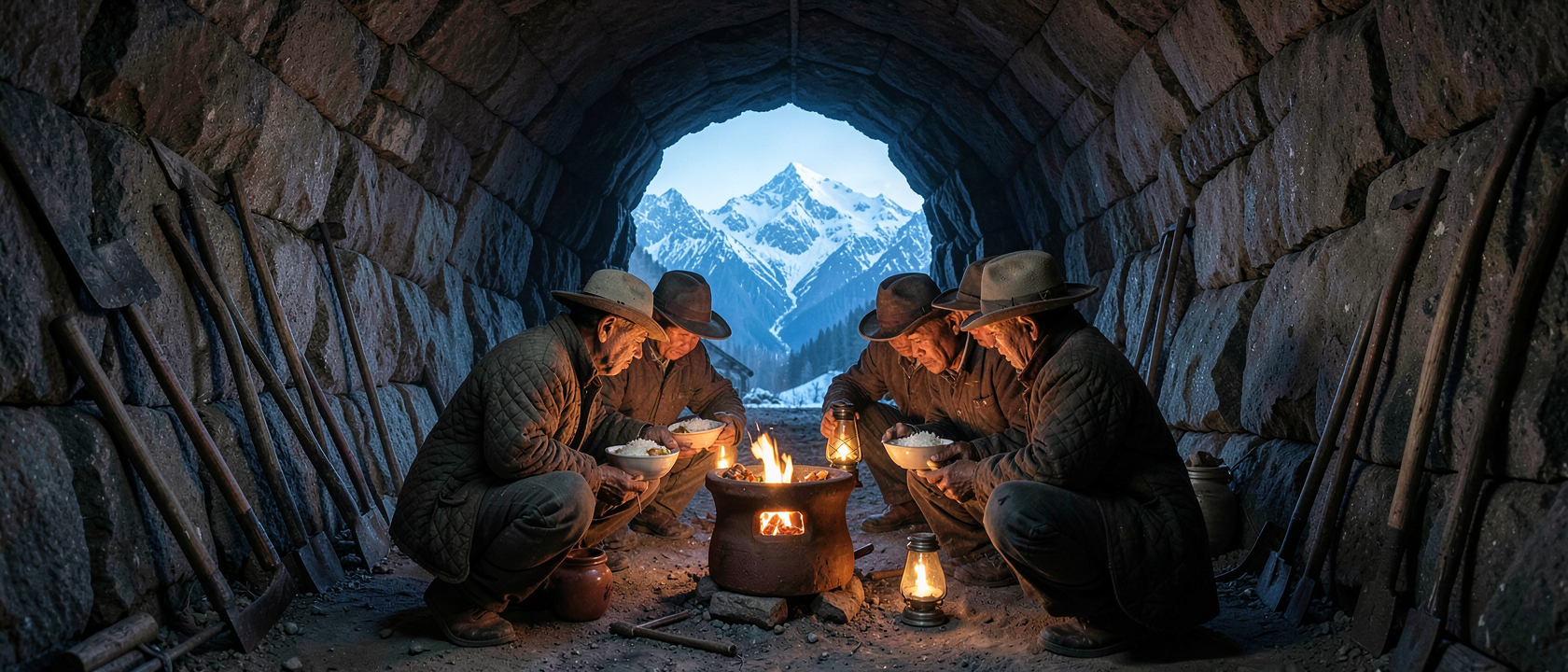
A Wok at 7,000 Feet
In the winter of 1867, crews of Chinese laborers working for the Central Pacific Railroad were boring the Summit Tunnel through solid granite at Donner Summit, high in California’s Sierra Nevada. The site sat at roughly 7,030 feet (2,143 meters), reportedly the highest railroad tunnel in the world at the time. The tunnel ran nearly 1,700 feet, officially 1,659 feet (506 meters), through rock that had to be cut by hand, a job that took more than fifteen months to finish. Between November 1866 and May 1867 alone, 44 recorded snowstorms buried the work site under more than 44 feet (13.6 meters) of snow.
Each crew of 12 to 20 men had its own cook, who set up a wok stove at the camp and fed the men through the shifts. The site sat close to where, roughly twenty years earlier, in the winter of 1846-47, the Donner Party had died of starvation and resorted to cannibalism. The altitude and the cold at Donner Summit in 1867 were much the same. What the men ate was not left to chance.
Half Your Wage, or Boiled Beef
Central Pacific paid its Chinese laborers roughly $30 a month. About half of that went straight back out, spent on food they had to buy and cook for themselves. East of the summit, the company’s largely Irish crews ate for free: boiled beef and potatoes, monotonous but provided at no cost. The two crews worked for the same company under very different terms.
Across the construction years, 1864 to 1869, the Central Pacific’s Chinese workforce is estimated at around 11,000 men, though other counts run as high as 20,000. An estimated 10 percent of that workforce died during the project, in avalanches, explosions, construction accidents, and possibly disease; one account points to a documented smallpox epidemic in Nevada as a contributing cause. Historians’ casualty figures vary widely: one assessment puts documented deaths at about 130, while other estimates run into the thousands. The money spent on food was a cost layered on top of that risk.
What Went Into the Pot
Most of the laborers came from Guangdong province in southern China, and they built their camp diet on food traditions from home. Chinese farmers who had settled in California during the Gold Rush, which had begun less than two decades earlier, supplied fresh meat and produce. Goods that could not be grown locally came by ship directly from Hong Kong: dried oysters, abalone, dried mushrooms, rice, vermicelli, and peanut oil among them.
Meals followed the traditional structure of fan, a grain base, and cai, the vegetable and meat dishes served alongside it, the same framework used at home rather than something improvised on the mountain. Water for tea was boiled rather than drunk raw, a habit that lowered exposure to waterborne illnesses such as dysentery. Herbal preparations, rice wine, and opium also turn up in the record; archaeologists read the quantities involved as moderate and tied to traditional medicine rather than heavy recreational use. A burial later uncovered in Carlin, Nevada, offers further evidence of medical practice among the workforce.
What the Ground Kept
The archaeologist Scott Baxter excavated Donner Summit campsites and recovered brown-glazed stoneware pickling jars, fragments of sauce and rice-wine jars, and keyhole-shaped wok stoves built into the ground. Soil samples turned up rice, barley, legumes, and foraged plants such as elderberry and bearberry.
Zooarchaeologist Ryan Kennedy, of Indiana University, studied the butchered animal bones from the camps and found them chopped into small pieces with cleavers, not sawed into large joints the way Euro-American crews cut their meat. That pattern matches stir-fries, soups, and stews rather than roasted cuts. The bones also turned up in unusually large quantities, especially pig and chicken, a marked contrast with the leaner diets the same workers would likely have known in resource-scarce southern China. The soil and the bones line up with what the pay stubs already suggested: these men were feeding themselves well, and feeding themselves differently from the men working the other end of the line.
Six Days Instead of Four Weeks
The Summit Tunnel opened to train traffic in November 1867. A year and a half later, on May 10, 1869, the Central Pacific met the Union Pacific line at Promontory Point, Utah, and the transcontinental railroad was complete. Crossing the continent, which had taken about four weeks overland, could now be done in six days; some accounts of the era put the old crossing time even higher, but every version agrees the drop was drastic.
That shortening of distance was paid for twice by the Chinese workforce: first in the estimated 10 percent who died building it, then in the wages they spent feeding themselves while the company fed the men working the eastern section for free. The Irish crews who ate boiled beef and potatoes at company expense never carried that second cost at all.
What We Don’t Actually Know
Not every story attached to the camps holds up. A popular legend claims the Chinese crews stocked a pond near Donner Summit with catfish during their stay there; both Baxter and Kennedy say the evidence points instead to the 1890s, decades after the railroad was finished.
Other details stop at informed guesswork. Baxter has said there is not enough evidence to state exactly what meals were cooked at the Donner Summit camp. Kennedy’s reading of the bone-chopping patterns, and comments from Sacramento chef David Soohoo on likely Cantonese cooking methods, are reasoned inferences drawn from artifacts and comparison, not a recovered recipe. Whether the herbal teas did what traditional medicine claimed for them is not something archaeology can settle; only the boiled-water habit has a clear, provable health benefit behind it. And how much opium the camps actually used, medicinal or otherwise, remains an interpretation of what was found in the ground, not a documented fact.