
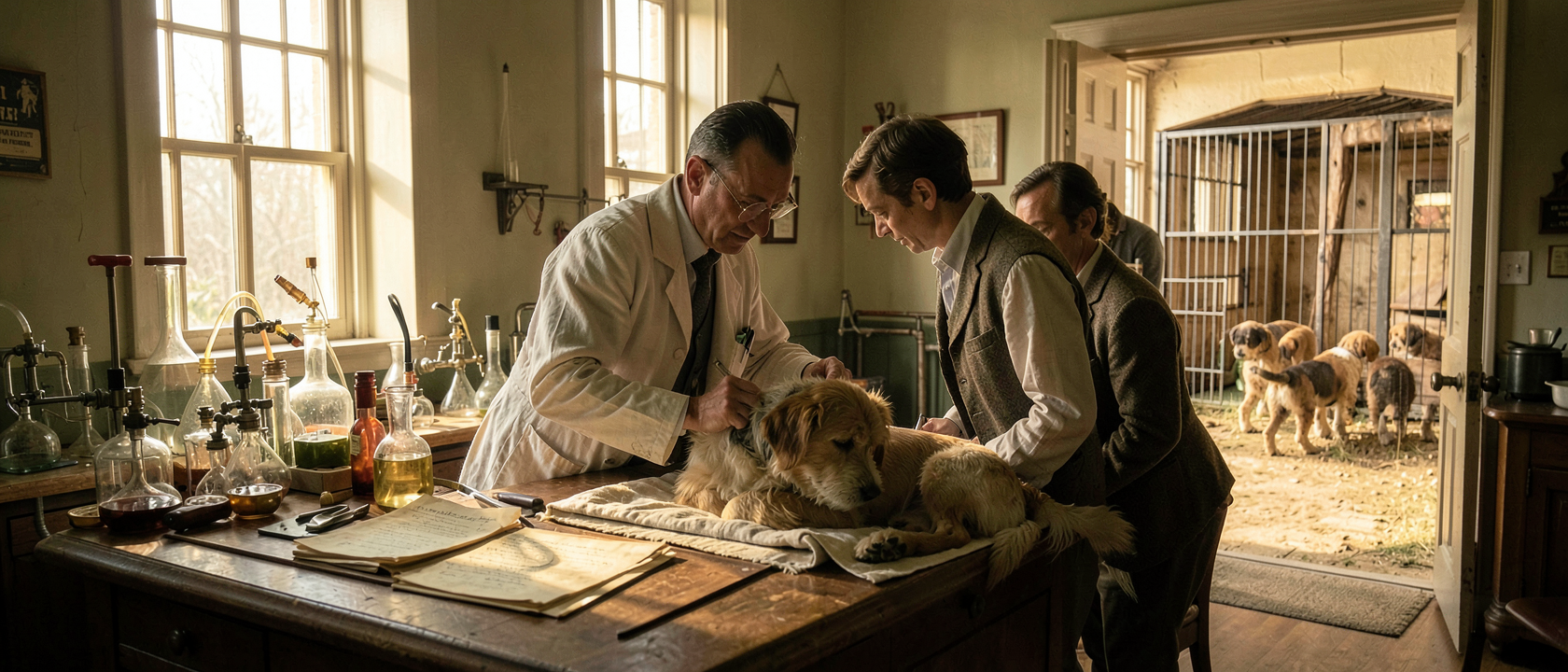
The Editor’s Office, 1922
In 1922, the editor of The Field, a magazine built around fox-hunting and country sport, sat down with representatives of the Medical Research Council to talk about a problem that was killing dogs across Britain. The Council had scientific standing but not nearly enough money to fund research at the scale the disease demanded. So the editor did something unusual for a sporting magazine: he opened a public appeal, the Distemper Fund, and asked breeders, kennel clubs, and ordinary readers to help pay for a cure. A government research body, a hunting magazine, and the wallets of private dog owners were now working toward the same end, an arrangement with no real precedent.
That same year, the Council recruited pathologist Patrick Laidlaw to run a virus research program at the National Institute for Medical Research. He made distemper his main project almost immediately, working with veterinary pathologist G. W. Dunkin.
A Disease Nobody Understood
The urgency behind that meeting came from the numbers. Trial data from the period put canine distemper’s mortality rate at somewhere between 50 and 75 percent, an estimate, but a brutal one, and foxhound packs took the worst of it. These weren’t strays off the street. They were animals bred and trained over generations for one purpose, and distemper could wipe out a kennel’s work in weeks.
Earlier science hadn’t gotten far. In 1901, French pathologist Henri Carré had identified a filterable virus as the cause, but his conclusion stayed disputed for two decades. A vaccine attempt, dated to around the turn of the century in the surviving record, had already failed. Vets simply lacked the tools and the certainty to know what they were up against.
Puppies, Then Ferrets
Laidlaw and Dunkin started from a basic flaw in earlier work: nobody could be sure their test dogs weren’t already carrying the disease. Starting in the summer of 1923, Dunkin raised a colony of purpose-bred, infection-free puppies, said to number 110 in all. He and Laidlaw chose “bitches of any sort of breed” over pedigree stock, on the reasoning that distemper didn’t discriminate by breed and that results from mixed-breed dogs would carry more weight with the public.
Breeding and testing dogs on that scale proved hard to sustain, both practically and otherwise, and the team shifted much of its work to ferrets, which became a standing fixture of the Institute’s virus research from then on. What the surviving record doesn’t spell out is exactly how the ferret experiments fed into the final vaccine formula; the sources describe rapid progress, not the mechanism connecting the two. What is reported is the result: the vaccine was said to have been tested on more than 400 dogs, with infection rates that had run as high as 50 to 75 percent in earlier trials said to have fallen to about 1 percent.
Going to Market
Between 1929 and 1931, British and American manufacturers began producing the vaccine commercially, several versions at once. For the first time, something built out of a decade of fund-raising and laboratory work was leaving the Institute and moving into ordinary veterinary practice. The campaign that had started in The Field’s office nine years earlier looked, for a moment, finished.
When Batches Failed
Mass production turned up problems the laboratory work hadn’t. Coordination between the researchers who had designed the vaccine and the firms now manufacturing it was loose, and rushed batches reportedly began failing at a rate close to 5 percent. The complaints came fast, especially from well-off dog owners whose animals had reacted badly, and a number of veterinarians went public with their doubts about the whole project.
The Field Distemper Council put the problem to its Scientific Committee, and by March 1930 the resulting inquiry had its answer: the fault lay in sloppy communication between researchers and manufacturers and in inconsistent production procedures, not in the vaccine itself. Organizers admitted the errors publicly and reworked the process.
Historians who have studied the episode, Michael Bresalier and Michael Worboys among them, treat these failures as statistically rare against the vaccine’s actual performance. At the time, public opinion ran the other way. A handful of bad batches, amplified by vocal owners, was enough to make people doubt a vaccine that was, by most accounts, working for the overwhelming majority of dogs that received it.
What the Record Doesn’t Say
Parts of this story stay incomplete. Nobody recorded a final total for what the Distemper Fund raised, or how many people gave to it. There’s no firm tally of how many dogs the vaccine saved, or how many had already died before 1922. The link between the ferret experiments and the finished formula is described only as fast progress, not as a traceable chain of steps. Even the puppy, dog, and failure-rate figures that survive come down through secondary accounts rather than a published data table, and are best read as reported rather than confirmed.
What is clear is the direction the disease took. On February 4, 1933, The Field marked the outcome with a twelve-page supplement on what it called “the scourge of dogdom,” setting out a decade of work that had turned a near-certain killer into something a dog could be protected against. The people who built that result did not wait for a complete answer before they started paying for one: a magazine editor, a government pathologist, kennel owners writing checks, and veterinarians running the trials that proved it worked.