
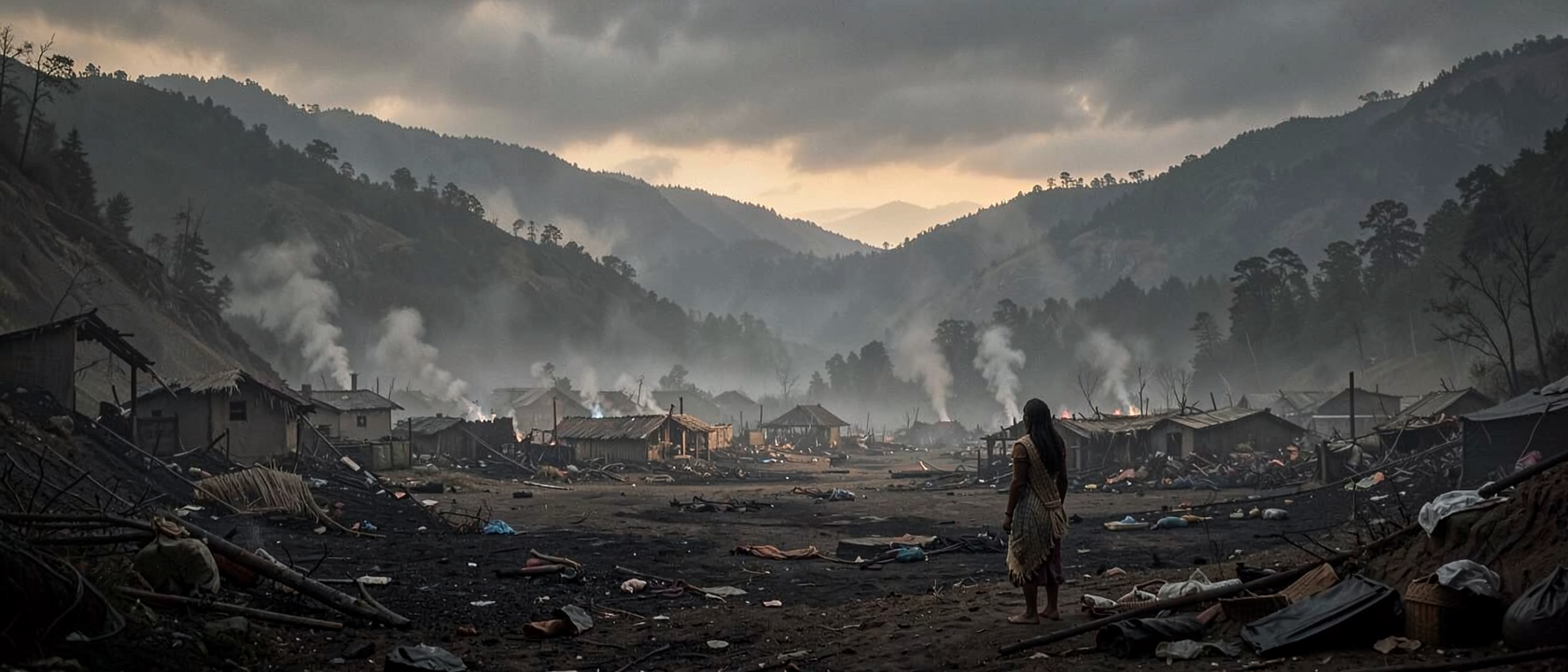
Round Valley, Before
Round Valley lies in Mendocino County, in Northern California, and was Yuki land for generations before anyone called it that. Historians estimate, and it is only an estimate, that close to 20,000 Yuki lived there before sustained contact with outsiders. California entered the Union in 1850, two years after gold turned up in the Sierra foothills, and the rush that followed pushed the territory’s non-Native population from about 13,000 to over 300,000 within a decade. The valley’s grass and water made it land other people wanted.
A State Pays for Killing
In 1854, six men from Missouri killed 40 Yuki people in what is now called the Asbill massacre, the first recorded killing of its kind in the valley. That same year, Congress began appropriating funds to help California cover the cost of militia campaigns against Native people, turning organized killing into a state expense the federal government helped cover. Serranus Clinton Hastings, California’s first Chief Justice and later its Attorney General, financed and organized expeditions into Yuki territory. H. L. Hall, hired to run Hastings’ ranches, carried out some of that violence himself, killing nine or eleven Yuki people after horses were lost on the ranch, and later killing women and children, including, by his own account, a girl he said he killed for being stubborn. The campaigns Hastings financed killed at least 283 people, by one historian’s count, the deadliest of 24 known state militia operations in California.
The Children Who Were Sold
In 1855, traders took Yuki children from the valley and sold them into bondage. California did not strike the law permitting the capture and sale of Native people from its books until 1862, so the practice carried no legal risk for years. Secretary of War Jefferson Davis, who had authority over federal troops in the region, chose not to send soldiers to stop it. The killings drew occasional notice at the time; the sale of children mostly did not.
One Death, Fourteen Dead
In early 1858, a white settler was killed, apparently by Yuki hands, one of the rare instances of Indigenous retaliation on record. Fourteen Indigenous people were killed in response. The arithmetic of that reprisal, one life taken and fourteen taken back, runs through the whole record of these years.
Soldiers Ordered to Watch
By 1859, at what accounts describe as the peak of the killing, federal dragoons were posted to Round Valley, but their commanders restricted what the soldiers could do once they arrived. Troops present were not troops intervening, and for years they did not intervene. U.S. Army soldiers eventually moved to end the killing outright, but only after the population had already been reduced to a fraction of its former size.
The Invoice
Testimony in 1860 described Hall’s men hunting down Yuki people who had fled into the mountains and killing them there. By then a second militia, the Eel River Rangers, was operating in the valley on the state’s payroll, led by Walter S. Jarboe. Jarboe’s unit billed California a substantial sum for the campaign, and the legislature paid it in full: killing, recorded as a government expense.
Funded Again
In 1861, Congress renewed the funding arrangement it had set up in 1854. This was not a single emergency measure authorized once and forgotten; it was a policy the federal government kept paying for, year after year, even as the human cost in Round Valley became impossible to miss. Only in 1862 did California revoke the law that had allowed the capture and sale of Native people in the first place.
300 Left
In 1864, California’s superintendent of Indian Affairs counted the Yuki population at Round Valley: 85 men and 215 women, 300 people in all. A decade earlier, perhaps 20,000 had lived in the same valley. Killing accounted for part of that collapse; enslavement, disease spread through rape, and starvation on the reservation accounted for the rest.
Named, Not Yet Named
In 1890, the historian H. H. Bancroft described what had happened in Round Valley as a hunt of human beings, an acknowledgment written within living memory of the people who survived it. The word historians would eventually settle on, genocide, was not applied to these events until the mid-1970s, roughly a century after the Yuki population had already been cut to a few hundred. Recognizing what happened and having the word for it turned out to be two different things, separated by generations.
Building the Case
In 2012, the historian Brendan Lindsay published “Murder State: California’s Native American Genocide, 1846-1873,” arguing that the broader destruction of California’s Native population over nearly three decades met the definition of genocide. Benjamin Madley’s research narrowed that claim to specific, documented cases, the Yuki among them, built from militia payrolls, legislative records, and sworn testimony rather than population estimates alone. “California state legislators,” Madley has said, “established a state-sponsored killing machine.”
The Disputed Ground
Not every historian agrees that California’s overall Native population decline came from deliberate killing rather than disease and other causes; statewide, the Indigenous population fell from an estimated 150,000 in 1846 to between 25,000 and 30,000 within two decades, and that decline had more than one cause. For the Yuki specifically, the record includes militia payrolls, courtroom testimony, and state invoices spelling out who was killed, by whom, and what the state paid for it. No record describes Hastings, Hall, or Jarboe facing any legal consequence for any of it.
Taking the Name Down
In 2019, Governor Gavin Newsom apologized for what he called California’s historical wrongdoings against Native peoples. A 2017 opinion piece calling for Hastings’ name to come off the law school he had founded led the University of California to commission its own review in 2020. On November 2, 2021, the school’s board voted to remove his name, and the legislature made it official the following year, renaming the institution the University of California College of the Law, San Francisco. Hastings had founded the school in 1878 with a $100,000 donation in gold coin. His name stood on the building for 143 years, longer than it took the Yuki population to fall from 20,000 to 300.