
The Dime Museum, February 1886
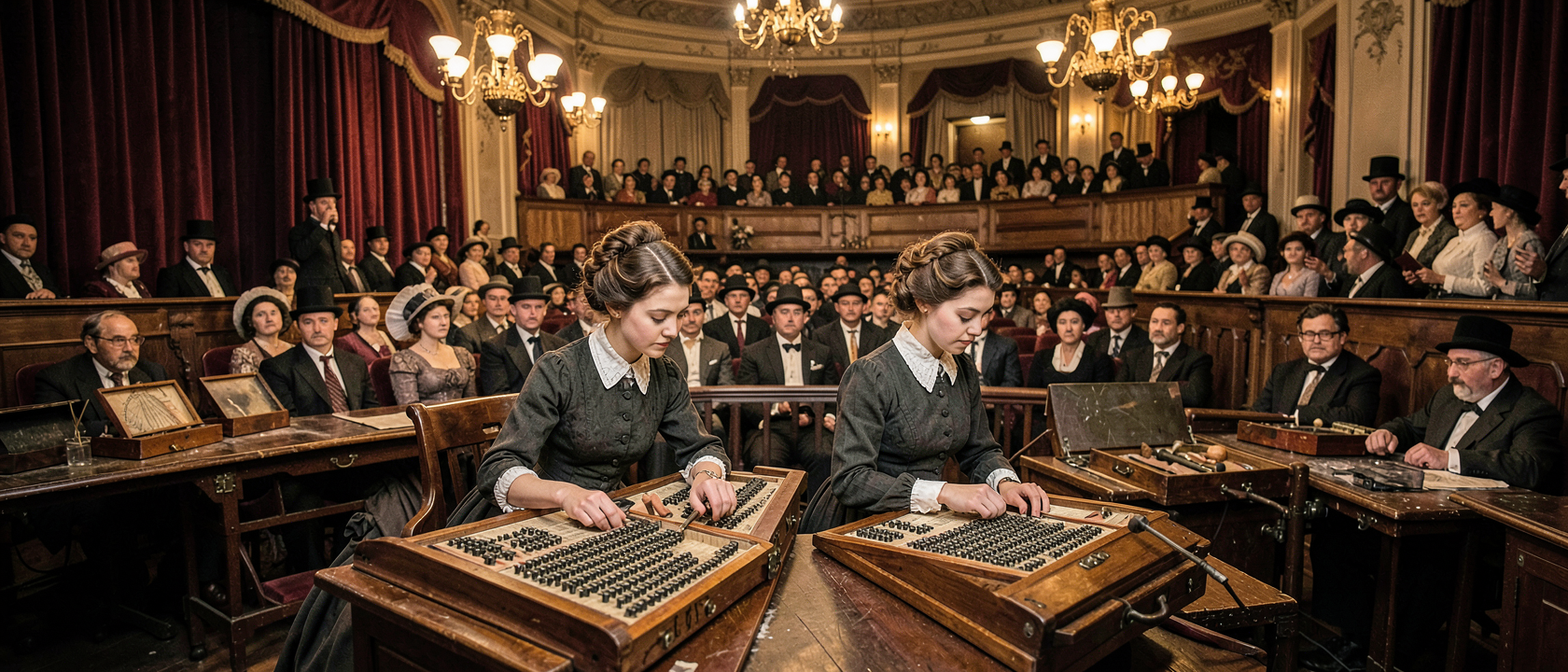
Austin & Stone’s dime museum sat in downtown Boston, Massachusetts, a hall built for variety acts rather than news production. Ahead of the contest, the owners sent in forty carpenters, gasfitters, and upholsterers to rebuild the main auditorium into something resembling a newspaper composing room, complete with type cases and work frames. The bill around the event was crowded: a pair of singing sisters, an Irish comic, a blackface act, the performer billed as The Great Annie Hindle, and two monkeys, Jack and Fido, who were walked off the floor whenever a race needed the space.
The main draw, as the museum sold it, was the Boston Typesetting Race, a week-long contest among the city’s male compositors that concluded on February 21, 1886. The day after it ended, on February 22, four women took the same stage for a separate heat, advertised as a secondary amusement. Nobody paying for a ticket that week came expecting the smaller, later act to be the one worth remembering.
Why Typesetting Was a Spectator Sport
Hand compositors arranged individual pieces of type by eye and by feel, letter by letter, measuring their output in ems, a unit based on the width of a lowercase “m.” A competent typesetter managed around 800 ems an hour. In 1870, George Arensberg, known in the trade as “the Velocipede,” reportedly set 2,064 ems in a single hour, a pace that made him a name among printers who called their fastest colleagues “swifts.”
By 1881, the sport had money behind it: Thomas C. Levy won $1,000 in a typesetting race, said by one account to equal roughly $30,000 in today’s dollars, though that conversion is not independently verified. Through the mid-1880s dime museums up and down the East Coast started booking these contests as entertainment, pulling the trade off the shop floor and onto a stage. All the while, women were setting comparable type for book publishers and small job-printing houses. Boston Typographical Union No. 13 did not count a single one of them as a member.
The Lesser Curiosity
The four women entered as Miss L. J. Kenney, Miss White, Miss Francis, and a fourth competitor whose name the record does not preserve. For the men, the contest had carried a title worth claiming: fastest typesetter in Boston, with whatever standing came attached to that. For the women, nobody had bothered to define what winning would mean. They were there to fill out an evening, not to settle anything.
The Heat That Outpaced the Week
From the first twenty minutes of their contest on February 22, three of the four women, Kenney, White, and Francis, were outpacing the speeds the men had posted the day before. They held that advantage through the heat. No source gives the actual figures for their work, a gap in the record rather than a detail anyone chose to leave out. George Graham had already been declared winner of the men’s race on February 21. The billing had told the crowd which contest mattered. The results told a different story.
The Unexamined Verdict
Nothing in the record suggests Graham’s title was reconsidered once it was clear the women had set faster than he and his rivals had. No organizer is recorded calling the result remarkable at the time. The faster performance appears to have been absorbed into the evening’s entertainment and left there, while the men’s result stood as the official one. That silence says plainly how little weight the women’s outcome was given inside the contest that produced it.
Local No. 13 Reconsiders
Outside the dime museum, something moved faster than the union had before. Within days, Boston Typographical Union No. 13 was debating whether to admit women. A few months later, the invitation went out. The exact date is not recorded.
The only earlier precedent in the trade was the Women’s Typographical Union No. 1, organized in 1868 under Augusta Lewis, chartered by the International Typographical Union in 1869, and disbanded by 1878. For eight years after that, no printers’ union had organized women nationally. No single document says the Boston race caused Local No. 13’s reversal. But the sequence, a public defeat of the men followed within months by the men’s own union opening its doors, is the only explanation the timing supports.
What Became of Them
The record stops where the contest does. Nothing documents what happened to Kenney, White, or Francis afterward: no later career, no mention in the union rolls that their performance may have helped open. The women whose typesetting arguably forced the institutional change left no further trace in the institution they changed.
A loose retelling might say that women proved themselves equal to men in a print shop. What actually happened is narrower: one week in February 1886, a heat played as an afterthought, three named women, and a silence afterward that the union’s own records never filled in.