
A Letter Returned Unread
In 1853, Lady Jane Franklin wrote to her husband one more time. By the reviewer’s account, she asked that if they could not be together on earth, they might be reunited in heaven. She sealed the letter and sent it north, toward the ice where Sir John Franklin had last been seen.
By then he had been dead for nearly six years. By the reviewer’s telling, the letter eventually came back to her, never opened by the man it was addressed to.
Two Ships, Ordinary Plans
HMS Erebus and HMS Terror left Greenhithe, Kent, on May 19, 1845, towed down the Thames at 10:30 in the morning. Aboard were 134 officers and men, commanded by Sir John Franklin, on a Royal Navy mission to find the Northwest Passage, the long-sought sea route through the Arctic ice.
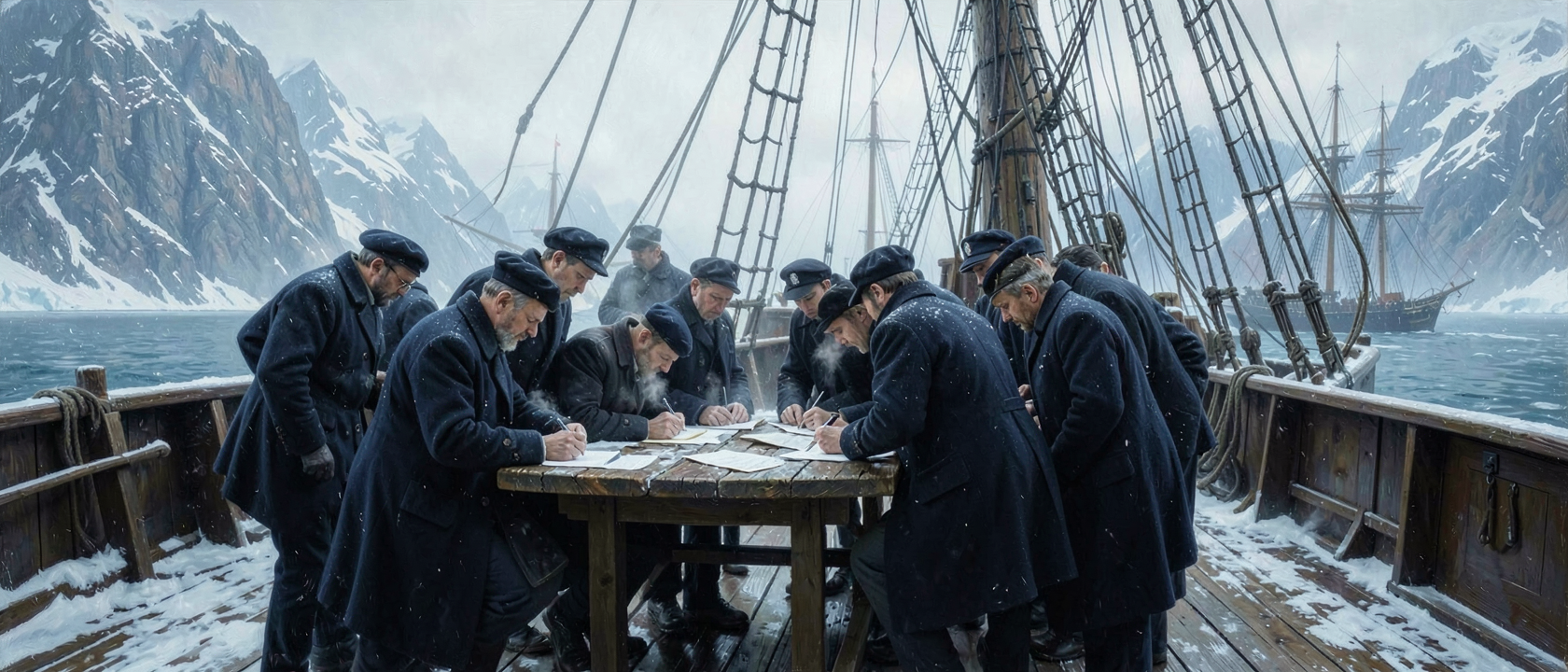
The letters the crew wrote before sailing, now gathered in “May We Be Spared to Meet on Earth,” read nothing like the opening of a disaster, at least as the collection’s editors present them. Second Lieutenant Henry Le Vesconte, aboard Erebus, wrote about his feelings for a woman named Henrietta LeFeuvre. Purser Charles Osmer, in charge of the ship’s accounts and stores, wrote about his hopes for promotion. Assistant Surgeon Harry Goodsir listed what it had cost him to fit out his cabin and instruments. Ice master James Reid, whose job was to read the pack ice and steer the ships around it, wrote home to reassure his wife. These are men planning careers and courtships, not men writing for the historical record.
The Last Letters from Greenland
The ships called at Stromness, in Scotland’s Orkney Islands, from May 31 to June 3, 1845, for final fresh supplies, then crossed to the Whalefish Islands in Greenland’s Disko Bay, arriving in July. There the crew wrote their last letters home before the ships pushed on toward Baffin Bay.
Five sick men were sent back to England from Greenland aboard a transport ship, the Barreto Junior, escorted by HMS Rattler. That left 129 officers and men to continue into the Arctic. Whaling ships sighted Erebus and Terror in Baffin Bay in late July 1845. No European reported seeing any of the crew again.
What survives after that point is thin. The ships wintered at Beechey Island over 1845 and 1846; three men died there and were buried on the island. In September 1846, Erebus and Terror became locked in ice off the northwest tip of King William Island. Franklin died on June 11, 1847. No letter, log, or witness account says how. The book does not try to fill that gap.
Thirty Bodies, by One Account
Francis Crozier, captain of Terror, took command after Franklin’s death. On April 22, 1848, he and James Fitzjames wrote a note, left at Victory Point, recording that the 105 surviving men had abandoned both ships and were setting out on foot for the Back River, far to the south. Later search parties found evidence that some of the men had resorted to cannibalism before they died.
None of the 129 men who sailed past Greenland made it home. The review states that only 30 bodies were ever recovered, a figure the review does not corroborate against other sources. If that number holds, it leaves 99 men whose remains were never identified, a gap no letter in the collection closes.
Writing Into Silence
The search did not begin right away. It took roughly two years of silence before the Royal Navy, pressed by Lady Jane Franklin, by Parliament, and by newspaper coverage, sent ships north. In 1850, searchers found the graves at Beechey Island, the first hard evidence of the expedition’s first winter. Not until 1859, when a search party on King William Island recovered a written note, was it established that the entire crew was gone.
Lady Jane Franklin kept writing and kept funding expeditions through most of that decade. Her 1853 letter asking to be reunited with her husband in heaven was, by the reviewer’s telling, one among many sent into a silence that had already closed over him. The book’s closing chapter traces the same pattern in other families: wives, mothers, and siblings who kept addressing men who were already dead, because nothing had yet arrived to tell them otherwise.
A Book That Doesn’t Solve Anything
“May We Be Spared to Meet on Earth” gathers nearly 200 letters written by officers and men of the expedition. It was published by McGill-Queen’s University Press on September 5, 2022, edited by Russell A. Potter, Regina Koellner, Peter Carney, and Mary Williamson, a descendant of Sir John Franklin, with a foreword by Michael Palin. Running to 504 pages, the collection covers correspondence sent up to the point the ships entered the waters north of Greenland, along with the later letters families addressed to men who were already lost.
Reviewing the book in History Today on February 10, 2023, Jacqueline Reiter noted that the editors make no claim to have solved the expedition’s fate. That was never the aim of the collection. Public interest in the story had already been renewed by the television series “The Terror,” but the book does something else: it preserves the ordinary paperwork of a disaster, written before anyone involved knew it was one.
Later searches found what the letters never could. HMS Erebus was located in September 2014, HMS Terror in September 2016, both in the waters off Nunavut, Canada. The wrecks confirmed where the ships had ended up. They added nothing to the bodies recovered, and nothing to what is known about the dozens of men whose letters were, in most cases, the last anyone ever heard from them.