
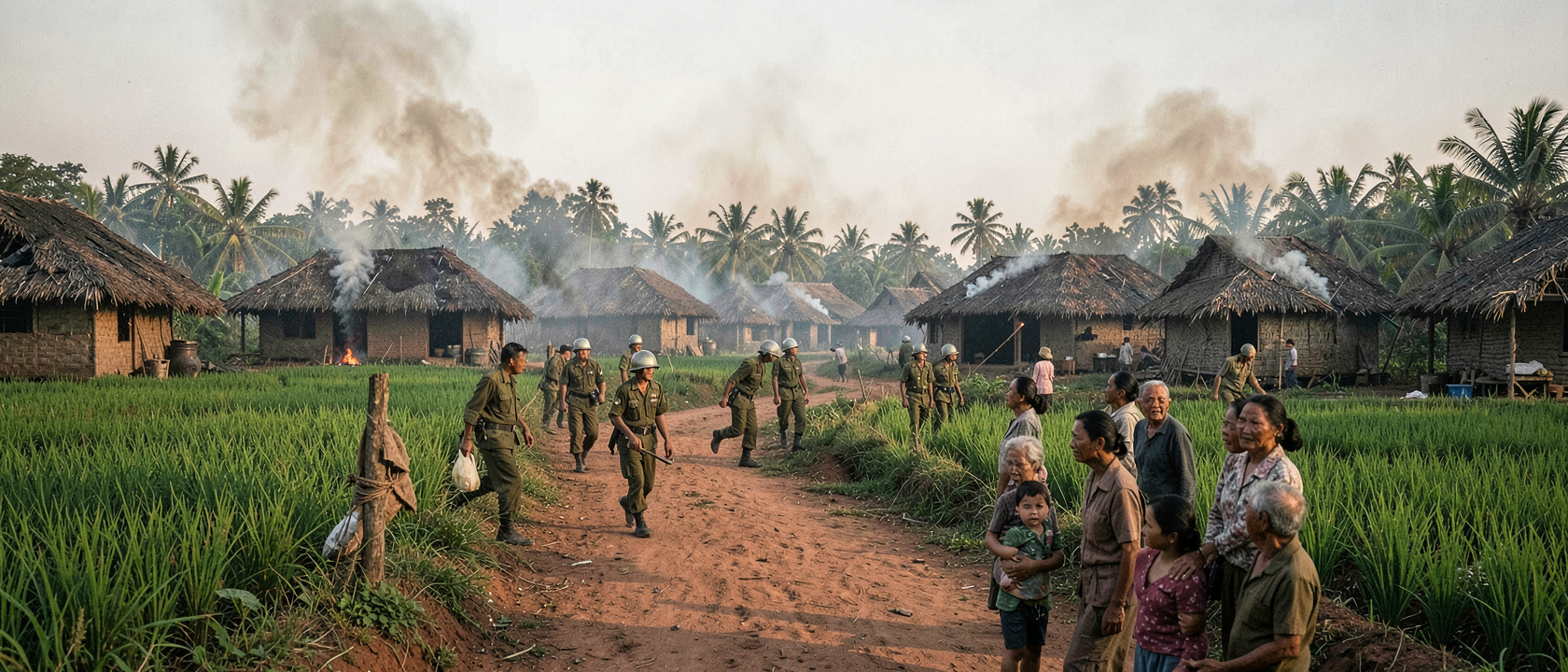
A Settlement, Not a Battlefield
Tú Cung hamlet sits on the central Vietnamese coast, about 7 miles (11 km) northeast of Quảng Ngãi city. In March 1968 it was part of the larger village of Sơn Mỹ, and on the morning of March 16 its population was what you would find in any coastal farming settlement mid-morning: women, elderly men, children. Few men of combat age were present.
At approximately 07:22–07:30, the 1st Platoon of Company C (Charlie Company), 1st Battalion, 20th Infantry Regiment, 11th Infantry Brigade (11th Light Infantry Brigade), 23rd Infantry Division (Americal Division), landed outside the hamlet as part of Task Force Barker, a temporary formation commanded by Lieutenant Colonel Frank Barker Jr. They came configured for combat. The hamlet contained none.
What Charlie Company Had Been Told to Expect
Charlie Company arrived in Vietnam in December 1967 and spent the weeks before March 16 taking casualties from mines and booby traps without once making contact with the enemy. A minefield in late February killed two soldiers and wounded thirteen; a memorial service for the dead was held on March 15.
That same evening, Captain Ernest Medina briefed the company. Task Force Barker had designated the Sơn Mỹ area as a search-and-destroy operation targeting the 48th Viet Cong Battalion. Whether Medina ordered his men to kill all inhabitants has never been settled. At his later court-martial, Medina testified he gave no such order. First Lieutenant William Calley, who commanded the 1st Platoon, testified the opposite. What is not disputed is what Charlie Company found when it entered Tú Cung the following morning: no enemy force, no opposing fire of any kind.
The 1st Platoon in Xom Lang
Killing began at approximately 07:35. The main concentration of violence took place in Xom Lang, designated My Lai 4 on US military maps and called “Pinkville” by American soldiers. Calley’s platoon was responsible for the majority of killings there; My Lai 4 was largely destroyed by 08:40. Residents were shot, including at close range into ditches. An unspecified number of women were raped before being killed. Homes were burned; livestock, food supplies, and the water supply were destroyed. Army Specialist Ron Haeberle, an official US Army photographer, was present and photographed the events.
All three platoons of Charlie Company participated to some degree. Chief Warrant Officer Hugh Thompson Jr., flying an OH-23 scout helicopter with crew members Lawrence Colburn and Glenn Andreotta, landed between American troops and surviving civilians and halted further killing, directing his aircraft’s guns at fellow US soldiers to protect those still alive. Killing continued into early afternoon. The company’s only casualty on March 16 was a self-inflicted wound. No enemy combatant was engaged at any point.
Who the Dead Were
The dead were overwhelmingly women, elderly men, and small children. No enemy fighters were killed. The US Army’s own figure was 347 killed at Tú Cung, not counting a simultaneous attack on Mỹ Khê 4 hamlet by Company B, where an estimated 38 to 90 additional civilians died. The Vietnamese government’s combined figure for both sites is 504. Historians place the total for March 16, 1968, at 347 to 504 unarmed civilians killed.
The Army initially reported the operation as a successful engagement with 128 enemy killed. That report was false, and the Army suppressed the truth for approximately 18 months. Ronald Ridenhour, a helicopter door gunner who learned of the massacre from soldiers who had been present, mailed a written account to members of Congress and the Pentagon on March 29, 1969. Journalist Seymour Hersh broke the story publicly in November 1969 via Dispatch News Service; on November 20, 1969, the Cleveland Plain Dealer published Haeberle’s photographs. At that point, the cover-up could not hold.
What the Record Does Not Settle
The exact death toll runs from 347 to 504 depending on which sites are included and which source is used. No single archivally settled number exists.
Whether Medina instructed his men to kill civilians remains contested. On March 29, 1971, Calley was convicted of the premeditated murder of at least 22 Vietnamese civilians and sentenced to life imprisonment. The Secretary of the Army reduced the sentence twice, first to 20 years and then to 10; Calley was paroled in 1974 after serving approximately three years under house arrest. Medina was tried and acquitted on all charges. Of the 25 officers and enlisted men originally charged, only Calley was convicted.
Lieutenant General William R. Peers, appointed to examine the concealment, submitted his report in March 1970, concluding the massacre had been hidden at every command level from company to division and recommending no fewer than 28 officers face charges. Thompson, Colburn, and Andreotta received the Soldier’s Medal for their intervention, but not until March 1998. Andreotta had been killed in combat approximately three weeks after March 16, 1968, and did not live to see it.
The Sơn Mỹ Memorial, built at the former Tú Cung hamlet site in 1978, names 504 dead.