
Before Dawn
In the hours before daylight on February 26, 1936, Japanese Army units moved through central Tokyo on orders from a cell of junior officers. Twenty-two of them commanded more than 1,400 soldiers, with later estimates ranging from 1,483 to 1,558 men. They occupied the Prime Minister’s official residence, the War Ministry, the Metropolitan Police Headquarters, and other points at the heart of the capital’s government. Japanese accounts call it the February 26 Incident, or Ni Ni-Roku Jiken.
The violence that morning targeted men near the top of the state. Finance Minister Takahashi Korekiyo, briefly prime minister in 1921 and 1922 and known abroad as the “Keynes of Japan,” was shot in his home. Saitō Makoto, Lord Keeper of the Privy Seal and a former prime minister himself, was killed as well. So was Watanabe Jōtarō, the army’s inspector general of military training, one of its most senior posts. Five policemen guarding these men died with them.
Others survived by chance. Prime Minister Okada Keisuke escaped the raid on his residence by hiding; the mutineers killed his brother-in-law, Colonel Matsuo Denzo, apparently mistaking him for the prime minister. Grand Chamberlain Suzuki Kantarō was shot and badly wounded but lived. Former Lord Keeper Makino Nobuaki escaped a separate attack at the resort town of Yugawara.
A Quarrel No One Outside the Army Could See
None of this came from nowhere. For roughly four years, the Japanese Army had been splitting into two rival camps. The Kōdōha, or Imperial Way Faction, pushed for a radical remaking of the nation built on direct loyalty to the Emperor. The Tōseiha, or Control Faction, took a more pragmatic line on how the military should modernize and extend its reach into government. What exactly separated the two in practice is still argued over; the record sketches the dispute’s outline more clearly than its finer points.
What is clear is how contained the quarrel stayed before it broke open. It played out inside barracks and ministries, not in newspapers. To ordinary Tokyo residents, and even to diplomats and journalists who had covered Japan for years, the rivalry was barely visible. Then, in a single morning, it produced gunfire in the middle of the capital.
The City Waits
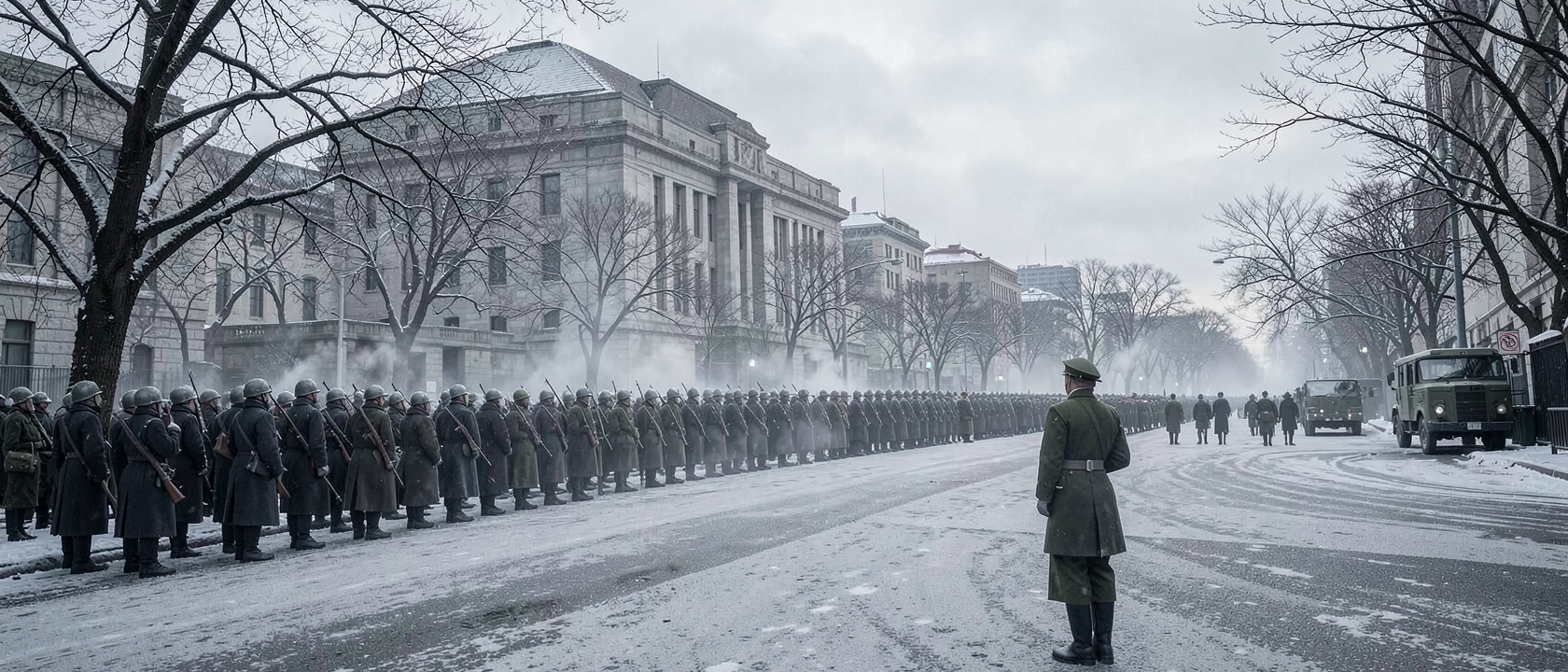
By February 27, the government had declared martial law in Tokyo. On February 28, an imperial order commanded the mutineers to return to their units, while loyal forces, eventually numbering about 23,841 men, surrounded the roughly 1,500 soldiers still holding the occupied buildings. Emperor Hirohito had opposed the uprising from the start and pressed for it to be put down.
For roughly two days, nobody in Tokyo could be certain the Japanese Army would not end up fighting itself in its own capital. Tens of thousands of loyal troops stood arrayed against a force that, however outnumbered, still held key buildings and had already shown it would kill. The uncertainty was not only about numbers; it was about whether units ordered against the mutineers would actually obey.
Surrender Without a Shot
The standoff ended on February 29, 1936, by most accounts, though some sources place the surrender a day earlier. Either way, the mutineers laid down their weapons without the battle the city had braced for. No combat deaths are recorded from the three days of standoff itself; the killing of February 26 had already happened before loyal troops ever closed in. One plot leader, Nonaka, took his own life around the time of the surrender. Another, Kono Hisashi, who had led the attack on Makino, died by suicide on March 6.
Within days, Tokyo returned to its ordinary rhythms. Why a revolt that opened with assassinations collapsed so fast and so completely is not fully spelled out even in later Japanese memoirs and histories; what survives explains the imperial order and the troop numbers better than it explains the private decisions that led individual units to stand down.
The Historians’ Chain
What followed is on firmer ground. The plotters faced a special court-martial that sat in secret, without defense counsel. On July 5, 1936, seventeen men were sentenced to death; fifteen were shot on July 12. Two more, Isobe and Muranaka, were kept alive as witnesses before being executed on August 19, 1937, alongside civilian ideologues Kita Ikki and Nishida Mitsugi. In all, nineteen officers and civilians died by firing squad, and roughly forty more were imprisoned. Kōdōha generals were purged from Army leadership; Sadao Araki, one of the faction’s most prominent figures, was forced into retirement that March.
Historians broadly agree the incident ended the years in which junior officers could reshape Japanese politics by killing men who disagreed with them, and that it left the military with a firmer grip on the civilian government. Richard Storry and others have gone further, reading February 26, 1936, as one link in a chain running toward the invasion of China the following year and eventually to Pearl Harbor in 1941. That longer argument is an interpretation of where the mutiny led, not a step-by-step case proven by the surviving documents, and historians still disagree about how direct the link actually was.
What the Record Won’t Give Up
Even after decades of memoirs, trial records, and historical writing, parts of February 26, 1936, have never fully closed. Sources still disagree on whether the mutiny ended on February 28 or 29. Some accounts even garble Watanabe Jōtarō’s title, calling him home minister instead of the army’s inspector general of military training, a confusion that has persisted through translation. What truly divided the Kōdōha and Tōseiha, beyond the broad labels of radical reconstruction against pragmatic control, remains sketched rather than settled.
That unresolved quality is part of what the mutiny cost. Takahashi, Saitō, Watanabe, five policemen, and two of the plot’s own leaders by suicide are the toll the record does preserve. What it has never fully delivered is a settled account of why a four-year quarrel inside the army ended, on one February morning, with men shot in their homes, and why the forces briefly poised to fight each other in Tokyo chose, within days, not to.