
Beidaihe, After Midnight
Sometime after midnight on 13 September 1971, a convoy left the leadership retreat at Beidaihe and drove to Shanhaiguan Airport, carrying Lin Biao, his wife Ye Qun, and his son Lin Liguo. At approximately 00:32, a Hawker Siddeley HS-121 Trident 1E aircraft, registration B-256, lifted off without clearance, without completing routine pre-flight procedures, and with an incomplete fuel load. One account, attributed to the limousine driver, holds that Lin was so physically depleted he had to be carried aboard; it is single-sourced and unverified. Lin Biao’s daughter, Lin Liheng, did not board the plane. According to the fact sheet, she warned Premier Zhou Enlai of the departure; Zhou attempted to prevent the takeoff but was circumvented.
The Second Man in China
In April 1969, at the 9th National Congress of the Chinese Communist Party, a new party constitution was ratified that named Lin Biao explicitly as “Comrade Mao Zedong’s successor.” He also held the office of Vice Chairman of the Central Committee and had served as Minister of National Defence since September 1959. He had graduated from the Whampoa Military Academy in 1925, was made a Marshal of the People’s Republic in 1955, and during the Cultural Revolution, which began in 1966, emerged as the foremost institutional promoter of Mao’s cult of personality. That is the context within which the events of 13 September resist any clear explanation: the man Beijing later accused of attempting to seize power by force was already, by law, next in line to receive it without violence.
2:30 a.m. Öndörkhaan
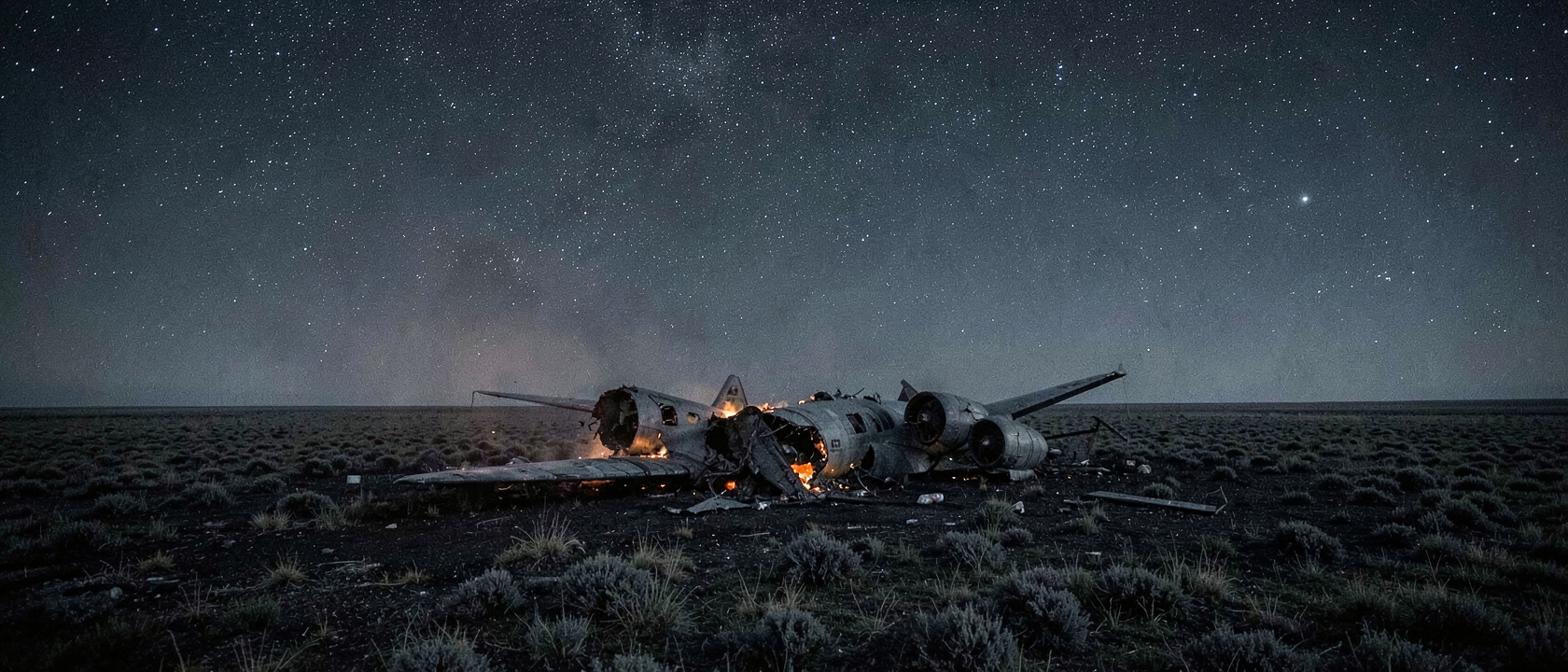
At approximately 2:30 a.m. on 13 September 1971, the Trident came down near Öndörkhaan in the Mongolian People’s Republic. All nine people aboard died: four crew members, including pilot Pan Jingyin, deputy commander of the PLA Air Force’s 34th Division, and five passengers, among them Lin Biao, Ye Qun, and Lin Liguo. Lin Biao was 63 years old. Mongolian authorities photographed the wreckage and shared the documentation with Soviet investigators; because the crash occurred on Mongolian soil, the Chinese government had no control over the scene, making that record some of the most reliable physical evidence that exists.
The Heading of the Plane
Beijing’s official account framed the night as the culmination of a failed coup attempt, codenamed Project 571 (五七一工程, Wuqiyi gongcheng, in Chinese a homophone for “armed uprising”): Lin and his family fled toward the Soviet Union once the plot collapsed, and the Trident went down because it had not taken on sufficient fuel. Three pieces of evidence complicate that account. The Mongolian General Intelligence Agency completed its report on 20 November 1971, compiled with Soviet military assistance, attributing the crash to pilot error rather than fuel starvation or hostile fire; Soviet forensic experts, working independently, described the crash as controlled flight into terrain, possibly due to pilot error. A post-crash fire was observed at the site, which is difficult to reconcile with fuel exhaustion. And the plane’s recorded heading at impact was southward, back toward China, not northward toward the Soviet border the escape narrative requires. Why the aircraft reversed course is unknown; historians have proposed that fuel was running low, that it was forced down, or that the departure was not Lin Biao’s voluntary act, none has been established by primary evidence.
What the Party Burned
Lin Biao’s death was not publicly acknowledged in China until 1972. Before any independent account could circulate, party members were convened in study sessions to absorb the coup narrative, and official files connected to the case were subsequently destroyed. His party membership was formally suspended by Politburo resolution on 20 August 1973, ahead of the 10th National Congress, and the 1981 party Resolution on Certain Questions in the History of Our Party designated him head of the “Lin Biao-Jiang Qing Counter-Revolutionary Group.” An official account of the crash did not appear in the Chinese press until December 1980, when the Shanghai newspaper Wen Hui Bao published one. The destruction of records was deliberate policy, closing off lines of inquiry no later researcher has been able to fully reopen.
An Open Question
More than five decades after the crash, three problems remain unresolved. The Chinese primary sources are gone. The southward heading contradicts the official account and has never been explained. And the biographical portrait of Lin Biao, cautious, physically frail, reportedly carried onto the plane he died on, is hard to square with the role assigned to him as architect of a violent seizure of power he was constitutionally positioned to inherit. Whether he directed Project 571, or whether the scheme was the work of Lin Liguo and Ye Qun without his knowledge, is likewise unresolved. The historian Jonathan D. Spence concluded that the story is “essentially beyond verification, since the photographs later released by the Chinese authorities are of dubious authenticity and details on Lin Biao’s exact plans and on the other plotters are blurred.” What the Mongolian and Soviet evidence establishes is that the Chinese government’s technical explanation for the crash does not hold. What it cannot establish is the sequence of decisions that put nine people on that aircraft, or why it was flying south when it came down.