
Eighty Stabs and a Letter to the Pope
On the night of January 8, 1354, armed men forced their way into an inn at L’Aigle, Normandy, and stabbed Charles de la Cerda, Constable of France and closest confidant of King Jean II, approximately 80 times. That figure comes from medieval narrative sources and should be understood as an expression of extremity rather than a precise count. De la Cerda was 26 or 27 years old.
The man who ordered the killing was Charles II of Navarre, then 21. He did not deny it: shortly after the murder he wrote to Pope Innocent VI stating that he had arranged the death himself. The letter survives. His brother Philip led the attackers; a henchman named Jean le Soult is named in the sources as the one who dealt the killing blows.
The Claim Behind the Killing
Charles II’s mother was Joan II of Navarre, only daughter of Louis X of France, making Charles II a grandson of a French king with a bloodline claim stronger than Jean II’s, though his parents had formally renounced it. Jean II also owed him money and territorial concessions he considered his due. The specific trigger was Jean II’s grant of Angoulême, which Charles II regarded as his mother’s fief, to de la Cerda instead.
Between 1354 and 1359, Charles II negotiated separately with England and France during the Hundred Years’ War, switching formal allegiance at least twice. Jean II had him arrested on April 5, 1356, at Rouen; Charles escaped in November 1357 and continued as before. Whether this constituted coherent strategy or compulsive miscalculation remains unanswered by the sources.
The Dauphin in the Streets of Paris, and the Poison That Missed
According to History Today, in December 1359 Charles II plotted to ambush and kill the Dauphin, the future Charles V, in Paris. The plan was not carried out. A caution belongs here: another source places a similar failed plot in December 1355 rather than 1359; both possibilities remain in play. Charles II also attempted to poison Charles V directly and targeted two of Charles V’s brothers, the Dukes of Burgundy and Berry, the same dukes who were brothers of his own wife, Joan of Valois, whom he had married on February 12, 1352. In 1378, fresh poisoning plans and a new alliance with England cost him all of Navarre’s Norman possessions except Cherbourg.
A separate and elaborate scheme involved Gaston III of Foix. Charles II gave his nephew, the young Gaston, son and heir of Gaston III and Agnes, Charles II’s sister, a bag of powder, claiming it was a love potion that would repair the estrangement between Gaston III and his wife. The powder was poison. The young man carried it northward with no apparent knowledge of its purpose until his half-brother Yvain de Béarn exposed it to Gaston III; a dog given the powder died. Gaston III imprisoned his son. Accounts then diverge: one version has Gaston III killing his son during a violent confrontation in the prison cell; another, attributed to Froissart, holds that the young man died of starvation. Both versions agree the young man died around mid-August 1380. Froissart’s verdict on responsibility was clear: it was his father who actually killed him, but the King of Navarre had dealt the mortal blow.
January 1, 1387: What the Brandy Did
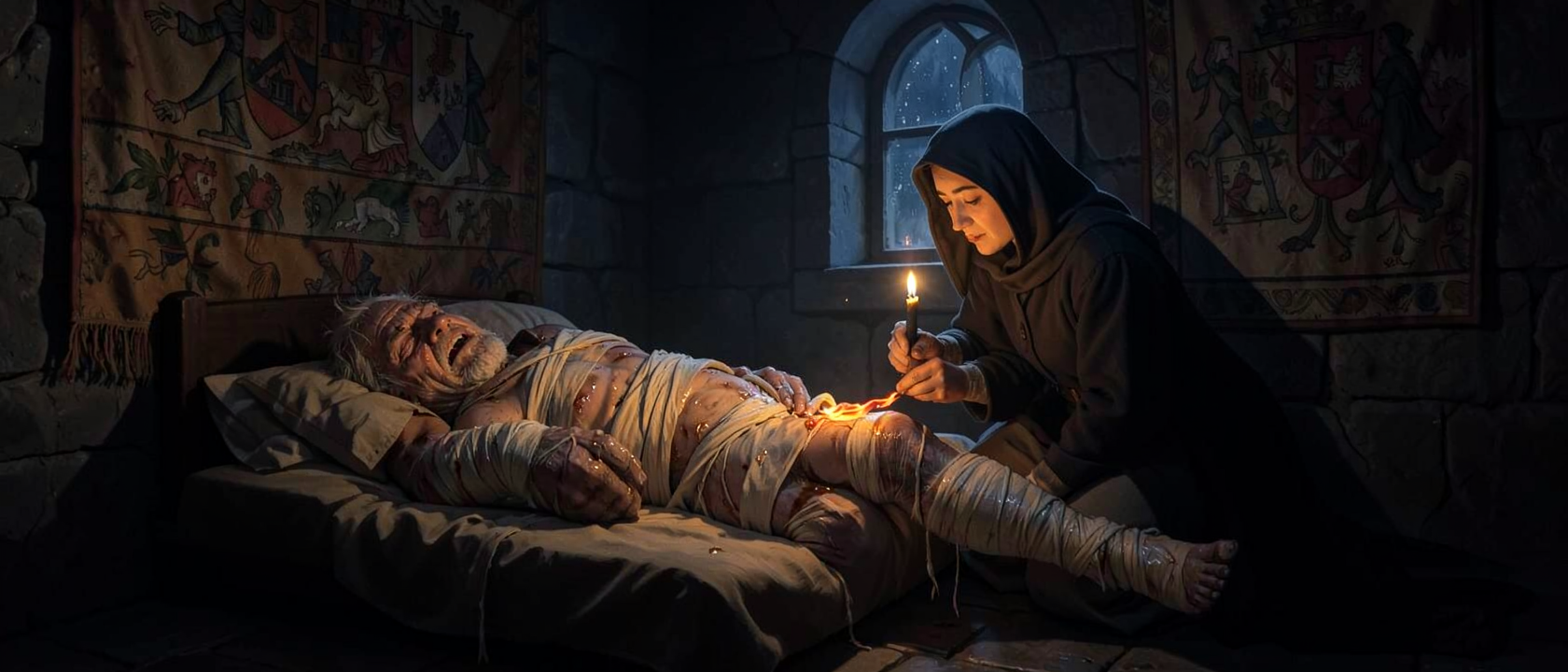
By his final years Charles II could no longer use his limbs. His physician prescribed nightly wrapping in linen cloths soaked in brandy. One night shortly before January 1, 1387, a servant reached for a candle rather than a blade to cut the last thread. The brandy ignited and Charles II was engulfed.
If Froissart’s Chronicle is accurate, and it is the only source giving a duration, Charles II survived in agony for approximately 15 days before dying on January 1, 1387, aged 54. He was buried at Pamplona Cathedral, where he had been crowned 36 years earlier. His son, Charles III of Navarre, took the throne the same day.
What Three Decades of Violence Produced
Charles de la Cerda was dead at 26 or 27. The young Gaston died around mid-August 1380 because of a scheme Charles II had set in motion without the young man’s knowledge. Assassination attempts by sword and by poison had been directed at the Dauphin, Charles V, the Dukes of Burgundy and Berry, and Gaston III himself, a campaign spanning more than two decades. Charles V survived them all and ruled France until 1380; the throne passed to his son Charles VI in an unbroken line. The Norman lands, apart from Cherbourg, were gone by 1378. The French throne Charles II had argued was rightfully his remained with the house he had spent his reign trying to destroy. The Valois dynasty outlasted him by more than a century.
Froissart’s Silence on the Question He Raised
Froissart recorded the manner of Charles II’s death in detail and then declined to draw the expected conclusion, writing that he could not determine whether the end was divine punishment or plain misfortune. The Chronique du Religieux de Saint-Denis, hostile to Charles II, still acknowledged his intelligence and personal eloquence. Historians have disagreed about whether he was a dynastic strategist who ran out of time or an opportunist who mistook noise for momentum. What the record settles is simpler: Charles II of Navarre died on January 1, 1387, burned alive by a medical treatment gone wrong, having secured none of the hereditary claims he had killed for.