
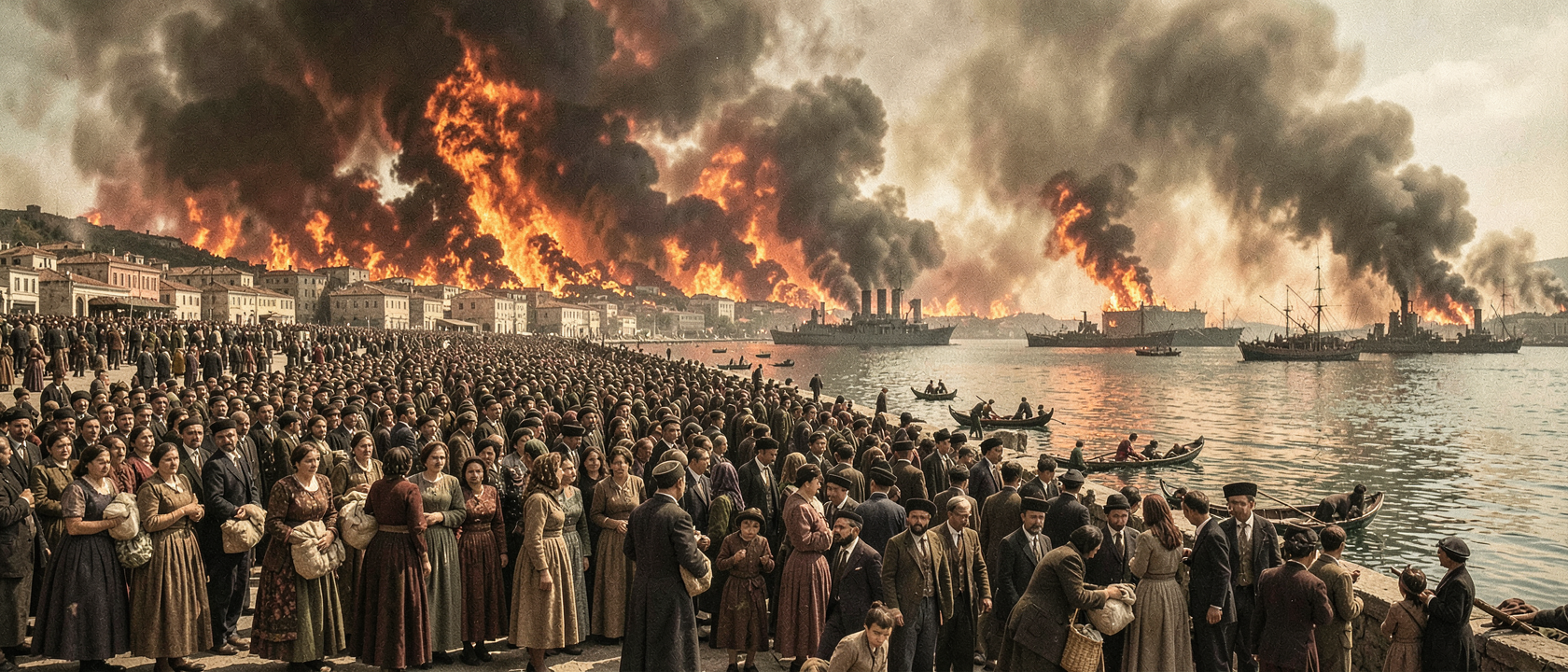
The Waterfront, September 13, 1922
By September 13, 1922, fire was moving through the Greek and Armenian quarters of Smyrna, on the Aegean coast of Asia Minor, the city known today as Izmir, Turkey. Turkish forces had entered the city four days earlier, on September 9. Flames ran block by block through the Christian districts while a crowd packed onto the quay, facing the harbor because there was nowhere else to go.
Offshore sat an estimated twenty-one Allied warships: eleven British, five French, two American, one Italian, with more arriving. Their standing orders were to protect their own citizens, not to intervene in what their governments treated as an internal Turkish matter. One detail from the reporting that followed would stand out without yet being explained: the Turkish quarter of the city stood untouched.
A City That Had Survived Everything Before
Smyrna’s history reached back to antiquity, when it was a Greek city tradition linked to the birthplace of Homer. The geographer Strabo rated it the finest city in Asia. By Christian tradition, Smyrna was also one of the seven churches of Asia addressed in the Book of Revelation, named there alongside suffering.
Across the centuries, accounts describe the city being leveled and rebuilt again and again, destroyed in turn by the kingdom of Lydia, by Persia, by the Seljuk Turks, and by the army of Timur. Each time, it came back. When the Ottomans took Smyrna in the 15th century, it kept something unusual for a city under Muslim rule: a Christian majority, large enough that Ottoman Turks nicknamed it “Gavur Izmir,” infidel Smyrna. The nickname stuck for centuries, until 1922.
Greece’s Gamble, 1919–1922
As the Ottoman Empire broke apart after the First World War, Greek troops landed at Smyrna on May 15, 1919, with Allied backing. The occupation put the city’s own people, tens of thousands of Greeks along with Armenians and other Levantine Christians, at the center of a war none of them had started. Greece’s High Commissioner in the city, Aristeidis Stergiadis, tried to restrain discrimination against the Turkish population, but ethnic tension never went away.
From its beachhead, the Greek army pushed deep into Anatolia, pursuing a wider claim to Ottoman territory. Turkish nationalist forces under Mustafa Kemal answered with what became known as the Great Offensive, fought from August 26 to September 18, 1922. It broke the Greek line and sent the army into full retreat toward the coast it had landed on three years earlier.
Nine Days in September
Turkish troops entered Smyrna on September 9, 1922: the 5th Cavalry Corps under Major-General Fahrettin Altay, part of the army Mustafa Kemal commanded overall. Soon after, a mob seized the city’s Greek Orthodox metropolitan, Chrysostomos, and killed him. Sources differ on exactly how, with some describing a hanging and others a more prolonged killing.
On September 13, four days after the army entered the city, fire broke out in the Greek and Armenian quarters. It burned for roughly nine days before it was brought under control on September 22. The Telegraph’s dispatch on the disaster carried two facts side by side, without comment: the Turkish quarter was intact, and 180,000 people were homeless. Who set the fire, and on whose order, is not settled by the surviving record. What is documented is where it burned, and where it did not.
What It Cost
No single figure for Smyrna’s human cost holds agreement among historians, but the range gives a sense of the scale. The Telegraph’s contemporary count put 180,000 people homeless; other estimates of the crowd that gathered on the quayside alone run far higher, into the neighborhood of half a million. Of those trying to escape, an estimated 250,000 were eventually taken off by British, American, and Greek ships.
Estimates of the dead run from the low thousands, in the account given by the American High Commissioner at the time, up to a widely cited figure near 100,000. Some sources go further, claiming another 100,000 people, mostly men, were marched out of the city into the Anatolian interior and never accounted for afterward. One estimate holds that of roughly 400,000 Christians living in Smyrna before the fire, there was no information on 190,000 of them by October 1, 1922. Every number here is an estimate. None is a confirmed count.
What We Don’t Actually Know
These gaps are not an oversight. They are what the record actually allows. No official census counted the crowd on the Smyrna quay, and reports put it anywhere from the tens of thousands up to close to half a million, depending on who was asked and when.
The death toll is disputed just as widely. Admiral Mark L. Bristol, the American High Commissioner in Constantinople, told Washington the total killed did not exceed 2,000, a figure critics have called politically convenient for a government reluctant to blame Turkish forces. Other estimates run from the tens of thousands past 100,000. The fate of the men said to have been marched into the interior is harder still to pin down: some accounts put the number as low as 25,000, others above 100,000, with no agreed figure for how many survived. Three things explain the gap: records lost in the fire itself, Greek, Turkish, and foreign observers each telling a version shaped by what their side had at stake, and a chaos on the ground that made any precise count impossible to take at the time.
Izmir, Not Smyrna
The city that emerged from the fire kept growing, under a different name. In time, Izmir became larger than Smyrna had ever been. What it did not get back was what Smyrna had always recovered before. The Christian population that had defined the city for centuries, the community that had once earned it a nickname for refusing to disappear under Ottoman rule, did not return in anything close to its former numbers.
In 1923, Mustafa Kemal became the first president of the new Republic of Turkey, built in part on the ground the Greek army had been pushed off. Smyrna had survived Lydia, Persia, the Seljuks, and Timur, rebuilding itself as the same city each time. After September 1922, it did not rebuild as what it had been. Izmir stands where Smyrna did, grown larger, home to a Christian population that never came close to its prewar size.