
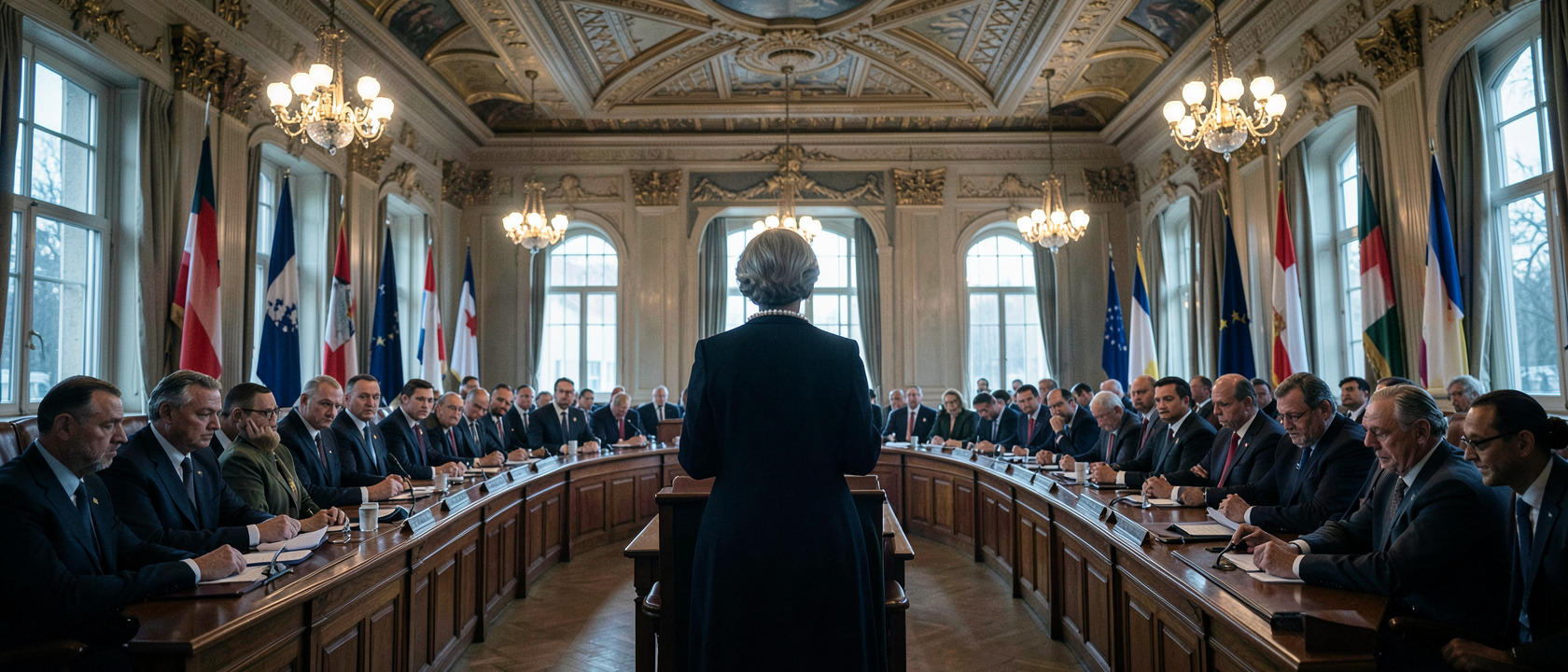
A Vote Before Dawn, Paris, December 10, 1948
The United Nations General Assembly was sitting at the Palais de Chaillot in Paris when it brought the Universal Declaration of Human Rights to a vote on December 10, 1948. By one widely cited account, the roll call did not close until roughly three in the morning; the surviving UN session records confirm the date but not that exact hour.
Fifty-eight countries belonged to the UN that year. Forty-eight delegations voted yes. None voted no. Eight abstained, and two took no part in the vote at all. The result, Resolution 217 A (III), closed a drafting process that had run for less than two years. By one account, delegates then stood and applauded; the UN’s own history page later named the chair of the drafting committee as the person chiefly responsible for getting the text adopted.
That chair was Eleanor Roosevelt, the delegate for the United States.
From a Speech Her Husband Gave to a Seat She Didn’t Expect
In January 1941, President Franklin D. Roosevelt used his State of the Union address to set out four freedoms as a statement of US war aims: freedom of speech, freedom of worship, freedom from want, and freedom from fear. Drafters working on the declaration in 1947 and 1948 built much of their thinking on that framework.
Franklin Roosevelt died in 1945. The following year, President Harry Truman appointed his widow to the US delegation to the UN General Assembly. Among the people who went on to staff the commission and the committee that wrote the declaration, hers was the only name attached to a woman.
Eighteen Nations, Then Nine
The Commission on Human Rights held its first session in January 1947, at Lake Success, New York. Eighteen countries sat on it: Australia, Belgium, the Byelorussian Soviet Socialist Republic, Chile, China, Egypt, France, India, Iran, Lebanon, Panama, the Philippines, the United Kingdom, the United States, the Soviet Union, Uruguay, and Yugoslavia.
A smaller group did the actual writing. That February, Roosevelt, the Chinese delegate Peng-chun Chang, and the Lebanese delegate Charles Malik began drafting what was then called the International Bill of Human Rights, working from a preliminary outline by John Humphrey, a Canadian law professor from McGill University who ran the UN Secretariat’s human rights division. Humphrey’s outline became the basis for a fuller draft completed by the French delegate, René Cassin, a legal scholar who would later become a Nobel laureate. A letter in late March 1947 widened the committee again, adding Australia, Chile, France, the Soviet Union, and the United Kingdom.
In its final shape, the Drafting Committee carried nine names: Roosevelt chairing for the United States, Chang as vice-chair, Malik as rapporteur, William Hodgson for Australia, Hernán Santa Cruz for Chile, Cassin for France, Alexander Bogomolov for the Soviet Union, Charles Dukes for Britain, and Humphrey for Canada, serving through the Secretariat. The UN’s own roster of the enlarged committee leaves Canada off the list even though Humphrey, a Canadian, sat on it as Secretariat staff, a small inconsistency that different accounts resolve differently.
A Text Worth Resigning Over
Roosevelt pushed to fold economic and social rights into a document that could otherwise have covered only civil and political ones. “You cannot talk civil rights to people who are hungry,” she said, by one account, and threatened to resign if the provisions were cut.
Her campaign for clauses on asylum and freedom of movement rested on a harder backdrop. Wartime had left an estimated 20 million refugees and displaced people in Europe alone, a contemporary estimate rather than an exact count. Roosevelt argued that a declaration meant little if it stayed abstract. She put the idea in a line that outlasted the meeting: universal human rights, she said, begin in small places close to home, places so small and so close that they never show up on any map of the world.
Two Years, Then a Vote
The Drafting Committee delivered its text in May 1948. That September it went to the wider UN membership, more than 50 states in all, for a final round of changes. The General Assembly’s Third Committee, which handled social and humanitarian questions, opened its own debate on October 6, 1948, in Paris, and approved the text on December 6 by a vote of 29 to 0, with 7 abstentions. Four days later it reached the full Assembly.
Eight Countries Stepped Back
The final tally is usually remembered as unanimous. It wasn’t quite. Six of the eight abstaining governments belonged to the Soviet bloc: the Byelorussian SSR, Czechoslovakia, Poland, the Ukrainian SSR, Yugoslavia, and the Soviet Union itself. Saudi Arabia abstained too; by one account, its delegation viewed the declaration as incompatible with Islamic law. So did South Africa, though the surviving record gives no stated reason for its vote. A few secondary accounts put the numbers lower, as few as three abstentions among 56 member states; the figures treated as authoritative here are the UN’s own: 58 members, 48 in favor, eight abstentions, and two delegations absent.
What the Record Doesn’t Settle
Some gaps stay open. No source gives an exact date for when Truman appointed Roosevelt to the delegation beyond the year 1946, nor for the moment she was formally named to chair the Drafting Committee rather than simply sit on it. A letter she wrote to Truman in June 1949, recalling that she and the Soviet delegation had practically never agreed, is dated seven months after the declaration had already passed. Roosevelt went on chairing the Human Rights Commission until 1950, so the friction she described may have carried into the Commission’s later work; nothing in the record specifies which argument the letter refers to. South Africa’s reasons for abstaining, unlike Saudi Arabia’s, were never written down anywhere this account could trace.
Roosevelt chaired the Commission on Human Rights from 1947 to 1950, longer than anyone else has held that post. She died in 1962. In 1968, the United Nations awarded her, posthumously, its Human Rights Prize.