
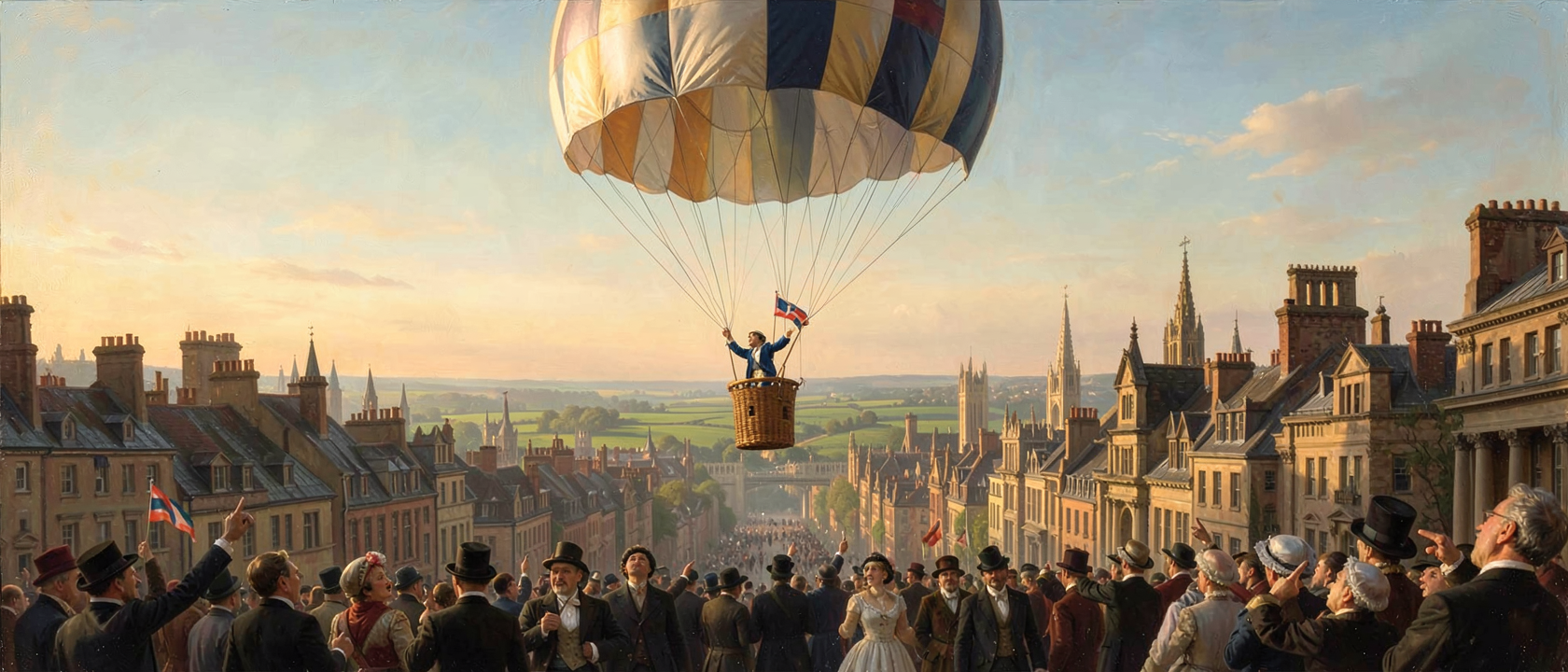
An Evening on North Audley Street
By early evening on September 21, 1802, a crowd had gathered at St George’s Parade Ground, on North Audley Street in London, to watch something no one in Britain had ever seen. Above the ground stood a striped hydrogen balloon and its rigging, the whole structure about 120 feet tall (36.6 m) from the top of the envelope to the basket hanging below.
Slung beneath the balloon’s netting was a second piece of apparatus: a canvas dome 23 feet across (7 m) when open, gathered now into a tight bundle and held at its crown by a wooden ring just ten inches wide (25 cm). Spectators compared its folded shape to a closed umbrella, or, as some of the women present put it, to a hooped petticoat. Below it hung a plain wicker basket, about four feet high (1.2 m) and a little over two feet across (0.69 m), built to carry one man.
That man was André-Jacques Garnerin, dressed for the occasion in a blue jacket, a white waistcoat, and pale nankeen trousers, nankeen being a sturdy cotton cloth common at the time. Nobody in the crowd yet knew what the folded canvas above his head was for. They had come to watch a balloon go up. What came down from it was the point of the evening, though none of them could have said so yet.
A Frenchman and an Untried Machine
Garnerin was thirty-three years old, a professional balloonist who had already made a parachute descent in Paris nearly five years earlier. In London that September, Britain and France were only just out of a long war, and the peace between them was not one anyone trusted completely. A Frenchman proposing to leap from a balloon basket into open air over the capital was, by itself, a curious thing for a crowd to turn out for.
No one in Britain had ever watched a parachute descent, so no one in the crowd, and arguably not even Garnerin, could say with certainty what would happen once he cut himself free. The balloon climbed to roughly 8,000 feet (2,440 m), a height from which a miscalculation would leave no second attempt. The size of the crowd was itself a kind of wager: this many people had chosen to stand under something entirely unproven.
The Jump
At altitude, Garnerin severed the line connecting his basket to the balloon above it. The canvas dome, until then just a bundle at the top of the rigging, filled with air and opened into its full 23-foot span. Garnerin began to fall, then to drift, carried by a gentle southwesterly wind rather than dropping straight down.
As he descended he waved a French tricolor flag from the basket. The wind carried him across London, swinging him gently as the canopy worked to slow his fall, until he came down safely near St Pancras Church, under two miles (3.2 km) from where the balloon had gone up. He was unhurt.
Cheers for a Frenchman
The crowd that met Garnerin on landing did not treat him as a foreign curiosity to be watched warily, nor as a Frenchman to be regarded with suspicion. They treated him as a hero. Accounts of the day describe his reception in those terms, flatly, without pausing to explain it.
At that time, Frenchmen in England could generally expect wariness rather than warmth, with the two countries only recently out of years of fighting. On September 21, that wariness seems to have given way to open admiration, at least for one evening. The surviving record states the fact of the welcome and moves on. It does not say why the shift happened, or whether it lasted past nightfall.
What the Record Leaves Out
The written account of the jump is thin in specific places. It says Garnerin cut himself free from the balloon, but it does not describe the mechanism: what he cut, how it was rigged, or how he judged the moment to do it. The general design of a Garnerin-type parachute, the canvas dome and its wooden crown ring, is known from separate technical descriptions written later. The 1802 London account itself gives none of that detail about this particular jump.
It also names no eyewitnesses beyond describing a crowd as a single body, and it never explains the turn from wariness to applause. These gaps are not contradictions. They mark the edge of what was written down, at a moment when a newspaper or a letter writer had no reason to think any of it would need explaining two centuries later.
What is certain is simpler and, in its way, more useful: a man stepped off a hundred feet of air over London in 1802 and lived, and the city that watched him do it changed its mind about him before he had even touched the ground.