A Merchant’s Claim in Fécamp
In 1863, a wine merchant named Alexandre-Prosper-Hubert Le Grand came across an old manuscript in his family library in Fécamp, a port town on the Normandy coast of France. He believed the document contained a herbal recipe devised in 1510 by a Benedictine monk named Dom Bernardo Vincelli at the Abbey of Fécamp. With a pharmacist’s assistance, Le Grand spent roughly a year deciphering and recreating the formula. He named the resulting liqueur Bénédictine and embossed every bottle with the initials D.O.M., standing for Deo Optimo Maximo, Latin for “To God, Most Good, Most Great.”
Le Grand then made an argument in stone. Construction on Le Palais Bénédictine in Fécamp began in 1882, designed by architect Camille Albert in a Neo-Gothic and Neo-Renaissance style that housed an active distillery alongside an art collection. The building was inaugurated in 1888. A fire on January 12, 1892 destroyed much of the original structure; it was rebuilt and reopened in 1900, two years after Le Grand’s death.
Whether the 1510 recipe is genuine history or a commercially useful story has never been settled. No independent medieval documentation has been produced to confirm Dom Bernardo Vincelli’s formula or his role in creating it. Historians treat the lineage as unresolved.
Bénédictine at the Base Hospitals, 1914–1918
When Britain entered the First World War, volunteers from East Lancashire formed a new battalion. The 11th (Service) Battalion of the East Lancashire Regiment, raised in September 1914, drew recruits from Accrington, Burnley, Blackburn, and Chorley, and was known informally as the Accrington Pals. Burnley’s contingent served as Z Company, called the Burnley Pals.
The battalion’s documented connection to Bénédictine came in two stages. During the war, soldiers wounded and sent to military hospitals in northern France encountered the liqueur mixed with hot water, served as a restorative. A letter written by Private Archy Wilson, East Lancashire Regiment, describes nurses at a French military hospital serving Bénédictine with hot water to the wounded. The equal-parts mixture had a practical logic: it stretched a supply subject to wartime rationing and delivered warmth to injured men.
The second stage came after the Armistice. Between June and October 1919, the battalion was stationed at Harfleur, a dispatching camp just over 20 miles from Fécamp. During that period, soldiers visited Le Palais Bénédictine and encountered the liqueur again in local cafés and establishments. By then the drink was not unfamiliar; it had come to them first in hospital wards.
What the Survivors Brought Home
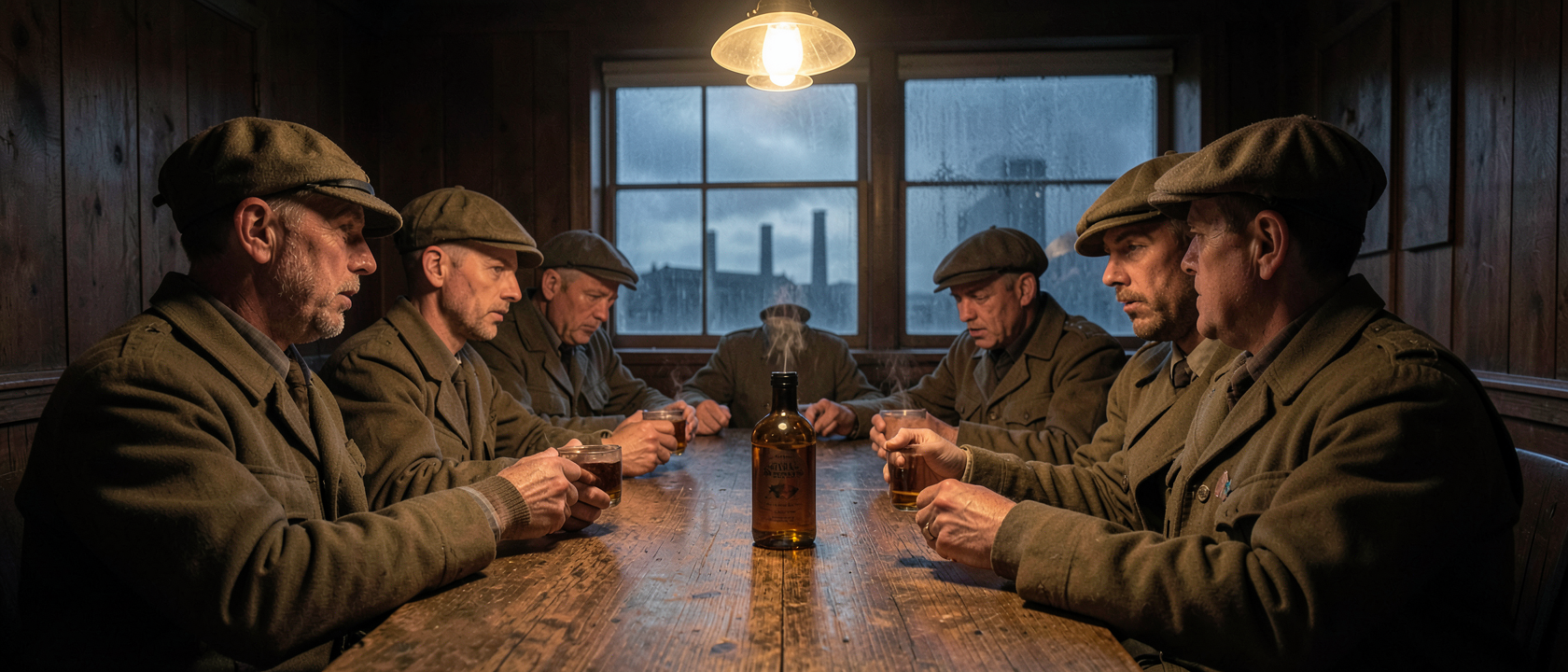
The Burnley Miners’ Working Men’s Social Club on Plumbe Street opened in 1918, as the war ended. Originally operating above a furniture shop under the name Miners’ Prosperity Lodge, it drew its membership from the town’s coal-mining community. The first Bénédictine delivery is documented but disputed between two sources: one records 18 bottles arriving in November 1918, another gives 24 bottles on December 22, 1918, followed by 100 bottles in January 1919. Both accounts agree that further orders followed promptly.
The drink the Burnley Pals carried home was the preparation they had encountered in France: Bénédictine and hot water in equal measure, known in Burnley as the Bene’n’hot. The men who placed those first orders were transplanting a habit formed under rationing and field conditions into a miners’ social club on Plumbe Street.
How the tradition survived across subsequent decades, past the deaths of every veteran who had tasted it in France, is not recorded in any surviving source. What the record shows is the outcome: the Bene’n’hot became a fixture of the club’s culture and held across generations of members who had no personal memory of the war.
A Thousand Bottles a Year
The Burnley Miners’ Working Men’s Social Club orders up to an estimated 1,000 bottles of Bénédictine per year. A typical British bar stocks one or two bottles annually. The liqueur’s manufacturer has confirmed the Plumbe Street club as the largest single on-trade consumer of Bénédictine in the world.
The club formalized the association over time. A dedicated Bénédictine Lounge was established inside the building, carrying historic memorabilia from the drink’s wartime origins. The club also sponsored a guide dog named Béné. The drink’s reach extended beyond Plumbe Street: neighboring East Lancashire towns including Nelson, Colne, Blackburn, and Accrington share the habit, and East Lancashire as a region consumes more Bénédictine than anywhere outside France.
Burnley Football Club, whose supporters overlap substantially with the Miners’ Club’s membership, sells the Bene’n’hot at every home game at Turf Moor. The club, known as the Clarets, was founded on May 18, 1882. A drink whose first documented delivery to Plumbe Street arrived within weeks of the Armistice is now poured at Turf Moor for supporters born more than a century after those first bottles arrived.
What Cannot Be Verified
Three gaps run through this account. Separating them from what is established is necessary.
The 1510 origin rests entirely on Le Grand’s account of the manuscript he found in 1863. No independent medieval record has been produced to confirm Dom Bernardo Vincelli’s formula or his documented connection to Bénédictine. The scholarship has not closed that question.
The chain of transmission inside Burnley is undocumented. How the Bene’n’hot passed from the original Burnley Pals to younger club members who had not served in France, and how it survived across the mid-twentieth century, has not been recorded in any source examined for this account.
What is not in dispute: the Burnley Miners’ Working Men’s Social Club orders up to an estimated 1,000 bottles of a French herbal liqueur per year, its Bénédictine Lounge exists, and the first delivery arrived before the end of 1918. That is the measurable end of the story. The line leading back to a Norman abbey and a monk named Vincelli passes through gaps the surviving record cannot close.