
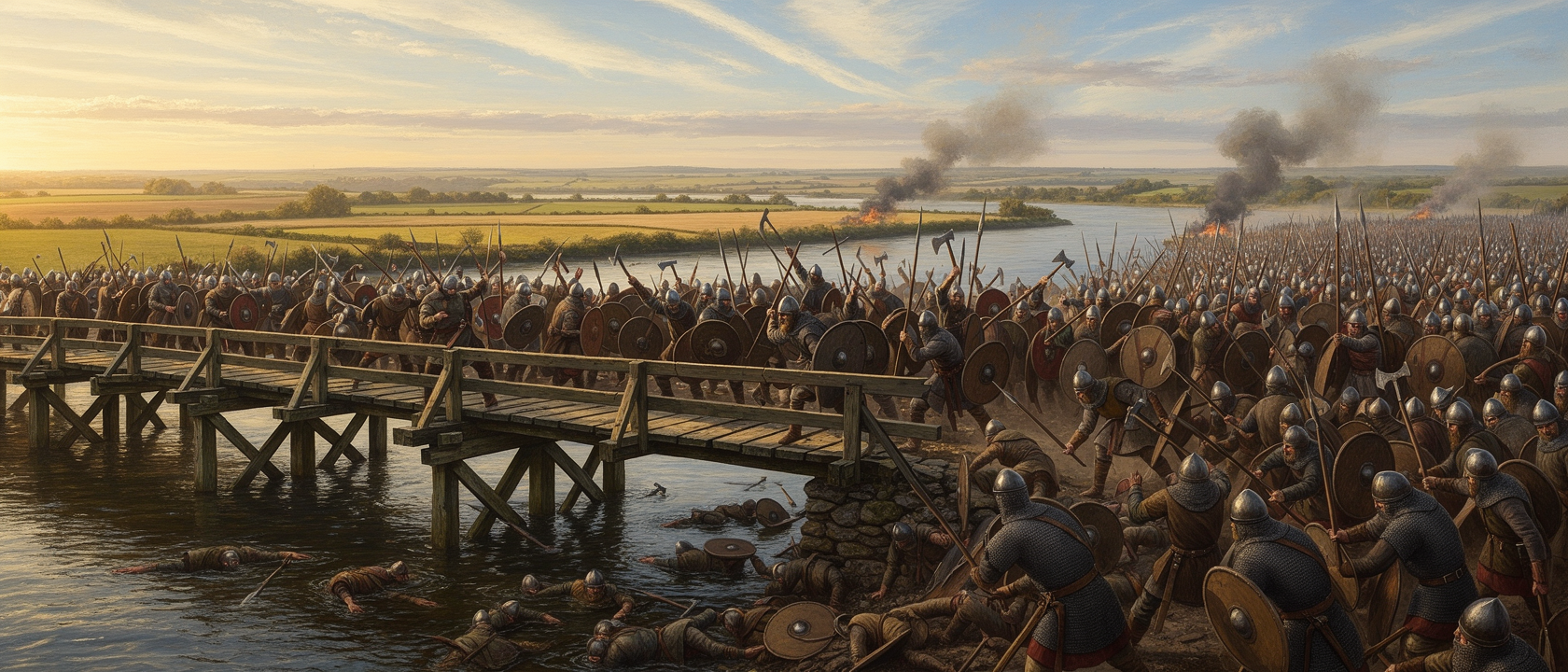
The Banks of the Derwent
September 25, 1066, fell on a Monday. The English army arrived at Stamford Bridge, a crossing on the River Derwent somewhere between 5 and 7 miles (8 to 11 km) east of York, sources differ on the precise figure, and found the Norwegian camp unprepared. According to the Anglo-Saxon Chronicle, many of Harald Hardrada’s men had left their chainmail at the ships, moored further south at Riccall. The English advance gave them no time to retrieve it.
The crossing itself was, by chronicle tradition, held briefly by a single Norwegian warrior before the English forced the bridge. The details of that account carry the marks of legend, and historians treat them accordingly. What is not disputed is the battle that followed: a decisive English victory that ended both an invasion and, in the view of most historians, an era.
A Fragile Succession
To place a Norwegian king by an English river that September, the story begins eight months earlier. King Edward the Confessor died at Westminster on January 5, 1066, leaving no direct heir. Harold Godwinson, Earl of Wessex and the most powerful nobleman in England, was crowned Harold II on January 6, 1066, probably the first English monarch to be crowned at Westminster Abbey.
The crown was immediately contested. Harald Hardrada, King of Norway since 1046, pressed a claim rooted in a treaty made around 1038 between Magnus of Norway and Harthacnut of England and Denmark. The treaty stipulated that if either died without an heir, the survivor would inherit both kingdoms. Harthacnut had died childless in 1042; Hardrada, as Magnus’s successor, argued the claim had passed to him. Historians generally regard this as an indirect and tenuous basis for an invasion, but Hardrada pressed it anyway.
Before becoming king, Hardrada had spent roughly 15 years as a mercenary commander in Kievan Rus’ and as head of the Varangian Guard in the Byzantine Empire. His epithet is drawn from the Old Norse harðráði, variously translated as “hard ruler,” “tyrannical,” or “ruthless.” His fleet, estimated across sources at somewhere between 200 and 360 ships (the figure most often cited is around 300), arrived at the River Tyne on or around September 10, 1066. He did not come alone.
The Northern Campaign
Tostig Godwinson, Harold’s younger brother and the former Earl of Northumbria, had been driven into exile by a Northumbrian revolt in October 1065. The rebels had entered York, killed members of Tostig’s household, looted his treasury, and named Morcar in his place. Tostig accused Harold of fomenting the revolt; Harold denied it. The sources record both claims without settling the question. By November 1, 1065, Tostig had been sent to Flanders.
From April 1066, Tostig raided the English coast. He visited Normandy and approached William, Duke of Normandy. He also traveled to the Danish court of Svein II, though the details of that meeting are recorded in only one source and cannot be independently verified. In the end, Tostig joined Hardrada at the Tyne with approximately 12 ships of his own.
The combined force sailed south, reached the mouth of the Humber on September 18, and landed at Riccall on the River Ouse. On September 20, they met the northern English earls Edwin of Mercia and Morcar of Northumbria at the Battle of Fulford, just south of York, and defeated them. York submitted shortly after.
Harold, still in London, received the news and marched. The exact date he first learned of the landing is not documented; some historians estimate it was as late as September 16. His army covered approximately 185 miles (298 km) north along an old Roman road in roughly four days. By the morning of September 25, they were at Stamford Bridge.
The Cost of Victory
Hardrada died from an arrow through the throat, a detail preserved consistently across the chronicle tradition, including Snorri Sturluson’s Heimskringla (a collection of Norwegian kings’ sagas written in Iceland in the 13th century) and the Anglo-Saxon Chronicle. Tostig Godwinson was also killed on September 25; he was later buried at York Minster.
The surviving Norwegians were permitted to leave. The Anglo-Saxon Chronicle records that they sailed home on 24 ships, drawn from an invading fleet estimated at 300 or more. The army that had crossed the North Sea, which various sources place at between 10,000 and 15,000 men (all figures are estimates), had been reduced to a force that could fit on two dozen vessels.
Viking raids on England had begun around 793, when Lindisfarne was attacked. From that date to September 25, 1066, was approximately 273 years. The “nearly 300 years” description used in many accounts is a reasonable approximation. Hardrada’s was the last large-scale Norse assault on England, and most historians mark Stamford Bridge as the point where that cycle closed, while acknowledging that the end of the Viking Age is not a clean historical boundary so much as a traditional framing.
The Unresolved Record
Two questions in particular remain open. The first is whether Tostig promised Hardrada half of England to secure his support, or whether Hardrada planned the invasion independently and Tostig simply joined it. Some historians suggest Hardrada may not have considered England at all until Tostig pressed him in 1066. The sources do not resolve this; both readings have defenders.
The second concerns timing. The exact date Harold learned of the Norwegian landing is not documented. Some historians estimate it was as late as September 16, which would compress the march north even further than the roughly four-day estimate already implies.
The victory at Stamford Bridge left Harold’s army depleted. William of Normandy’s fleet landed at Pevensey on the Sussex coast on September 28, three days after the battle. Harold turned south. On October 14, 1066, nineteen days after Stamford Bridge, he was defeated and killed at Hastings. The bill for the northern campaign came due almost at once, though not at the river where it had been won.