
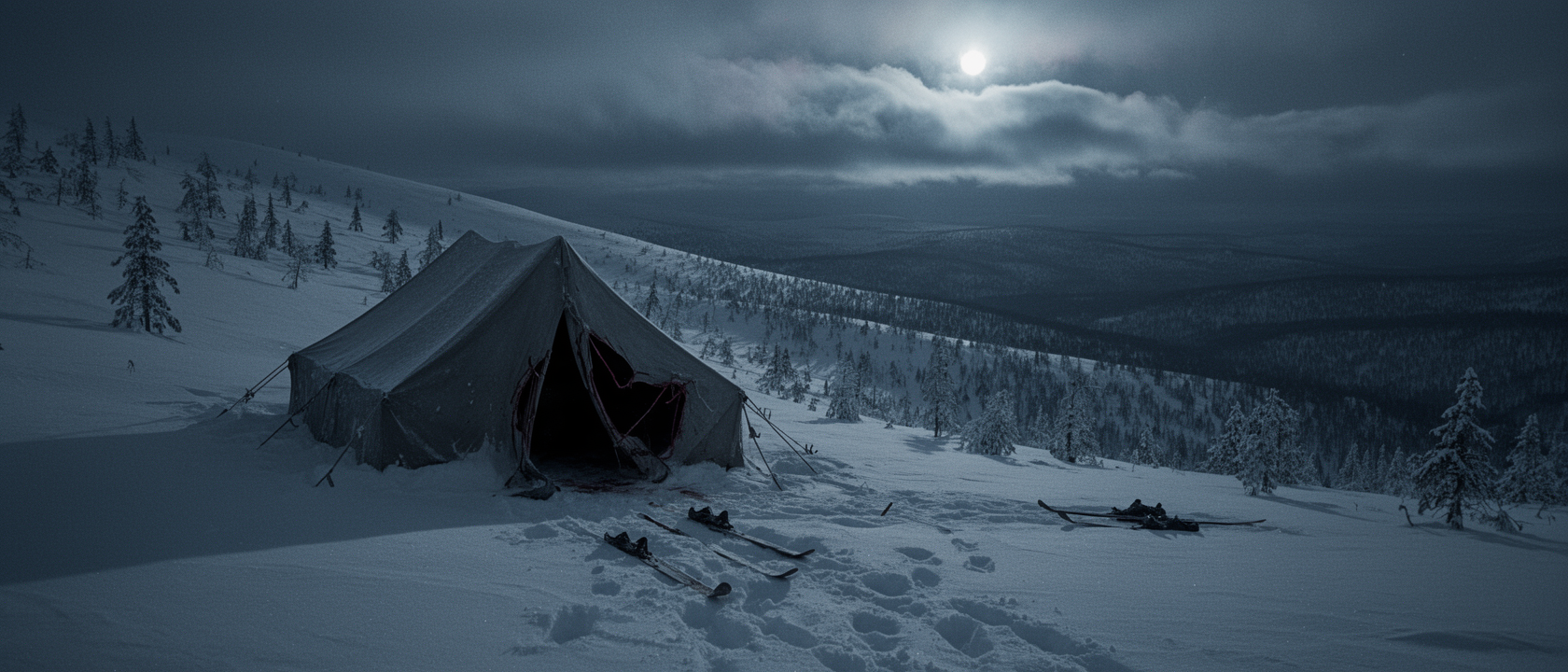
The Slope of Kholat Syakhl
On February 26, 1959, a search party in the northern Ural Mountains found an abandoned tent on the eastern slope of Kholat Syakhl, cut open from the inside. Footprints led away downhill toward a tree line roughly 1 mile (1.6 km) away.
The group that pitched that tent consisted of nine students and graduates of the Ural Polytechnical Institute in Sverdlovsk. They had left on January 23, 1959, on a Category III skiing expedition, the highest difficulty rating available, aiming to cover about 190 miles (305 km) across the northern Urals and reach the summit of Gora Otorten. A tenth member, Yuri Yudin, turned back on January 28 due to illness. The other nine pressed on.
The first two bodies were found near a cedar tree, over a mile from the tent, wearing almost nothing. The remaining bodies were recovered across the slope over the following months, the last four after the snow melted in May. Autopsies recorded six deaths from hypothermia, two from blunt chest trauma, and one from a fractured skull. The chest injuries were severe enough that the force required was considered inconsistent with a simple fall. Temperatures had dropped as low as −40 °F (−40 °C). None of the nine had adequate clothing when they died.
The expedition’s leader was Igor Alekseyevich Dyatlov, 23 years old. The mountain pass near the site now carries his name.
The Architecture of Rumor
The Soviet investigation concluded in May 1959. Its verdict was brief: the nine had been killed by “a compelling natural force.” No elaboration followed, and the area was closed to hikers for three years.
More than 75 theories have been proposed since: a Yeti attack, KGB or CIA involvement, conflict with the Indigenous Mansi people, infrasound effects, alien abduction, and radiation from covert weapons tests. The radiation theory gained some traction when investigators found traces of radioactivity on some of the hikers’ clothing. One explanation noted by researchers is that two hikers had prior connections to the zone affected by the 1957 Kyshtym nuclear disaster, though this remains disputed. A brief, opaque verdict from a closed Soviet investigation gave the story the shape of a cover-up whether or not one existed.
In February 2019, the Russian Prosecutor General’s Office formally reopened the case and announced a conclusion: a small slab avalanche. A second federal investigation in 2020 reached the same finding. Neither announcement ended the public debate.
A Calculated Conclusion
On January 28, 2021, professors Johan Gaume of EPFL (Switzerland) and Alexander Puzrin of ETH Zurich published a study in Communications Earth & Environment. Using computational models of the slope and snowpack, they concluded that a delayed slab release, detaching hours after the hikers undercut the snowpack by pitching their tent, could strike sleeping bodies with enough force to produce the documented injuries, and that darkness and extreme cold would explain why the group cut their way out and ran downhill without stopping to dress.
Three subsequent expeditions examined the site. During a January 2022 visit, researchers observed two fresh slab avalanches under conditions similar to those of February 1959, concluding that the area is clearly prone to that category of event.
The core objection has remained consistent: the slope angle at the campsite sits below the range typically associated with slab release, and observers in late February 1959 recorded no visible avalanche debris. The Gaume-Puzrin study addressed both points through modeling; a segment of researchers found that modeling insufficient to override the physical record.
The Final Tally
The nine who died on the night of February 1–2, 1959, were Igor Dyatlov, Yuri Doroshenko, Lyudmila Dubinina, Yuri Krivonischenko, Alexander Kolevatov, Zinaida Kolmogorova, Rustem Slobodin, Nikolai Thibeaux-Brignolles, and Semyon Zolotaryov. Dubinina was 20; Zolotaryov, at 37 or 38, was the oldest by a considerable margin and had joined as a late addition. The others ranged from 21 to 24.
The case reached a fresh wave of readers in November 2023, when The Atlas Obscura Podcast devoted a two-part series to it, with journalist Douglas Preston, who writes for The New Yorker, National Geographic, and Smithsonian, as the featured voice. Preston’s collection The Lost Tomb: And Other Real-Life Stories of Bones, Burials, and Murder, published by Grand Central Publishing on December 5, 2023, placed the case alongside other forensic accounts. The book was named Amazon’s History Book of the Month for December 2023 and reached the New York Times bestseller list.
The Persistent Gap
The slab avalanche conclusion now has backing from two Russian federal investigations and a peer-reviewed study from Swiss institutions. That combination has not produced agreement. The slope angle question remains unresolved, and the absence of avalanche debris in the 1959 scene photographs is still disputed. The gap between “officially concluded” and “generally accepted” is real, and it has not closed.
Nine people entered the Ural Mountains in the winter of 1959 and never returned. The Soviet state provided a three-word verdict and shut the file. Sixty-seven years on, the case keeps returning to public attention, not because the evidence has changed, but because the original record was too thin to carry the weight of what happened on that slope.