
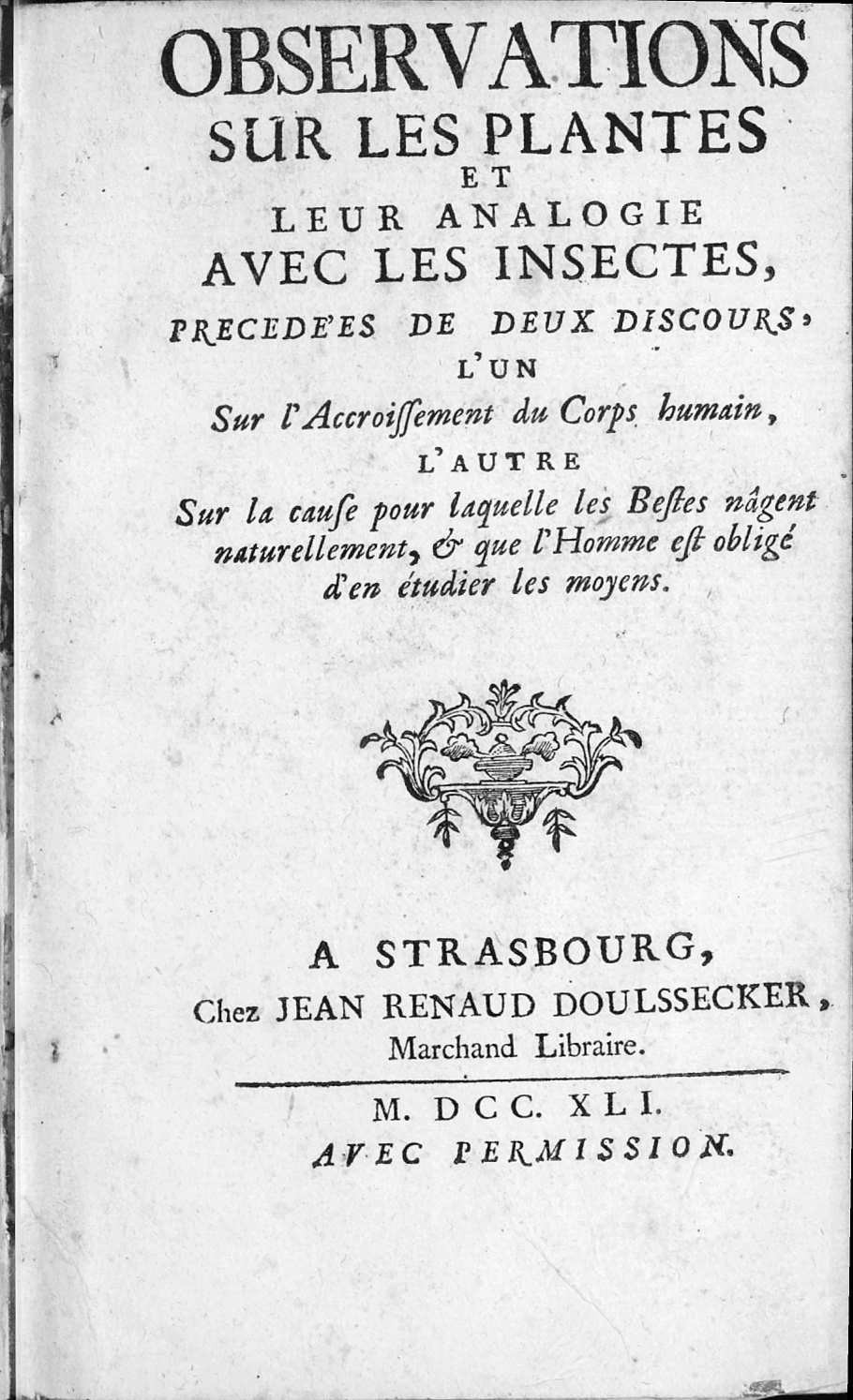
Gilles-Augustin Bazin (1681–4 June 1754) was a French physician, naturalist, entomologist, and biologist, born in Paris and long settled in Strasbourg, where he practised medicine and pursued natural history in the orbit of René-Antoine Ferchault de Réaumur. He produced six volumes of popular natural history in dialogue form, participated in foundational biological debates of the eighteenth century, and held simultaneous roles as librarian, civil administrator, and scientific correspondent. A 1967 scholarly article described him as a mind of encyclopedic range who left minute observations across a wide variety of scientific fields, a reputation almost entirely eclipsed by his habit of publishing anonymously.
Key facts
- Born: 1681
- Birthplace: Paris
- Died: 4 June 1754
- Place of death: Strasbourg
- Country: France
- Occupation: physician; naturalist; entomologist; biologist
Early life and formation
Born in Paris in 1681, Bazin studied medicine at the University of Strasbourg, the city where he would spend the greater part of his adult life and where he died on 4 June 1754. His medical training at Strasbourg was supplemented by a course of lectures on human anatomy at the university, which he undertook specifically to sharpen the dissection skills he needed for insect research, an unusual cross-application that illustrates how closely his medical and natural-history pursuits were intertwined.
Before establishing himself permanently in Strasbourg, Bazin lived for a period at Réaumur’s country estate in Poitou. There he observed, collected, and described insects, sending larvae, caterpillars, eggs, cocoons, and butterflies to Paris. He was also a capable draughtsman, and he kept up a steady flow of letters, specimens, and drawings from Poitou to Réaumur’s circle in the capital.
Roles and institutional positions
In Strasbourg, Bazin earned his living as a practising physician while holding two additional posts of quite different character. He served as librarian to Cardinal Armand-Gaston de Rohan at the cardinal’s palace in Strasbourg. Réaumur noted in his published works that Bazin also held the administrative post of Controller at the salt depot (grenier à sel) in Paris, suggesting that some of his responsibilities extended beyond Alsace.
His standing in the learned world was formalised on 11 December 1737, when he was officially named a correspondent of the Académie royale des sciences. In 1747 he also became a corresponding member of the Académie des belles-lettres, sciences et arts de La Rochelle.
Published works
Bazin’s first major publication appeared in Strasbourg in 1737: the Traité sur l’acier d’Alsace, ou l’art de convertir le fer de fonte en acier, printed by Jean Renaud Doulssecker. The work addressed Alsatian steel-making and included a partial French translation of Emanuel Swedenborg’s treatise on converting iron into steel.
In 1741 Doulssecker printed Bazin’s Observations sur les plantes et leur analogie avec les insectes (134 pages), the work considered his most highly esteemed. Its preface offered an explicit defence of scientific conjecture as a legitimate tool of inquiry. Two years later, in 1743, he published the Traité sur l’accroissement des plantes, and in 1745 a Lettre au sujet des animaux appelés polypes, entering the widely followed debate on freshwater polyps that Abraham Trembley’s discoveries had ignited.
His most ambitious project, the Histoire naturelle des abeilles and its sequel, the Abrégé de l’histoire des insectes, pour servir de suite à l’Histoire naturelle des abeilles, together comprised six volumes. The Abrégé, published in Paris by the Guérin brothers between 1747 and 1751 in four volumes, was structured as 31 conversations or letters among three fictional characters: Eugène, Clarice, and Hortense. The format was deliberately pedagogical, aimed especially at young women. The four volumes of the Abrégé were illustrated with 53 folding engraved plates, produced by the engravers Weiss and Striedbeck. Both major natural history works were published anonymously.
Scientific engagement and debates
As a correspondent of Réaumur, Bazin was drawn into the period’s most contested biological questions. He participated in the debates on the preexistence of germs, a controversy that sat at the foundation of eighteenth-century biology and divided naturalists across Europe.
His 1745 letter on polyps placed him within the broader discussion that followed Trembley’s discoveries about the regenerative capacities of freshwater polyps, a topic that attracted attention from physicians and philosophers alike. Bazin’s principal natural history works were praised in a 1967 article in the Revue d’histoire des sciences as reflecting a truly encyclopedic mind that produced minute observations across a wide variety of scientific fields. That same article noted that his name had fallen into almost complete obscurity, characterising him as a faithful friend and correspondent of Réaumur.
His scholarship attracted the notice of Jean Hermann (1738–1800), the naturalist and professor at the University of Strasbourg, who owned copies of Bazin’s works, a detail that places Bazin within the reading habits of Strasbourg’s most prominent late-eighteenth-century naturalist.
Legacy and reception
Bazin’s decision to publish anonymously complicated later attribution. His authorship of the Abrégé de l’histoire des insectes was established only through the work of Antoine-Alexandre Barbier, the French bibliographer who specialised in identifying anonymous publications. Without Barbier’s identification, Bazin’s contribution to the popularisation of entomology would have remained entirely unassigned.
Copies of the Abrégé survive in institutional collections. The Lloyd Library and Museum in Cincinnati, Ohio, holds a copy of the Paris 1747–1751 edition, which includes depictions of cicadas alongside many other insects, reflecting the breadth of species the work covered. The Traité sur l’acier d’Alsace, meanwhile, left a small footprint in the history of metallurgical translation by carrying Swedenborg’s iron-and-steel ideas into French print.
Did you know
- Bazin published both his major natural history works anonymously. The Abrégé de l’histoire des insectes was attributed to him only after the fact, “d’après Barbier” — a reference to the French bibliographer Antoine-Alexandre Barbier, who made a specialty of identifying the authors behind anonymous publications. (archive.org)
- Bazin’s Traité sur l’acier d’Alsace of 1737 contained a partial French translation of the Swedish scientist Emanuel Swedenborg’s treatise on converting crude iron into steel, making Bazin one of the early French transmitters of Swedenborg’s metallurgical ideas. (librairiejumentverte.com)
- The Lloyd Library and Museum in Cincinnati, Ohio, holds a copy of Bazin’s Abrégé de l’histoire des insectes (Paris, 1747–1751). The copy includes depictions of cicadas among many other insects, illustrating the breadth of entomological coverage across the work’s four volumes. (lloydlibrary.org)
Data sources
- Wikidata
- alsace-histoire.org
- dokumen.pub
- persee.fr
- cths.fr
- librairiejumentverte.com
- ader-paris.fr
- alde.fr
Where it appears
- Réaumur’s Bug Mail: How 1730s France Shipped Insects for Free October 29, 2026
Data updated: 2026-10-27