
A Parcel From a Lawyer
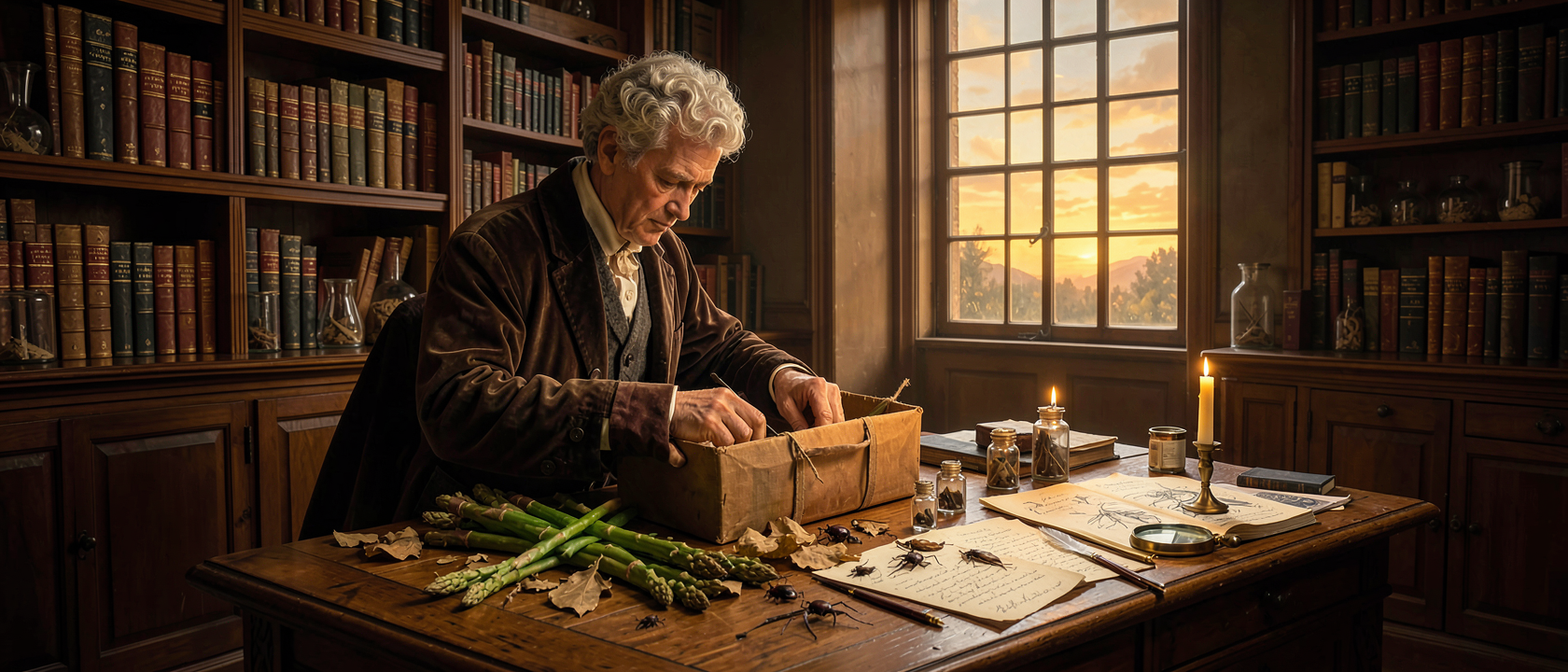
According to Terrall’s research, as reported by JSTOR Daily, Ferchault de Réaumur once unwrapped a package that had traveled up from the provinces to his rooms in Paris, likely around 1733. Inside were a few stalks of asparagus, some loose leaves, and, tucked among the greenery, the beetles and bugs in various stages of growth that he had specifically asked for. The parcel came from Gilles-Augustin Bazin, a lawyer and friend who sent him specimens more than once over the years. (Some later biographical dictionaries describe Bazin as a doctor; the historian Mary Terrall, working through the surviving letters, found nothing in the archive to support that, though she notes he did attend a course of anatomy lectures in Strasbourg later in life.)
By then Réaumur had belonged to the French Academy of Sciences since 1708, a quarter century before this particular box arrived, and he was gathering material for his multi-volume Mémoires pour servir à l’histoire des insectes (“Memoirs Serving as a Natural History of Insects”), the first volume of which appeared in 1734. The parcel from Bazin was not the start of anything new. It was proof that a working delivery system between Paris and the provinces already existed, and that Réaumur had simply started feeding it insects.
Free Postage, No Questions Asked
According to Terrall’s research, none of it would have moved so fast, or so cheaply, without one piece of institutional goodwill. The Postmaster General of France was himself interested in science, and under his arrangement, packages like Bazin’s traveled through the royal mail quickly and without charge. No name or further confirmation of this arrangement survives beyond that account, but if it holds, it explains a great deal. Réaumur did not need to vet his senders or ask for credentials. He could simply ask, in effect, for insects, dead or alive, and a lawyer, a nobleman, or an unnamed peasant could feed something into the same system that carried the king’s own correspondence, at no cost to anyone.
The Chain Down to Provence
Not every correspondent was a single friend posting the occasional box of beetles. In Provence, in the south of France, Réaumur built a steadier exchange with Joseph de Seytres, marquis de Caumont, documented in letters held in the Fonds Trembley archive in Geneva. Caumont was a nobleman, and he did not go out collecting anything himself. He relied, per Terrall’s account, on a retired local man, known in the correspondence only as “M Alphons” (Monsieur Alphons), based in a small Provençal town. Alphons, in turn, did not hunt cicadas and beetles alone either. He enlisted peasants from the area, people who knew the fields, the trees, and the seasons better than Caumont or Réaumur ever would, and who did the actual digging and catching the work required.
A Basket of Soil
One episode from this Provence line, as Terrall’s account relates it, survives in enough detail to picture clearly. A peasant brought Alphons a basket, not of insects but of plain soil, packed with cicada nymphs still buried inside it. Digging the nymphs out himself risked crushing them, so Alphons did not try. He sent the whole basket to Caumont exactly as it was, dirt and all. Caumont freed the nymphs, packed them for the road north, and forwarded them to Réaumur in Paris along with Alphons’s letter explaining where they had come from.
Instructions Back Down the Line
Réaumur answered with method rather than compliments. He explained how to pack live insects with enough food to survive the journey, and, when that was not possible, how to kill them properly and store them in diluted alcohol so they would hold their shape for later study. In a letter to Caumont dated November 17, 1736, he laid out the mixture in plain terms: a bottle of spirits of wine, a strong distilled alcohol, cut by roughly a quarter with ordinary water, enough to hold four or five specimens of whatever turned up, caterpillars, beetles, flies. Butterflies, he noted, would not survive it. Caumont sent the same basket back down the chain to Alphons, now loaded with jars, alcohol, and the written instructions needed to do the job properly the next time.
The Cicada Sings Again
The payoff, by Terrall’s account as reported by JSTOR Daily, came months later. A cicada that had been dead since summer, kept all that time in its bottle of alcohol, still had something to give once it reached Réaumur’s desk. He worked a pin into one of its muscles, and the dead insect reportedly produced its song again. Terrall’s account suggests Réaumur saw this as a demonstration no live specimen could offer him: a cicada too alert and too quick to let a naturalist probe its machinery while it was still breathing. If the story holds, a single insect had traveled from a Provençal field, into a basket of soil, into a jar of spirits of wine, passed through at least four pairs of hands, and ended by making a sound again on a desk in Paris.
What the Letters Don’t Say
The record has real gaps. Nothing in what survives states how many packages like Bazin’s or Caumont’s actually reached Réaumur over the years, how many correspondents fed the network at its height, or how many specimens arrived alive rather than dead on arrival. There is no tally of what Réaumur ultimately published from this particular traffic, only the fact that his insect studies began appearing in print in 1734 and continued for years afterward. And the phrase used to describe all of this, “citizen science,” is Mary Terrall’s own term, a label she applied in her research to make sense of a system that Réaumur, Caumont, Alphons, and the Provençal peasants never named or organized around any shared idea of themselves.
Whose Name Survived
What is clear, in the parts of the record that are documented, is who ended up with a name attached to the work, and who did not. Réaumur is remembered; his insect studies still carry his name. Bazin is remembered, at least well enough that his letters are cataloged individually, with dated correspondence surviving from as late as 1738. Caumont is remembered as the correspondent in Provence, his exchanges with Réaumur preserved across several dated letters. Even Alphons survived into the record, if only as a shortened name in someone else’s letters, per Terrall’s account. The peasants who actually crawled through the dirt, found the cicada nymphs, and judged which basket of soil was worth sending north left no names anywhere in what has come down to us. Terrall’s own framing points to exactly this imbalance: a system that depended on local, largely anonymous labor while recording only the names of the men who corresponded by letter.
Three names survive from this one Provence line: Bazin the lawyer, Caumont the marquis, Alphons the retired go-between. The people who found the nymphs in the dirt did not need their names recorded for the system to work, and nobody recorded them anyway.