
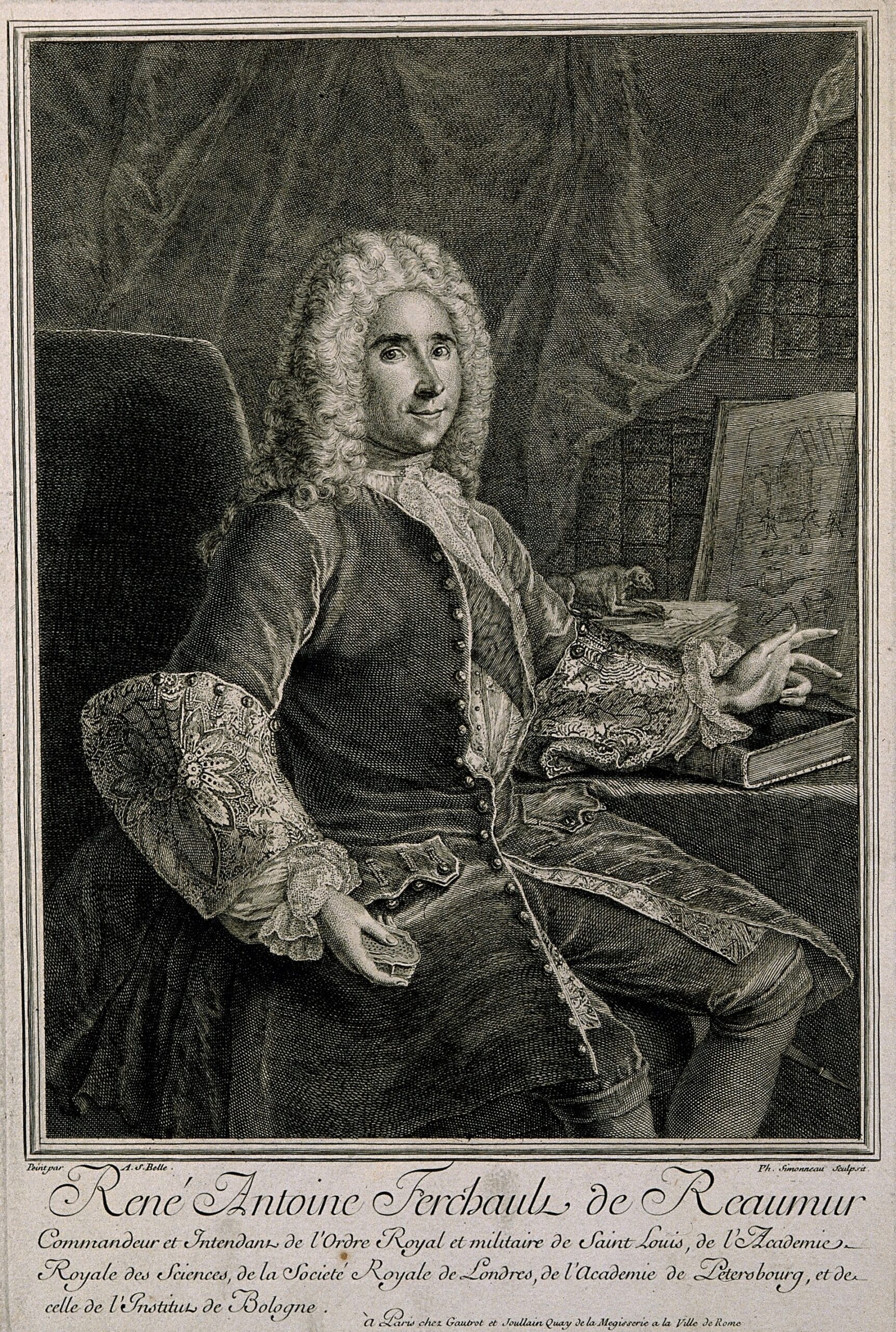
René Antoine Ferchault de Réaumur was born on 28 February 1683 in La Rochelle and died on 17 October 1757, leaving behind a body of work that stretched from geometry and metallurgy to entomology and animal behaviour. Few French scholars of the eighteenth century worked across as many fields with such documentary rigour; his papers alone, bequeathed to the Académie des Sciences, filled 138 portfolios. His first published paper, in 1708, addressed a problem in geometry; his last, in 1756, examined the architecture of birds’ nests. Between those two dates he transformed the French steel industry, proposed wood-pulp paper a century before anyone built a mill to make it, and produced six illustrated volumes on insects that shaped the science of entomology for generations.
Key facts
- Born: 28 February 1683
- Birthplace: La Rochelle
- Died: 17 October 1757
- Place of death: Château de La Bermondière
- Country: Kingdom of France
- Occupation: entomologist; physicist; mathematician; meteorologist
- Field: entomology; philosophy; law; mathematics
- Education: University of Bourges
- Awards: Fellow of the Royal Society; Order of Saint Louis
Education and early career
In 1699, at barely seventeen, Réaumur was sent by his uncle, a canon of La Sainte-Chapelle, to Bourges to study civil law and mathematics at the University of Bourges. He went on to study philosophy at the Jesuits’ college at Poitiers before moving to Paris in 1703, where he concentrated on mathematics and physics. That trajectory, from law to natural philosophy, defined the breadth that marked his later career.
By 1710, his reputation was already sufficient for the French government to name him chief editor of the Descriptions of the Arts and Trades, a major project aimed at the establishment of manufactures new to France and the revival of neglected industries. He held that editorial post for the rest of his working life, and the work it demanded pushed him directly into metallurgical research.
Metallurgy and industrial science
Réaumur’s contribution to metallurgy was systematic rather than accidental. In 1720, he discovered that iron castings too hard to be worked could be softened by packing them into iron ore or hammer slag and subjecting them to high temperatures over a number of days. That process, which produced what we now call malleable iron, gave French foundries a practical route to material they had previously been unable to machine or shape.
His 1722 treatise, L’Art de convertir le fer forgé en acier, published in Paris by Michel Brunet, laid out the results of twelve years of metallurgical study and provided the first scientific foundations for the French steel industry. For his discoveries regarding iron and steel, Regent Orleans awarded Réaumur a pension of 12,000 livres. He declined to keep the money personally and instead requested that it be secured to the Académie des Sciences to fund further experiments on improved industrial processes.
Entomology and the study of animal behaviour
Réaumur devoted sustained attention to insects, producing Mémoires pour servir à l’histoire des insectes, published in six volumes by the Imprimerie Royale in Paris between 1734 and 1742. Systematic in method and precise in illustration, the work is considered one of the foundational texts of eighteenth-century entomology. His approach went beyond classification: he recorded how insects built structures, cared for offspring, and interacted with their environments. For that sustained attention to animal behaviour as a subject of scientific study, he has been considered a founder of ethology.
The six-volume set contained 267 folding engraved plates and was originally conceived on a larger scale; Réaumur had planned ten volumes, but only six were completed before his death in 1757.
Administrative roles and honours
In 1735, for family reasons, Réaumur accepted the post of commander and intendant of the royal and military Order of Saint Louis. He carried out those duties with close attention but, as with the pension from Regent Orleans, declined to receive any of the associated emoluments. He was also elected a Fellow of the Royal Society, recognition from outside France of work that had reached audiences well beyond the Académie des Sciences.
Death and legacy
On 17 October 1757, Réaumur was returning from Mass near the village of La Bertaudière, close to his Château de La Bermondière in Saint-Julien-du-Terroux, when he fell from his horse and sustained injuries from which he died.
His manuscripts, filling 138 portfolios, and his natural history collections passed to the Académie des Sciences as he had directed. His scientific papers span nearly every branch of natural science pursued in his era: geometry, metallurgy, entomology, ornithology, meteorology, and more. The first paper, in 1708, concerned geometry; the last, submitted in 1756, described the forms of birds’ nests.
Did you know
- In 1719, after observing North American paper wasps chewing wood fibers to construct their nests, Réaumur proposed that paper could be made from wood rather than rags. The idea took more than a century to become industrial practice. (engines.egr.uh.edu)
- In 1710, Réaumur wrote a paper on the possibility of producing silk from spiders. The paper attracted such attention that the Kangxi Emperor of China had it translated into Chinese. (en.wikisource.org)
- Réaumur’s six-volume Mémoires pour servir à l’histoire des insectes contained 267 folding engraved plates. The work was originally planned in ten volumes, but only six were completed before his death in 1757. (abebooks.com)
Data sources
- Wikidata
- 1902encyclopedia.com
- todayinsci.com
- ebsco.com
- metallurgyfordummies.com
- abebooks.co.uk
- grokipedia.com
- en.wikisource.org
Where it appears
- Réaumur’s Bug Mail: How 1730s France Shipped Insects for Free October 29, 2026
Data updated: 2026-10-27