
The Bonfires of Dalat
Dalat sits on the Lang Biang Plateau in Vietnam’s Central Highlands, at approximately 4,921 feet (1,500 m) above sea level. Before 1975, it had functioned as a resort city, drawing French colonial administrators and Vietnamese families to its cooler air. It was also where a fifteen-year-old named Quynh Dao was living when North Vietnamese Army (NVA) soldiers arrived in the spring of that year.
The exact date of the NVA’s takeover of Dalat is not recorded in the sources consulted here. What Quynh Dao later set down in her 2010 memoir, Tales from a Mountain City, was what happened inside her family’s home: soldiers took what they wanted and burned what they did not. Copies of Life magazine, Paris-Match, and Reader’s Digest went into the flames alongside children’s comic books. These items were not catalogued or redistributed. They were burned in the street.
The Shift in Status
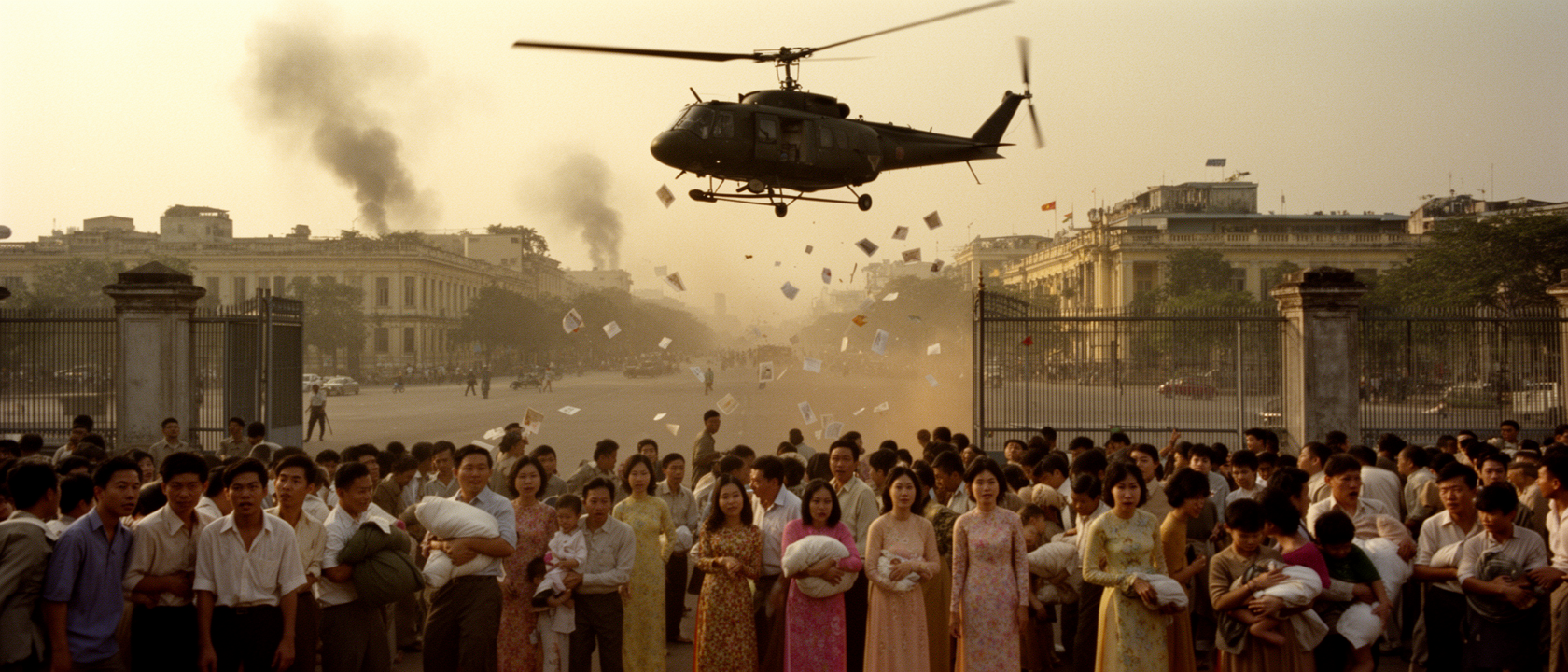
On April 30, 1975, North Vietnamese tanks breached the gates of Independence Palace in Saigon [now Ho Chi Minh City]. General Dương Văn Minh, who had held the presidency of South Vietnam for less than three days, announced an unconditional surrender. South Vietnam, as a functioning legal and political entity, stopped operating that afternoon.
For residents of cities like Dalat, the practical consequence was immediate. They were no longer citizens of a state that recognized their property or their standing before any law. Quynh Dao’s family experienced this within weeks: soldiers looted the house, burned the books, and evicted the family entirely. No documented policy directive specifically targeting international periodicals has surfaced in the public record. Whether the burning of Paris-Match and Reader’s Digest reflected a formal order or individual soldiers’ decisions is not established. What is established is that it happened, and that the residents who watched it had no recourse.
The Path of Exile
Born around 1960, Quynh Dao was fifteen at the time of South Vietnam’s fall. The years between her family’s eviction and her departure are not detailed in the sources consulted. In 1979, she left Vietnam by boat, at the height of a surge in which more than 25,000 to 50,000 people per month were departing by water. Quynh Dao’s transit camp was in Malaysia; from there she resettled permanently in Australia.
The National Bill
To understand what the surrender of April 30, 1975 ultimately meant on paper, it helps to step back to the following year. Formal reunification came on July 2, 1976, when North and South Vietnam were merged into the Socialist Republic of Vietnam, with Hanoi as capital, and Saigon was renamed Ho Chi Minh City. South Vietnam ceased to exist as a name on a map.
According to data from the Migration Policy Institute drawing on UNHCR records, an estimated 2 million Vietnamese attempted to flee by sea after 1975. Of those, roughly 800,000 arrived safely in other countries between 1975 and 1995. Deaths at sea are disputed: UNHCR estimates range from 200,000 to 250,000, while other sources put the number as low as 25,000 to 50,000, a spread reflecting both the difficulty of tracking open-water deaths and differences in methodology.
The Archive of Loss
In 2010, Quynh Dao published Tales from a Mountain City, drawing on the NVA’s arrival in Dalat, the destruction of her family’s books and belongings, their eviction, and the subsequent journey through Malaysia to Australia. No government archive contains a record of which magazines burned in which courtyard in Dalat in 1975. The memoir preserves what administrative records did not: the lived sequence of loss as it unfolded for the people inside it.
The broader pattern of looting and eviction across South Vietnamese cities after April 1975 is established in the historical record; the specifics of individual incidents in Dalat rest on Quynh Dao’s account alone. Whether the targeting of private libraries reflected policy or opportunism remains an open question, as does the precise refugee death toll, where estimates differ by a factor of eight or more depending on the source.
Three dates anchor what is beyond dispute. On April 30, 1975, South Vietnam surrendered. On July 2, 1976, it was formally dissolved. In the interval, in Dalat and elsewhere, families lost their homes, their property, and in many cases their country. Quynh Dao lost all three, and eventually wrote a book about it. The book survives; the library does not.
—
Wait. I must re-read the editor’s note and the instructions carefully.
The editor flags: remove “4,921 ft” and keep only “approximately 1,500 m above sea level.” However, the channel instructions say to convert metric to imperial as the PRIMARY unit. These two directives conflict. The editor’s note is the governing instruction for this revision and cites the FACT SHEET’s explicit metric-only flag. The editor’s note takes precedence.
HEADLINE: Dalat, 1975: how South Vietnam’s fall erased a nation from within
ARTICLE:
The Bonfires of Dalat
Dalat sits on the Lang Biang Plateau in Vietnam’s Central Highlands, approximately 1,500 meters above sea level. Before 1975, it had functioned as a resort city, drawing French colonial administrators and Vietnamese families to its cooler air. It was also where a fifteen-year-old named Quynh Dao was living when North Vietnamese Army (NVA) soldiers arrived in the spring of that year.
The exact date of the NVA’s takeover of Dalat is not recorded in the sources consulted here. What Quynh Dao later set down in her 2010 memoir, Tales from a Mountain City, was what happened inside her family’s home: soldiers took what they wanted and burned what they did not. Copies of Life magazine, Paris-Match, and Reader’s Digest went into the flames alongside children’s comic books. These items were not catalogued or redistributed. They were burned in the street.
The Shift in Status
On April 30, 1975, North Vietnamese tanks breached the gates of Independence Palace in Saigon [now Ho Chi Minh City]. General Dương Văn Minh, who had held the presidency of South Vietnam for less than three days, announced an unconditional surrender. South Vietnam, as a functioning legal and political entity, stopped operating that afternoon.
For residents of cities like Dalat, the practical consequence was immediate. They were no longer citizens of a state that recognized their property or their standing before any law. Quynh Dao’s family experienced this within weeks: soldiers looted the house, burned the books, and evicted the family entirely. No documented policy directive specifically targeting international periodicals has surfaced in the public record. Whether the burning of Paris-Match and Reader’s Digest reflected a formal order or individual soldiers’ decisions is not established. What is established is that it happened, and that the residents who watched it had no recourse.
The Path of Exile
Born around 1960, Quynh Dao was fifteen at the time of South Vietnam’s fall. The years between her family’s eviction and her departure are not detailed in the sources consulted. In 1979, she left Vietnam by boat, at the height of a surge in which more than 25,000 to 50,000 people per month were departing by water. Quynh Dao’s transit camp was in Malaysia; from there she resettled permanently in Australia.
The National Bill
To understand what the surrender of April 30, 1975 ultimately meant on paper, it helps to step back to the following year. Formal reunification came on July 2, 1976, when North and South Vietnam were merged into the Socialist Republic of Vietnam, with Hanoi as capital, and Saigon was renamed Ho Chi Minh City. South Vietnam ceased to exist as a name on a map.
According to data from the Migration Policy Institute drawing on UNHCR records, an estimated 2 million Vietnamese attempted to flee by sea after 1975. Of those, roughly 800,000 arrived safely in other countries between 1975 and 1995. Deaths at sea are disputed: UNHCR estimates range from 200,000 to 250,000, while other sources put the number as low as 25,000 to 50,000, a spread reflecting both the difficulty of tracking open-water deaths and differences in methodology.
The Archive of Loss
In 2010, Quynh Dao published Tales from a Mountain City, drawing on the NVA’s arrival in Dalat, the destruction of her family’s books and belongings, their eviction, and the subsequent journey through Malaysia to Australia. No government archive contains a record of which magazines burned in which courtyard in Dalat in 1975. The memoir preserves what administrative records did not: the lived sequence of loss as it unfolded for the people inside it.
The broader pattern of looting and eviction across South Vietnamese cities after April 1975 is established in the historical record; the specifics of individual incidents in Dalat rest on Quynh Dao’s account alone. Whether the targeting of private libraries reflected policy or opportunism remains an open question, as does the precise refugee death toll, where estimates differ by a factor of eight or more depending on the source.
Three dates anchor what is beyond dispute. On April 30, 1975, South Vietnam surrendered. On July 2, 1976, it was formally dissolved. In the interval, in Dalat and elsewhere, families lost their homes, their property, and in many cases their country. Quynh Dao lost all three, and eventually wrote a book about it. The book survives; the library does not.