
A Week’s Invitation
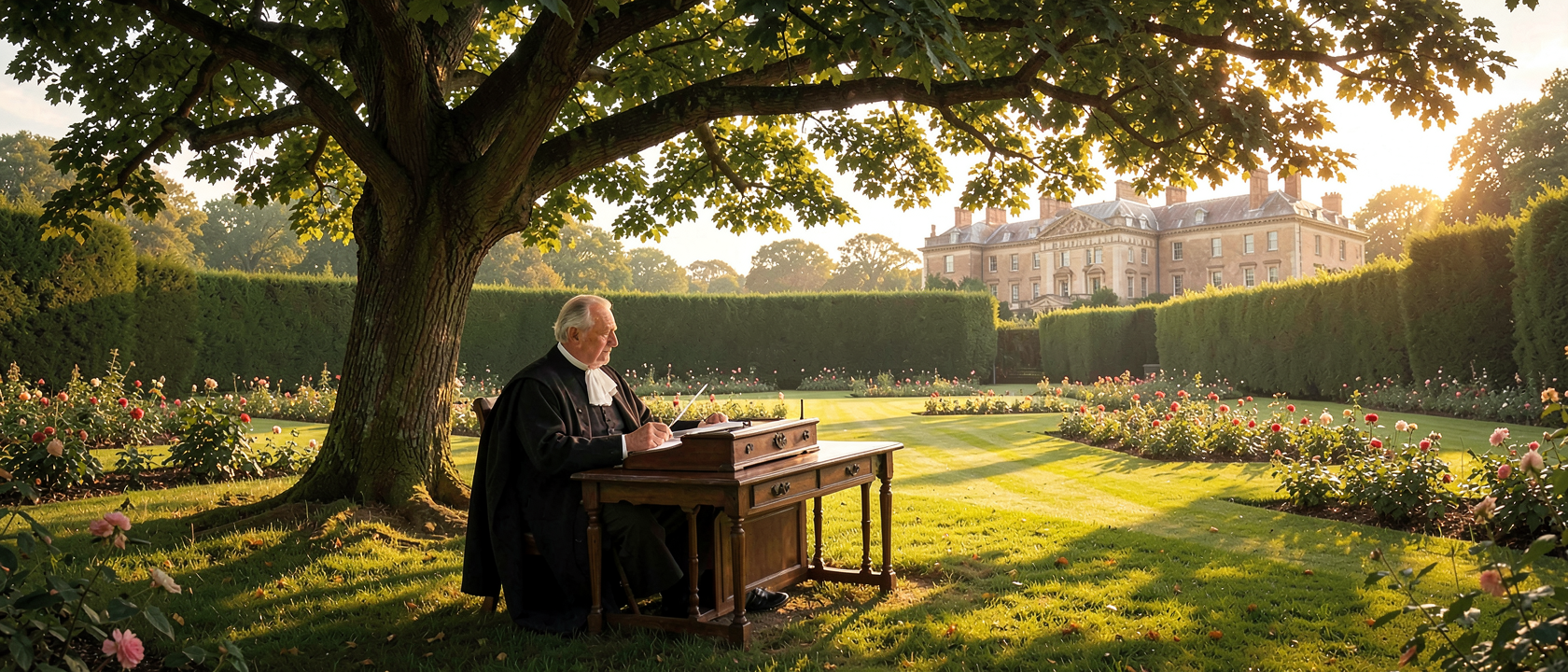
In 1712, Isaac Watts was pastor of a Congregationalist chapel on Mark Lane in the City of London, one of the Dissenting congregations that worshiped outside the Church of England. He was already known in London’s Dissenting circles: his 1707 collection had given the city the hymn “There is a land of pure delight,” and more work was expected of him. That year he traveled to the Hertfordshire home of Sir Thomas Abney, a former Lord Mayor of London and one of the original directors of the Bank of England, meaning to stay a week.
A Body That Couldn’t Keep the Pace
The stay mattered because Watts’s body had stopped matching the demands of his pulpit. In 1712, ill health forced him to give up the pastorate at Mark Lane. The record does not say what was actually wrong with him, only that it was serious enough to end a ministry he had held for years. He had no household of his own to retreat to and no income apart from what his congregation and well-wishers provided. A week at the Abneys’ home was, in that light, ordinary charity toward a sick clergyman. What followed was not.
The Week That Became Thirty-Six Years
The week did not end. It became months, then years, and Watts kept working from inside the Abney household the whole time. In 1715 he published Divine Songs Attempted in Easy Language for the Use of Children, dedicating it from Theobalds on June 18, 1715, to the three Abney daughters, Sarah, Mary, and Elizabeth. In 1719 came his paraphrase of the Psalms, which gave English congregations “Jesus shall reign” and “Our God, our help.” Seven years into a seven-day visit, he was still there, and still writing.
Widowed Household, Same Guest
Sir Thomas Abney died in 1722. Watts did not leave. His widow, Lady Abney, asked him to stay on with her, and he did. Exactly when the household moved to Abney Park in Stoke Newington, outside London, is disputed: one account places it around 1733, another puts it as late as 1736. There Watts spent his remaining years writing theology and philosophy alongside hymns, inside the same arrangement that had started as a week’s favor more than two decades before.
Crossing the Atlantic Before He Could
In 1737, John Wesley published a hymn book for the American colonies. Of its seventy hymns, more than a third were Watts’s. His words had reached across an ocean he never crossed himself. He remained, at that point, a guest in someone else’s house in Middlesex, with no pulpit of his own and no sign that any of this was about to change.
What He Never Had
Isaac Watts was born on July 17, 1674, in Southampton. He never married and never kept a household of his own. He died in Stoke Newington on November 25, 1748, at the age of 74, thirty-six years after a visit that was meant to last seven days. He was buried, as he had asked, at Bunhill Fields, the London burial ground reserved for Dissenters, in the same plot of ground as John Bunyan, George Fox, and Daniel Defoe.
Six Hundred Hymns, Six Hundred Editions
What outlived him is counted in print runs. Watts is credited with an estimated 600 to 750 hymns, putting him alongside Charles Wesley and J.M. Neale among the most prolific hymn writers in English. Divine Songs went through repeated reprintings for more than a century afterward; tallies of just how many editions vary widely depending on the source and the cutoff year, running from roughly a hundred up past a thousand by the mid-1800s. Methodist worship carried his hymns forward from the 1730s, and Anglican evangelicals kept them circulating after that. The children’s verses had lodged deep enough in common memory that Lewis Carroll could parody them and expect readers to catch it, turning “How doth the little busy bee improve each shining hour” into “How doth the little crocodile improve his shining tail.”
Statues for a Man Who Owned No House
Watts is commemorated three times over: a statue in Southampton, his birthplace; an earlier monument by Edward Banks in Westminster Abbey; and a statue by Edward Baily set where Abney House once stood, on ground that was later cleared and reopened in 1840 as Abney Park Cemetery. None of it was property he ever held himself. Two gaps in the record deserve to stay open rather than be smoothed into certainty. One is the claim, often repeated, that Watts had mastered Latin, Greek, French, and Hebrew as a child, each at an improbably young age; it has no independent corroboration beyond the tradition itself, though his schooling in the classical languages at Southampton’s King Edward VI School is well attested. The other is the exact date he first arrived at the Abneys’ household, with one account placing it in 1712 and another in 1713, a gap the record never quite closes.