
The Last Morning
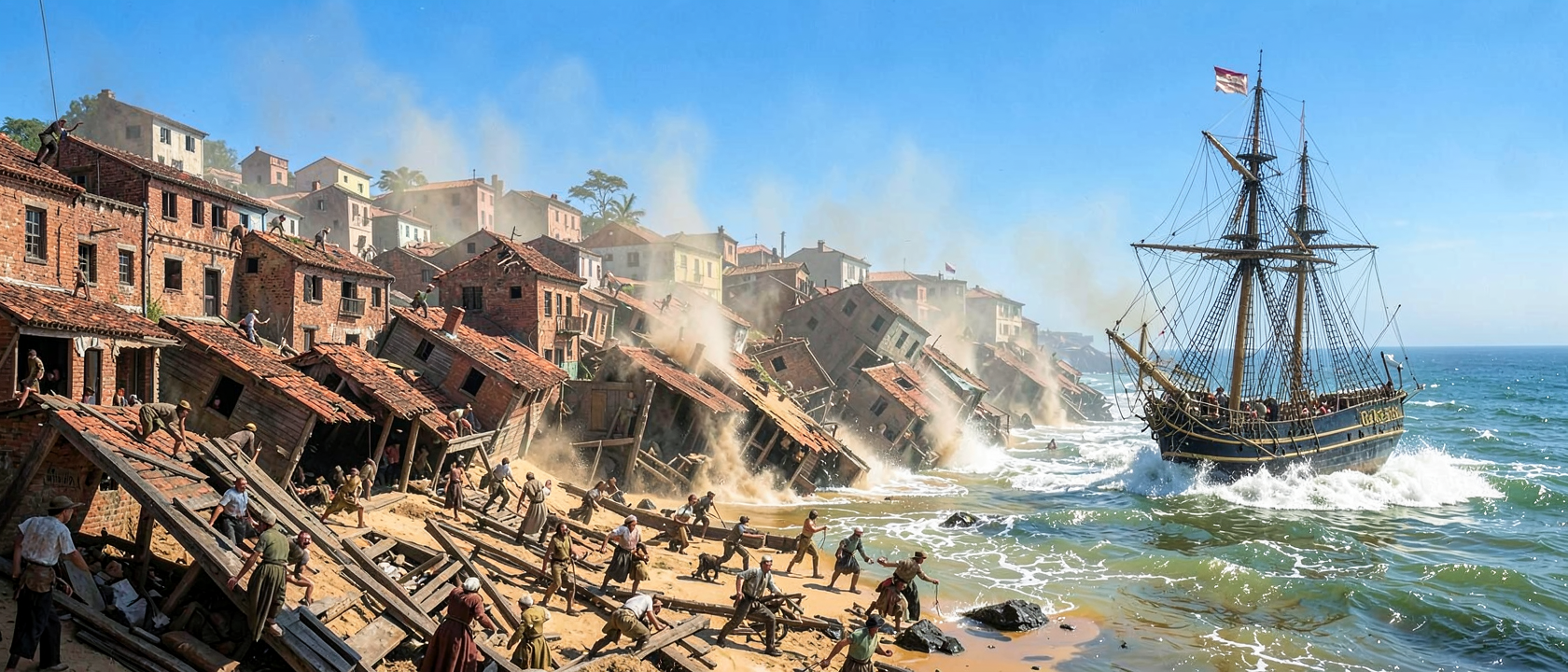
On June 7, 1692, Port Royal was doing what it had done for decades: running a crowded Caribbean waterfront on Jamaica’s southern coast, under British control. Ships rode at anchor in the harbor now called Kingston Harbour, and the town itself stood on a narrow spit of sand, holding an estimated 8,000 residents.
Contemporaries had two names for it. One was admiring, “the storehouse and treasury of the West Indies.” The other was not, “the wickedest city in the world.” Both described the same waterfront, built on money that moved through it, legitimate or not.
In 1959, excavators pulled a pocket watch from the harbor mud. Stopped by the flood, its hands read 11:43 in the morning, as close as the record gets to the moment the ground began to move.
How a Pirate Haven Got Rich
Port Royal existed because Britain built it to exist. Through the second half of the 1600s it served as the common home port for privateers and pirates working the Caribbean, and the city grew wealthy on what moved through its docks. By 1692 it ranked among the busiest and richest ports in the Americas, behind a ring of forts guarding the harbor mouth.
None of that wealth sat on solid ground. The city was built on sand, and nobody at the time treated that as a problem worth solving. UNESCO’s own account of the site notes that its fortifications and infrastructure were built largely by the labor of enslaved Africans.
The Ground Gives Way
Modern seismologists put the quake at roughly magnitude 7.5, with some estimates running as high as 7.7. The rupture began about 6.2 miles (10 km) below the seabed, off Jamaica’s southern coast.
The shaking triggered liquefaction: the sand under Port Royal lost its strength and turned fluid. An estimated two-thirds of the city, some accounts say closer to 60 percent, sank into the sand and the sea within minutes. Later surveys found that many buildings slid largely intact, settling on the harbor floor in roughly their original position.
A wave followed. Some accounts call it a seiche, a wave trapped and repeating inside an enclosed body of water rather than arriving once from the open sea. It lifted the frigate HMS Swan, then under repair, and carried it over the wreckage of the sinking city into a house, which would go on to shelter some of the people who survived the morning.
What It Cost
One contemporary account describes the cemetery holding the privateer Henry Morgan, dead four years earlier, sliding into the sea, so that his remains surfaced among the freshly dead.
The earthquake, the liquefaction, and the wave together are estimated to have killed around 2,000 people that morning, an estimate rather than a census. In the weeks that followed, roughly as many died again, from injury, hunger, and bad water, and above all from an outbreak of yellow fever thought to have killed at least 2,000 on its own. Combined, modern estimates for total deaths run from about 3,000 to as many as 5,000.
English observers at home reached for a different explanation. Port Royal’s reputation preceded it: contemporaries called it “one of the lewdest in the Christian world, a sink of all filthiness, and a mere Sodom,” and preachers were quick to read the earthquake as a verdict on the city’s morals. One account puts it plainly: “By this terrible judgment, God will make them reform their lives.”
What We Know and What We Don’t
Several numbers in this story are modern reconstructions, not contemporary readings. The magnitude, usually put at 7.5 and sometimes 7.7, comes from modern seismology applied to old evidence, not any instrument running in Jamaica in 1692. Other figures vary by source: population estimates run from about 6,500 to 8,000, forts guarding the harbor are counted anywhere from three to six, and total deaths range from roughly 3,000 to 5,000. No surviving record gives an exact founding date for Port Royal, only that it grew through the 1600s into the city that stood there in 1692.
The idea that God destroyed Port Royal for its sins was a belief of 1692, not a finding of modern science. The explanation that replaced it has nothing to do with the city’s reputation: Jamaica sits near the boundary between the Caribbean plate and the Gonâve microplate, cut by faults that slip sideways rather than pull apart, and it was that geology, not vice, that gave way on June 7.
The Trade Moves On
Two-thirds of Port Royal stayed exactly where the earthquake had put it: intact, but under the harbor floor. There was no reclaiming that ground, and what remained above water was a fraction of the town that had stood there that morning. It never grew back to the city it had been.
Port Royal had been the common home port for the Caribbean’s privateers and pirates, one of the richest ports in the Americas. Nothing in the record suggests it held on to that role in the years that followed. A boomtown built on sand did not get a second act on the same scale.
What’s Still Down There
Port Royal’s ruins remain in Kingston Harbour, and divers can still make them out: building footprints, floors and walls that slid into place on June 7, 1692 and have stayed there since, and the hull of HMS Swan resting where the wave left it. A documentary that followed one of the archaeological teams working the site, Sophie Elwin Harris’s “Drain the Sunken Pirate City,” brought some of that footage to a wider audience.
On July 12, 2025, UNESCO added the Archaeological Landscape of 17th Century Port Royal to its World Heritage List, describing it as a grave site for merchants, the poor, and the enslaved alike. The sand that made the city possible, and then swallowed two-thirds of it in a few minutes, still holds the rest of the story in place under the water.