
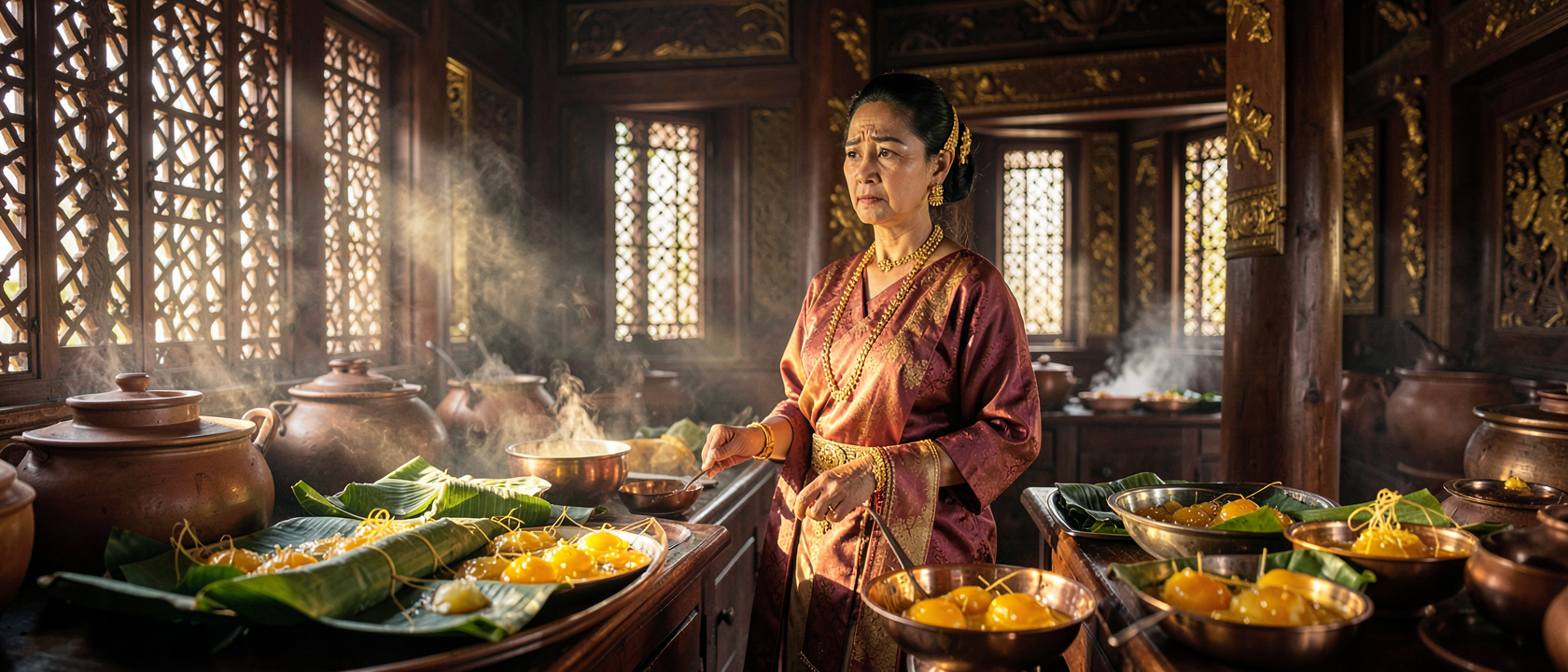
In Thailand, her desserts are better known than her name. Sangkhaya fak thong, a coconut-pumpkin custard, and foi thong, egg-yolk threads cooked in syrup, trace through court tradition to a woman remembered as Thao Thong Kip Ma, the “Queen of Thai Desserts.” Her real name was Maria Guyomar de Pinha, and the road to the royal kitchens ran through a fortune, an execution, and roughly 15 years of forced labor.
A Marriage at the Height of Ayutthaya
Guyomar was born in 1664 in Ayutthaya, capital of the Kingdom of Siam (today Ayutthaya, Thailand). Her mother, Ursula Yamada, was a Japanese Christian whose family had come to Siam after Christians were driven out of Japan. Her father, known as Fanique, was a Catholic of modest means from Goa, of mixed Portuguese, Bengali, and Japanese descent.
In 1682, at 18, she married Constantine Phaulkon, a Greek-born adventurer who had become one of the most powerful men in the kingdom. He served King Narai as Phra Khlang, minister of the treasury, from 1683 to 1685, then as Samuhanayok, chief minister, from 1685 to 1688, and carried the Siamese title Chao Phraya Wichayen. Catholic France granted both him and Guyomar citizenship and noble rank; in French circles she was known as Madame Constance. The couple had two sons, Jorge and João. By 1688 the family stood near the top of Ayutthaya society, and none of it had come from birth.
Power With No Foundation Under It
Phaulkon was not Siamese, and every office he held came from King Narai’s trust alone. His control over the treasury and over dealings with France, which had brought French troops into the kingdom, rested entirely on that one relationship. There was no family estate behind the household, no hereditary rank, nothing to catch Guyomar or her husband if the king died or changed his mind. Siamese kings valued foreign advisors for this exact reason: they owed nothing to local factions. It also meant nothing local stood ready to protect them if the king’s favor ran out.
The Fall
King Narai fell gravely ill in March 1688. In May his cousin Phetracha seized the royal palace at Lopburi and placed the king under house arrest. Phaulkon was arrested the same month, tortured in custody, and beheaded near Lopburi on June 5, 1688, at 40 or 41. Narai, by then powerless, died on July 11.
Guyomar was placed under house arrest too. With help from a French officer, Sieur de Sainte-Marie, she escaped and reached French troops in Bangkok on October 4, 1688. That garrison, an estimated 200 men, had been under siege for months by a much larger Siamese and Dutch force. Under pressure from Phetracha, and as part of a truce tied to that siege, the French commander, General Desfarges, handed her back to the Siamese on October 18 in exchange for hostages. The safety promised to her did not hold. She was condemned to a lifetime of servitude in the royal kitchens.
Fifteen Years in the Kitchens
Guyomar remained Phetracha’s captive until his death in 1703, a span of roughly 15 years. In that time she rose from forced laborer to head of the royal kitchen staff, which is nearly everything the record offers. No diary survives, no kitchen register, nothing describing a single day of the work. Historians have the start, 1688, the end, 1703, and a sequence with no dates attached in between.
What It Cost
Measured against 1682, the account by 1703 is short. She had a husband; he was executed. She had standing built on royal favor; she spent about 15 years as the property of the man who killed him. What became of her two sons in those years is not part of the documented record. The source material gives no figure for how many others paid a price in the 1688 rebellion beyond Phaulkon’s death and France’s eventual withdrawal from Siam. For Guyomar, the toll is stated plainly: a husband, a position, and 15 unpaid years.
Freedom, and a New Legacy
Phetracha died in 1703. His son took the throne and reopened Siam to the foreign ties his father had cut off. Guyomar was freed and kept her post running the royal kitchens for the rest of her working life. Counting both her years as a captive and her years as a free overseer, tradition credits her with more than 25 years in charge of that kitchen.
It is in her years of freedom that tradition places the desserts she is remembered for. Siamese royal dining favored careful presentation, fruit carved into flowers, nothing inedible left on a plate, and European trade had widened both the sugar supply and the habit of serving something sweet after a meal. Within that setting she is credited with sangkhaya fak thong, a coconut-pumpkin custard, and foi thong, egg-yolk threads cooked in syrup, close enough to the Portuguese fios de ovos that the real differences are strand length and the use of pandan leaf instead of vanilla. Both belong to the Nine Auspicious Desserts, golden sweets served at weddings for the luck their color is meant to carry. The recipes stayed inside the palace for generations, reaching ordinary households mainly after 1932, when Thailand became a constitutional monarchy and the old court households broke up; descendants of court families carried the recipes out with them. Guyomar died in 1728, at 63 or 64.
What’s Actually Known
Popular memory has given Guyomar credit for more than the record supports. She is sometimes named as the inventor of the curry puff, or of ho mok, a fish curry found across Southeast Asia long before her lifetime, with no documented link to her kitchen. Food writer Chawadee Nualkhair and other historians treat these particular claims as exaggerated or unverifiable. Even the sturdier attributions, sangkhaya fak thong and foi thong among them, rest on court-family memory rather than a surviving recipe or a contemporary record naming her as the creator.
Nualkhair has described the story, in her own words, as something Thais believe rather than something fully documented. That is not a flaw in it so much as a description of what kind of story it is: one carried by families for generations, with a job left for historians, which is to say plainly where the record stops and the memory takes over.