
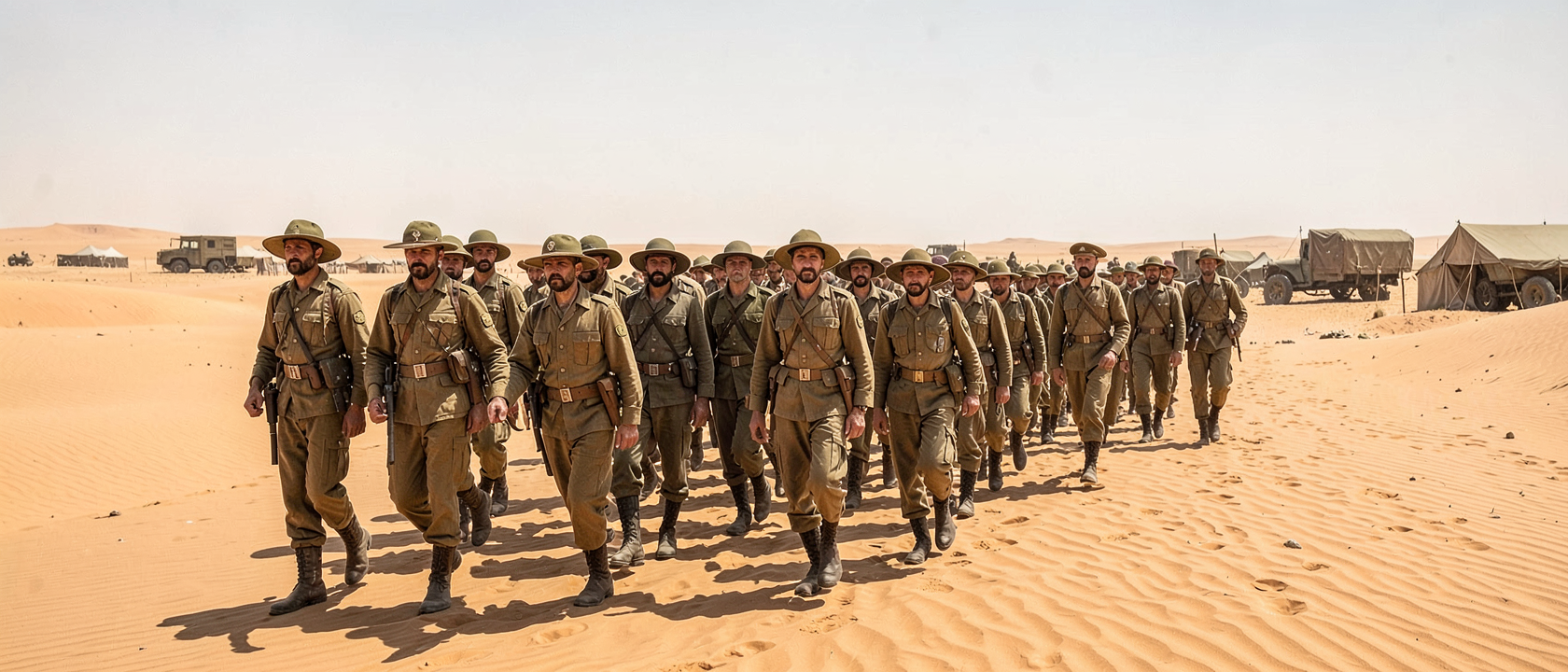
Thousands of Palestinian Arabs put on British uniforms between 1939 and 1943 and served in France, in North Africa, and in the rescue work that followed German air raids over England. They did it alongside Jewish volunteers from the same stretch of British-administered territory, against the same enemy. When the fighting ended, no memorial went up for them on either side, and the story slipped out of both Israeli and Palestinian national memory.
The Recruiting Office
In October 1939, with Britain newly at war, the Mandate government and British Army recruiting stations opened a campaign for volunteers in Palestine. Notices ran in the Arabic-language press. The initial target was modest: about 2,000 men, wanted for engineering, transport, medical work, and the armament corps.
This was not an improvised levy thrown together in a hurry. It was a formal enlistment drive, run through printed notices, set quotas, and the ordinary channels of British military bureaucracy in the Mandate.
A Country Not of One Mind
Palestinian Arab opinion on the war was not unified. Historians studying the period describe three broad camps: those who stayed neutral, those who leaned toward Britain, and those who opposed British rule outright. The anti-British camp looked to Mohammed Amin al-Husseini, the Mufti of Jerusalem, who was by then in contact with Nazi Germany and Fascist Italy.
Al-Husseini met with Adolf Hitler and offered to raise an Arab legion to fight on Germany’s side. Hitler, for his part, promised to destroy what he called the Jewish element residing in the Arab sphere under the protection of British power. Historians note that against this backdrop, enlisting with Britain was not a neutral act, given how deeply the war split Palestinian Arab society at the time.
Platoon 401: France to the Blitz
One unit can be followed in some detail. Platoon 401 was sent to France in March 1940, months before the German offensive broke the Allied line in June. When the expeditionary forces collapsed, the platoon was evacuated to England and stationed near fortifications around London.
During the Battle of Britain it helped evacuate casualties. Later, it shipped out of Glasgow and sailed back to the Middle East around the Horn of Africa, arriving home to what the record describes as a festive welcome. The exact date of that return voyage has not survived in the sources consulted.
Mixed Companies and the Desert War
Platoon 401 was one part of a wider pattern. In August 1940, mixed Arab and Jewish infantry companies were organized under the East Kent Regiment. Sources differ on the exact unit designation, whether it is best described as part of the Royal Fusiliers or listed separately as a pioneer company, but Arabs and Jews from Mandate Palestine served together in these companies regardless.
In North Africa, between 1940 and 1943, a unit known as Command Unit 51 carried out guerrilla operations under the command of an Indian division. As the war went on, Palestinian volunteering widened further still, into the air force, the navy, and women’s auxiliary corps.
The Bill
Historian Mustafa Abbasi, drawing on the research of historian Ashley Jackson, puts the number of Palestinian Arab volunteers at around 12,000, inside a wider estimated range of 9,000 to 17,000. The campaign many of them fought in, North Africa between 1940 and 1943, cost the Allied Commonwealth forces as a whole roughly 220,000 casualties, more than 35,000 of them deaths. That toll covers Australians, Indians, New Zealanders, Free French, Poles, and other Allied troops alongside the Palestinian volunteers; it was never broken down by nationality.
Some Palestinian Arab volunteers died in that campaign. Others are listed only as missing. No postwar organization was ever set up to record their names or count their dead. In 1948, the Nakba, the mass displacement of Palestinians that accompanied the founding of the State of Israel, destroyed archives that might have filled in the gap. No memorial to these men exists.
What We Don’t Know
Much about this chapter remains open. The total number of volunteers is not fixed: Abbasi’s 12,000 is an estimate, not a count, and the range historians work with runs as high as 17,000 and as low as 9,000. No precise casualty figure exists for Palestinian Arab volunteers specifically, only the knowledge that some died and others went missing.
Why men enlisted is also disputed. Abbasi argues that volunteers came from a broad cross-section of society, with urban recruits more often driven by opposition to fascism and rural recruits more often driven by pay and provisions. Other historians argue that material compensation was the dominant motive across the board, and that Abbasi’s picture of ideological volunteering is too generous. The return date of Platoon 401 to the Middle East, like much of the operational record, simply was not written down, or has not surfaced yet.
Two Memories, One Forgotten
In July 1944, the Jewish units that had grown out of the same Palestine companies were organized into the Jewish Brigade, which went on to fight in Italy in 1945. In the decades that followed, the Jewish Brigade became part of Israel’s founding story, a thread tying Mandate-era volunteering to the birth of the state.
The Palestinian Arab volunteers who had served in the same years, often in the same units, got no equivalent place in memory. Israeli historiography kept its attention on Jewish military service; Palestinian historiography, as Abbasi has argued, focused instead on opposition to Zionism and the struggle against British rule. Neither left much room for men who had volunteered to fight Hitler and Mussolini in a British uniform. They got no brigade, no monument, and, in the end, barely a mention.