A Promise Written at a Distance
On April 4, 1660, Charles II was still in exile at Breda when he signed the Declaration of Breda, offering “a liberty to tender consciences” and promising that no one would be “disquieted or called in question for differences of opinion in matter of religion which do not disturb the peace of the kingdom.” The precise terms of any religious settlement would be left to Parliament. Presbyterian and nonconformist clergy read this as a credible guarantee. The declaration named no mechanism to enforce the tolerance it offered and set no preconditions. When Parliament later attached its own conditions, the promise dissolved without anyone formally breaking its words.
An Impossible Clock
Charles II returned to England in May 1660. The Cavalier Parliament, strongly royalist and Anglican in composition, was summoned in May 1661. On May 19, 1662, it passed the Act of Uniformity by 186 votes to 180. The Act required all Church of England clergy to declare “unfeigned assent and consent” to a newly revised Book of Common Prayer, to hold or obtain episcopal ordination, and to renounce the Solemn League and Covenant. The deadline for full compliance was August 24, 1662.
The first printed copies of the revised prayer book came off the presses on August 6, 1662, leaving fewer than eighteen days for distribution across England and Wales. In Middlesex, many parishes reportedly did not receive a copy until after August 24 had already passed. The Act provided no allowance for late delivery. In documented cases, the clock ran out before the required object had physically arrived.
St Bartholomew’s Day, 1662
August 24 was St Bartholomew’s Day, a fixed point on the Church of England’s liturgical calendar, written into the statute as the hard compliance date. For nonconformists, the choice carried a specific charge: it was the same calendar date as the St Bartholomew’s Day Massacre of 1572, when thousands of Protestants were killed across France. When nonconformist communities later named what happened to their ministers “Black Bartholomew’s Day,” the echo was chosen, not accidental. The statute recorded a compliance deadline reached or missed; the communities recorded an erasure. The two framings have sat alongside each other ever since.
What Ejection Actually Meant
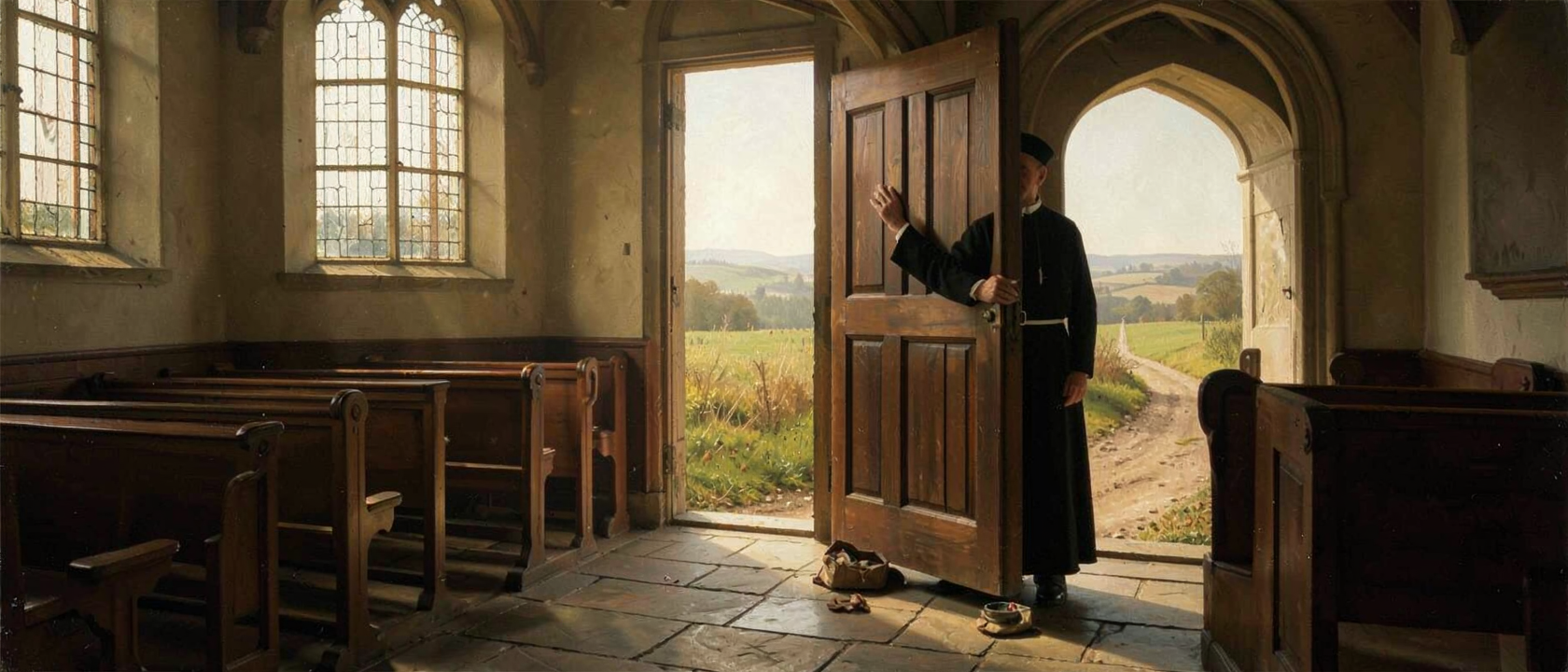
A church living in seventeenth-century England was income, housing, and professional standing bound into a single legal tenure. A minister removed on August 24, 1662 lost all three at once, with no staged transition. The source record contains no evidence of physical persecution tied directly to the ejection itself, but the loss was total. Richard Baxter was among those ejected. Edmund Calamy the Elder, perpetual curate of St Mary Aldermanbury in London since 1639, lost his living the same day, having earlier declined the bishopric of Coventry and Lichfield; he died in 1666 and was buried in the ruins of his own church, destroyed in the Great Fire of London. His son, Edmund Calamy the Younger, was ejected from the rectory of Moreton in Essex.
Three Centuries of Counting
Edmund Calamy the Elder’s grandson, Edmund Calamy III, born in 1671, became the primary chronicler of the ejection. His 1702 abridgment of Richard Baxter’s history listed 1,897 ejected ministers. A second edition followed in 1713, with further corrections in 1728.
John Walker, rector of St Mary the More in Exeter, published a rebuttal in 1714 after roughly ten years of research, arguing Calamy’s count was substantially inflated and conceding no more than 50 nonconformist ministers as having lost their livings in 1662. Later historians observed that his motivation was partly to establish that Anglican clergy had suffered more harshly under Interregnum Puritanism than nonconformists had at the Restoration, an argument that shaped his arithmetic.
The figure with the strongest claim to precision came in 1934, when A.G. Matthews published Calamy Revised (Clarendon Press, Oxford), a systematic audit of both lists. Matthews found that at least 47 of Calamy’s 1,897 names belonged to men who had died before August 24, 1662; 41 names appeared twice; 113 could not be verified; and approximately 695 clergy had in fact lost their livings in 1660, when returning royalist incumbents reclaimed parishes, a separate event Calamy had folded into his 1662 account. After removing the dead, duplicates, unverifiable entries, and 1660 displacements, Matthews arrived at 936 ministers and lecturers ejected in 1662 as a direct result of the Act of Uniformity. His combined total across all categories reached roughly 1,909.
Walker’s figure of roughly 50 is regarded by most later historians as a severe undercount; the traditional round figure of “about 2,000,” still cited in some accounts, conflates the 1660 and 1662 ejections and is not a verified count. Matthews’s 936 for the 1662 ejection specifically remains the most methodologically rigorous estimate produced to date.
The Act of Uniformity of 1662 was also the foundational statute of what became known as the Clarendon Code, a set of penal laws that barred nonconformists from public office and university degrees and restricted their public worship for roughly 150 years. Partial relief came with the Toleration Act of 1689. The congregations formed by the ejected ministers became the foundation of English Protestant Dissent, a permanent separation nowhere anticipated by the Declaration signed at Breda in April 1660.