
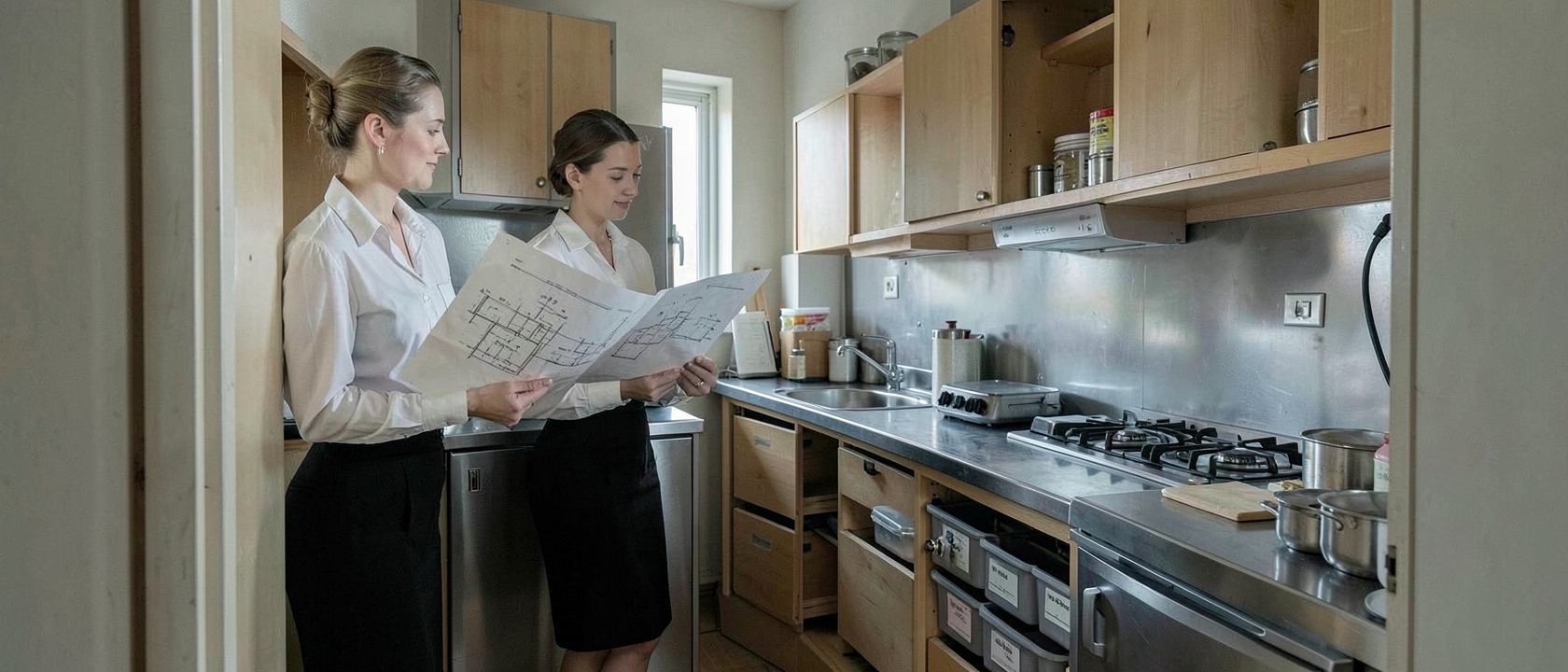
A Kitchen Designed by Calculation, Not Experience
In 1926, at a drafting table in Frankfurt am Main, Germany, Margarete Schütte-Lihotzky laid out a kitchen she had never needed herself. She had trained as an architect, among the first Austrian women to do so, but she had never run a household or cooked a family’s dinner. The German architect Ernst May brought her to Frankfurt to work on New Frankfurt, a public housing program meant to put working-class families into modern apartments, and her assignment was one room.
She approached it like an engineer studying a factory floor. Using time-motion studies from the American efficiency expert Frederick Winslow Taylor, and her own observations of railway dining-car galleys, she worked out exactly how far a hand or a foot had to travel between stove, sink, and shelf. The result was a room 6 feet 3 inches wide and 11 feet 2 inches long (1.9 by 3.4 meters), with continuous counters, a tiled backsplash, built-in cabinets, and drawers sized for specific ingredients. As London’s Victoria and Albert Museum notes, it was not the first fitted kitchen ever built, but it was the first one built in quantity: an estimated 10,000 units went into Frankfurt apartments before the decade was out.
The Numbers Behind New Frankfurt
The pressure behind that one room was arithmetic, not inspiration. Schütte-Lihotzky had trained in Vienna, a city still working through a severe postwar housing shortage, and in the early 1920s she designed for its settlement movement, the Siedlerbewegung: self-build huts and expandable “core houses” for families with almost no capital. That work taught her how a kitchen’s layout could cut both a builder’s costs and a housewife’s labor, and it is what made her the right choice when May needed a design that could be reproduced by the thousand at a price a housing authority could afford.
From Blueprints to the Underground
She did not stay with kitchens for long. In 1930, Schütte-Lihotzky and her husband, the architect Wilhelm Schütte, whom she had married in 1927, moved to the Soviet Union. She was the only woman among seventeen architects and planners assigned to lay out new industrial cities, including Magnitogorsk, under Stalin’s first Five-Year Plan; her own condition for taking the job was that she design kindergartens and nurseries rather than more kitchens. By 1938, with Stalin’s purges closing in, she left for Istanbul, Turkey, and joined the resistance network of the Communist Party of Austria, working from exile against the regime that then ruled her homeland.
Arrested, January 22, 1941
In December 1940, she returned to Vienna as a courier for that network. On January 22, 1941, the day before her 44th birthday, the Gestapo arrested her. She was initially sentenced to death; at the last minute the sentence was commuted to fifteen years in prison. She remained imprisoned until the war ended in 1945, when she was released from a prison in southern Germany. In her own account, she described how, on May 1, 1942, she and fellow imprisoned communists marked the date together by draining water from the shared plumbing and using the pipes to pass messages between cells.
The Postwar Bill
Austria did not welcome her back as a builder. Wary of her communism, its postwar architectural establishment kept her off the major public projects her Frankfurt record might otherwise have earned. She found steady work abroad instead, as a consultant in China, Cuba, and the German Democratic Republic, with only a handful of private houses to design at home. In the 1970s a different argument reached her: second-wave feminist critics described the Frankfurt Kitchen not as liberation but as confinement, a small separate room that isolated a woman from her family while she worked alone. Schütte-Lihotzky answered back directly in her memoir, published in 1985, and did not treat the kitchen as something to apologize for.
A Lecture, a Refusal, Late Honors
Recognition arrived late and in pieces. In 1980, she gave a lecture attended by Christine Zwingl, then an architecture student and later director of the Vienna museum that now carries Schütte-Lihotzky’s name; renewed interest in her full biography traces back to that talk. The City of Vienna gave her its architecture prize the same year. In 1988, offered the Austrian Medal for Science and Art, she turned it down because the honor would come from President Kurt Waldheim, whose own Nazi-era past she would not set aside for a ceremony. She accepted the same decoration in 1993, after Waldheim had left office, the year Vienna’s Museum of Applied Arts mounted an exhibition of her work. She died in Vienna on January 18, 2000, five days before her 103rd birthday, from complications of influenza, and was buried in an honorary grave at the city’s Zentralfriedhof cemetery.
What the Record Doesn’t Settle
Some questions never closed. Whether the Frankfurt Kitchen freed women’s labor or boxed it into a smaller space is still argued both ways, and the record does not settle it. No reliable count exists of how many of the original 10,000 units survive, and no figure for what the housing program cost has been documented; that gap should stay a gap, not get filled with an invented number. What remains sits mostly in museums: original units are held by the Museum of Modern Art in New York, described by one account as the earliest work by a female architect in its collection, and by the Victoria and Albert Museum in London. Her own Vienna apartment on Franzensgasse has since opened to the public, and her personal kitchen there, a 1970s design that hid red-painted interiors behind dark-green cabinets and reused tricks from 1926 like a folding ironing board, was reconstructed under the architect Renate Allmayer-Beck. Sources differ on timing, with one dating the apartment’s public opening to 2021 and another dating the kitchen’s completed reconstruction to September 2024.