
A Manuscript With No Name
In 1584 a manuscript began moving through the English court under an unwieldy title, “The Copie of a Leter wryten by a Master of Arts of Cambrige.” No printer’s name appeared on it, and the crown had never licensed it. It had in fact been printed in France and smuggled into England in hundreds of copies, which then passed hand to hand once they arrived. Today it is known by a shorter name: Leicester’s Commonwealth, after its target, Robert Dudley, Earl of Leicester, the queen’s longtime favorite.
Elizabeth and her Privy Council moved fast once copies surfaced. The crown banned the book and imposed penalties even for owning a copy, a measure that shows how seriously it treated the pamphlet’s threat.
A Favorite Worth Attacking
Robert Dudley had been Elizabeth’s favorite from the earliest days of her reign until his death in 1588. His standing rested on the queen’s personal regard rather than on inherited office. That made it powerful, and it made it fragile: discredit the man, and everything built on his favor was exposed. Leicester’s Commonwealth itself assumed that Dudley had once aimed to marry Elizabeth outright and failed. Whether or not that was true, the assumption shows how close to the crown his contemporaries believed him to stand. An attack of this kind could never stay private. It reached his faction at court and every ally whose fortunes ran through his.
The Charge Reaches Backward
The pamphlet did not stop with Robert. It went back a generation to his father, John Dudley, who became Duke of Northumberland in 1551 (born around 1504, though some accounts place his birth as early as 1502). The text invoked what it called a prophecy: that Dudley’s house would bring ruin on the royal blood of Henry VIII. The claim had something real to hang on. In 1553, with Edward VI dying, Northumberland arranged the marriage of his son Guildford to Lady Jane Grey and persuaded the king to name her as his heir, cutting both of Henry VIII’s surviving daughters, Mary and Elizabeth, out of the succession. Whether an actual prophecy ever circulated, or whether the pamphlet invented one to dress a political argument up as fate, the surviving record does not say.
Three Generations, One Hill
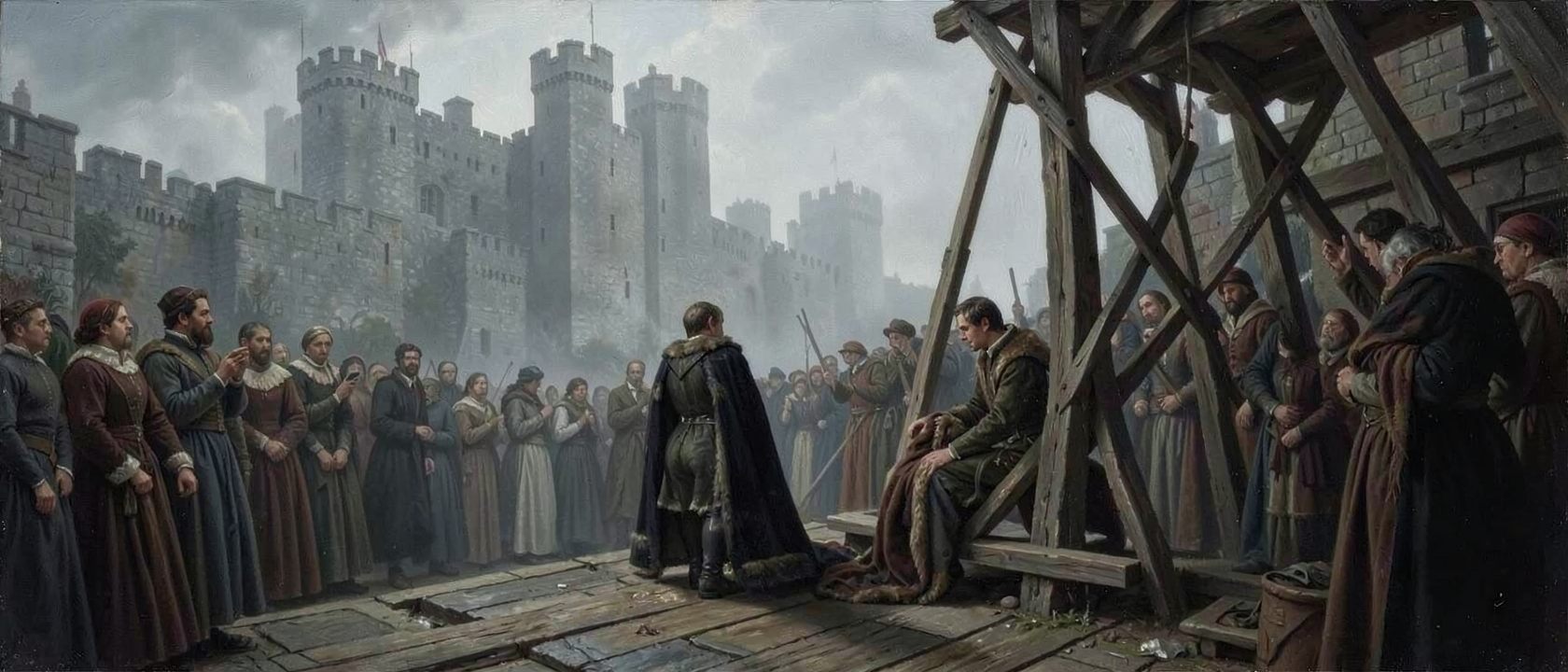
The accusation never named anyone. Filled in, the record is precise. Edmund Dudley, Robert’s grandfather and a councillor and financier to Henry VII, was arrested the moment Henry VIII took the throne in 1509 and beheaded on Tower Hill on August 17, 1510. His son, Northumberland, was tried and convicted of treason at Westminster Hall on August 18, 1553, and beheaded on Tower Hill four days later, on August 22, the same ground his father had died on forty-three years earlier. Northumberland’s own son, Guildford, husband of Lady Jane Grey, was executed in 1554. Three men from one family died on the same patch of London ground across three generations.
There is a quieter thread tying them together. While Edmund Dudley sat in prison awaiting execution, he wrote a treatise defending absolute monarchy, The Tree of Commonwealth. By one surviving account, a manuscript copy was made for his son, and a further copy was produced in 1563, by the chronicler John Stow, for his grandson Robert. If that account holds, the condemned grandfather’s own defense of royal power passed down through the very family the crown kept putting to death.
What the Executions Actually Cost
Set the hereditary theory aside and the plain fact remains: three men from one family, across three generations, were executed by the Tudor state between 1510 and 1554, a toll of three deaths inside forty-four years. Robert came close to being a fourth. After Northumberland’s plot collapsed, Robert was condemned to death too, as his brother Guildford had been. He was released in 1554 and went on to fight at the Battle of St. Quentin in 1557, rebuilding a career his family’s collapse should have ended. However the pamphlet chose to read that record, the deaths themselves are not in dispute. Only their meaning is.
Conspirators or Survivors?
Historians still disagree on what that record actually shows. One reading treats the Dudleys as repeat offenders, a family that kept reaching for power beyond its legal claim and kept paying the price. Other historians argue Northumberland was made a convenient scapegoat, blamed for every failure of Edward VI’s reign after 1549 rather than for one clear plot of his own. Leicester’s Commonwealth never entertains that second reading. It states the hereditary charge and moves on, because its job was political damage, not balance. Tudor court politics ran on exactly this kind of risk, families rising fast on royal favor and falling just as fast when it turned, and ambition on its own has never proven a conspiracy.
What the Record Still Won’t Say
The author of Leicester’s Commonwealth has never been identified. A 1985 critical edition by Dwight C. Peck argued for Sir Charles Arundell, a Catholic exile; other scholarship, including material held by the British Library, points instead to Thomas Morgan, a figure from the same exile circles. No surviving copy carries a name. The pamphlet’s most sensational claim was that Leicester arranged the death of his first wife, Amy Robsart, found at the foot of a staircase with a broken neck, her headdress supposedly undisturbed. Modern historians regard it as unsubstantiated libel, not established fact. Leicester’s own nephew, Sir Philip Sidney, wrote a rebuttal, and Elizabeth herself defended him. He went on to lead England’s military campaign in support of the Dutch Revolt between 1585 and 1587, holding the queen’s commissions even after the libel was already circulating. He died at Cornbury, Oxfordshire, on September 4, 1588, four years after the pamphlet first appeared. More than four centuries later, the question it raised about his family, treachery bred in the blood or just the ordinary risk of Tudor politics, is still without an answer.