
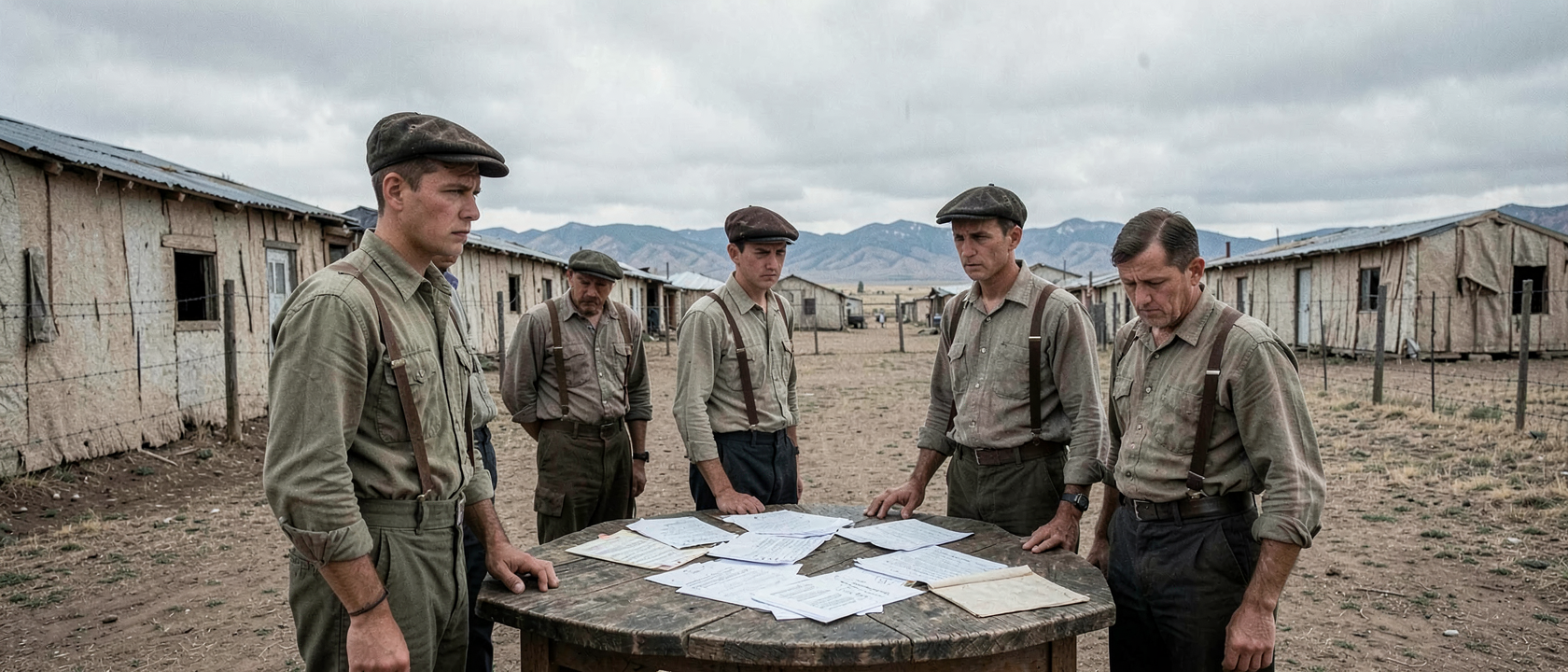
The 442nd Regimental Combat Team came home from World War II as the most decorated unit for its size and length of service in U.S. military history, proof, many said, that Japanese Americans had earned back the citizenship the government had taken from them. A quieter story sat behind it. Inside the camps holding roughly 120,000 Japanese Americans, most of them U.S. citizens, several hundred young men looked at a draft notice from the same government and refused.
A Loyalty Test at Heart Mountain
By late 1943, Heart Mountain War Relocation Center in northwestern Wyoming held 10,767 people behind barbed wire, most of them Nisei, U.S.-born citizens. Administrators required every adult to complete a loyalty questionnaire. Question 27 asked whether they would serve in the armed forces wherever ordered. For men who had lost their homes and businesses and were held without charge, the question read less like an invitation than a trap.
In November 1943, inmate Kiyoshi Okamoto declared himself a one-man “Fair Play Committee.” By January 26, 1944, he and six others, including Frank Emi, had organized it into a formal group, the Fair Play Committee, or FPC. Dues-paying membership eventually reached about 275.
The Draft That Was Taken Away and Given Back
The FPC’s objection rested on a contradiction. After Pearl Harbor in December 1941, the War Department classified Japanese Americans as enemy aliens, barring them from service and pulling men already in uniform from active duty. In January 1943, service reopened, but only to volunteers, who mostly joined segregated Army units; many of the earliest came from the Territory of Hawaii, where there had been no mass removal.
In February 1944, the War Department reinstated the draft itself, making Nisei men eligible for conscription straight out of the camps. Citizenship rights were not restored. Confinement did not end. The government was now ordering men to risk their lives for a country that still would not let them go home.
Omura’s Early Dissent
This contradiction was visible even before the camps filled up. On February 23, 1942, Congress held hearings in San Francisco on the mass removal then just getting underway. Denver journalist James Matsumoto Omura testified against it, arguing the government had no real evidence of disloyalty against the people it was about to intern; his wife and business partner, Fumiko Okuma, testified alongside him.
At the same hearings, representatives of the Japanese American Citizens League, or JACL, urged cooperation with removal as the surest proof of loyalty. Omura’s stand put him outside the mainstream of Japanese American political leadership two years before the Heart Mountain resisters stood trial. He would stand trial alongside them.
Sixty-Three Men, Then Three Hundred and Fifteen
Once the draft order went out, 63 men at Heart Mountain refused to report for their pre-induction physicals. All 63 were indicted and tried together in Cheyenne, in what is described as the largest mass trial in Wyoming’s history, and sentenced to three years in federal prison, split between McNeil Island Penitentiary in Washington State and Leavenworth in Kansas.
The seven FPC leaders were charged separately with conspiracy, as was Omura, despite being neither draft-age nor a Heart Mountain inmate. That trial ended in November 1944 with convictions and sentences recorded in different sources as either three or four years. A second group of 20 Heart Mountain men was convicted the following year and given two-year terms, bringing the camp’s total to 85. Counting resisters from eight of the ten War Relocation Authority camps, estimates of the national total convicted run from 267 to roughly 315.
Acquittal, Reversal, Dismissal, and a Pardon
The legal reckoning came in pieces, after the fact. Omura was acquitted on November 1, 1944, the only defendant in his trial found not guilty, on grounds that his editorials were protected by the First Amendment. The Tenth Circuit Court of Appeals reversed the FPC leaders’ conspiracy convictions in January 1945, ruling the jury should have been allowed to weigh civil disobedience as a defense. They stayed in Leavenworth anyway, until March 1946.
In a separate case, federal judge Louis Goodman dismissed draft-evasion indictments against a group of resisters at Tule Lake, California, on July 29, 1944, ruling it unconscionable to hold a citizen under suspicion of disloyalty and then prosecute him for refusing to serve the government holding him. Sources differ on how many men that covered, seven or twenty-six. On December 24, 1947, President Harry Truman issued a blanket pardon for the resisters. None of it gave back the time already served.
Ostracized by Their Own
Legal vindication did not restore standing inside the Japanese American community. The 442nd’s battlefield record had become the proof the community pointed to when arguing for its own citizenship. Measured against that record, men who had refused the draft looked, to many, like they had undercut what the 442nd’s dead and wounded were buying back.
Soldiers came home to parades and recognition. Resisters came home from prison to silence, and in some cases open hostility, from their own neighbors. The prison sentence was one bill. Being treated as a source of shame by the people they had grown up among was a second one, and it came due for much longer.
Why the JACL Didn’t Want This Told
According to historian Arthur A. Hansen, the JACL actively discouraged the resistance story from being told after the war, favoring a public narrative built around the 442nd’s service as proof that loyalty had been earned through sacrifice, not protest. That discouragement is documented; less settled is the JACL’s full reasoning, or how widespread resistance actually was in camps beyond Heart Mountain and Tule Lake, where the record is thinner. For roughly two decades, the resisters mostly stayed out of the story told about the camps.
Found Again in the Late 1960s
The story resurfaced in the late 1960s, alongside the Civil Rights movement and a new wave of resistance to the draft over Vietnam. Both gave a younger generation language for what the Heart Mountain men had done decades earlier: a distinction between military service and citizenship, and the argument that the second should not have to be earned through the first.
The facts had not changed. What changed was which facts got repeated. Draft resistance in the camps has since become, in one historian’s description, a significant part of how the internment era is remembered, alongside the record of the men who went to Europe.