
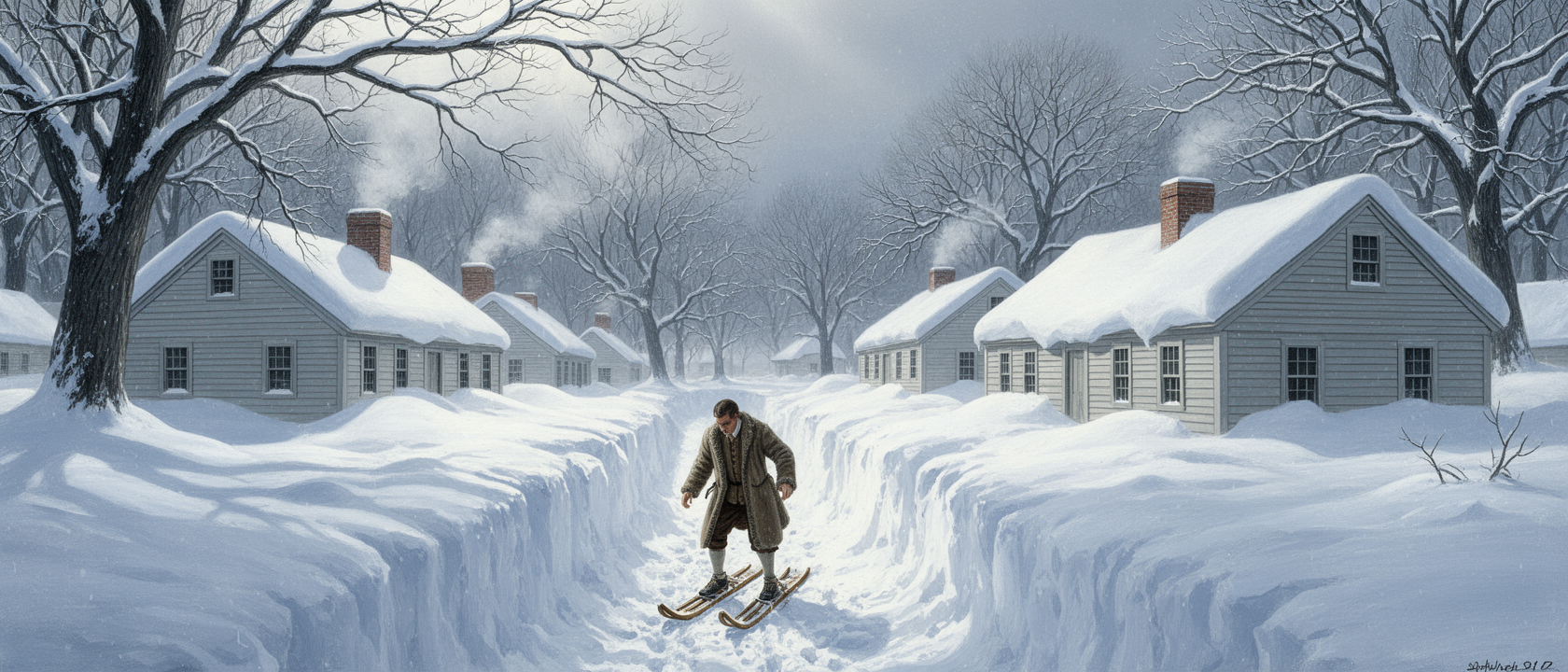
The Submerged Colony
The winter of 1716–1717 came early to New England. Cold and snow had been building since November 1716 across Massachusetts, New Hampshire, and Connecticut, and by late February the landscape bore little resemblance to what lay beneath it. In some sheep pastures, Cotton Mather, Boston’s prominent Puritan minister, recorded drifts reaching 16 feet (4.9 m). Single-story houses disappeared entirely under the snowpack; two-story structures fared better, but the drifts climbed their walls regardless.
The Great Snow of 1717 is considered the most thoroughly documented winter event of the colonial New England period, recorded across almanacs, diaries, letters, sermons, and newspaper accounts.
The Logistics of Survival
A colonial household in 1717 ran on livestock and firewood. Cattle, horses, and sheep provided food, labor, and materials; firewood was the only source of heat. Both depended on roads, and the roads stopped functioning. A contemporary account described conditions allowing “no traveling for horse, or man, but with Rackets”, the period term for snowshoes, borrowed from Native American practice. Settlements could not reach each other, supplies could not move, and people who needed rescue in places like Hampton, New Hampshire, had to wait for someone on snowshoes to find them. In cities, when roads closed and harbors became hazardous, firewood deliveries stopped entirely.
The February Sequence
Four storms struck the region within an 11-day window. The exact dates are disputed, partly because colonial settlers used the Julian (Old Style) calendar, running 10 to 11 days behind the Gregorian calendar. Thomas Wickman, whose peer-reviewed essay appeared in the journal Northeastern Naturalist in 2017, places the opening storm on February 18, 1717 (Old Style), with three more following before February 28. Other sources give a Gregorian equivalent of February 27 to March 7. All four were most likely nor’easters, extratropical cyclones tracking up the Atlantic coastline with sustained northeasterly winds and heavy snowfall.
The resulting snowpack reached 3 to 5 feet (roughly 0.9 to 1.5 m) across much of New England and persisted for approximately six weeks. On March 7, 1717 (Old Style), Mather wrote that there had been “Never such a Snow, in the Memory of Man” and sent a formal account to the Royal Society in London. By March 8, the firewood shortage had reached Harvard College in Cambridge, where student Thomas Paine, not the pamphleteer of the same name, born in 1737, recorded the crisis; students were sent away because the college could not be heated. Church services in Boston were suspended for two consecutive weeks after the final storm, and in Framingham no public meetings were held until the end of March. Drifts on roads leading north toward New Hampshire and Maine reached 14 feet (4.3 m).
Livestock and Mandates
Animals brought into barns or homes before the storms had a chance of surviving; those that could not be reached did not. Livestock on islands or along coastlines were cut off entirely. Deer, sheep, horses, and cattle died across the region, and orchards suffered heavy damage. One account in historian Sidney Perley’s 1891 work Historic Storms of New England describes a single farmer losing more than 1,100 sheep, though this has not been verified against any primary record. Claims that over 90 percent of New England’s deer population died appear only in secondary sources with no confirmed primary or peer-reviewed basis.
April 1717 arrived with snow banks still several feet deep. Governor Samuel Shute, barely five months in office since October 1716, issued a proclamation calling for a public day of fasting and prayer, asking God to “bless the Springing of the Year.” A colonial resident named Ebenezer Billings wrote that Native Americans around 80 years old told him their fathers had never described anything like the storm.
The Environmental Dispute
Whether the Great Snow exceeded any normal meteorological range, or whether colonial land management made a severe but not unprecedented snowfall far worse, is where historians divide. Wickman argues the landscape itself bore significant responsibility: colonists had cleared entire forests to create open fields, unlike Native Americans, who burned undergrowth while leaving the tree canopy in place. The colonial method produced an exposed landscape with higher wind chill and greater drifting potential. A comparable storm striking a forested interior, he suggests, would have left different conditions on the ground.
The case against that reading draws partly on the Native American accounts Billings collected: if elderly witnesses said their fathers had never described a storm like it, the meteorological event itself may have been genuinely rare, not merely the colonial experience of it. Billings’s account does not resolve the dispute.
What the record does confirm is the bill. Livestock died by the thousands across three colonies. Students left Harvard because there was no fuel to heat it. A governor barely five months in office called on divine intervention while snow banks that should have been gone since February still stood in April. The land management question remains open. The cost does not.