
The Morning of May 6, 1933
The building at In den Zelten 10, on the edge of Berlin’s Tiergarten park, was more than an archive. By the spring of 1933 the Institute for Sexual Science held a research library, medical and case records, and consultation rooms where staff treated sexually transmitted infections and offered marriage and sexual counseling. Its founder, Magnus Hirschfeld, kept an apartment upstairs. His partner, Karl Giese, ran the library and archive housed inside.
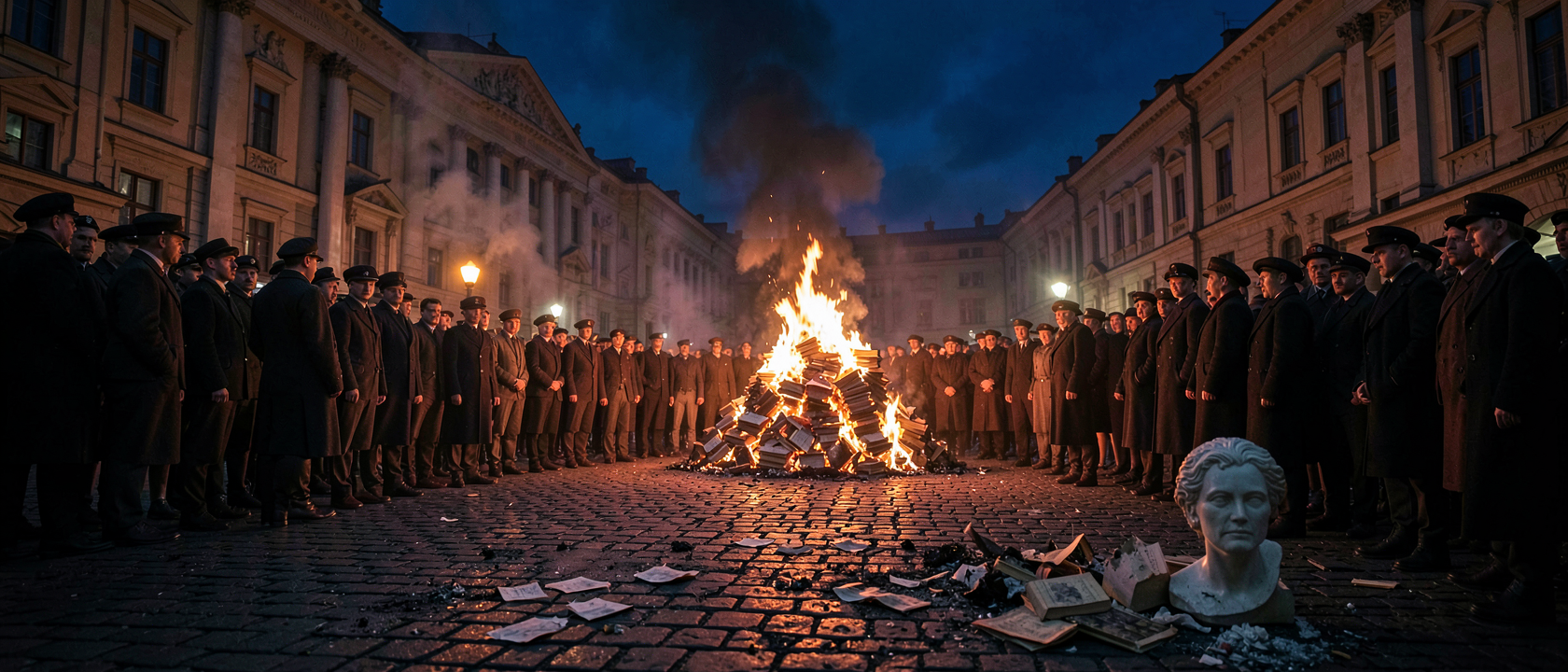
On the morning of May 6, 1933, members of the German Student Union (Deutsche Studentenschaft), a Nazi-aligned organization, marched on the building. Nearly eighty students, by one estimate, pushed inside, and members of the Sturmabteilung, the Nazi Party’s paramilitary wing known as the SA or Brownshirts, joined them. Together they ransacked the institute and hauled out an estimated half a ton (about 450 kilograms) of books, files, and research material. This was not a crowd that had gathered on its own. It was a planned action, carried out in daylight, against a single named address.
The seized material did not burn that morning. By most accounts it was piled up and set alight four days later, on May 10, in Berlin’s Opernplatz square (renamed Bebelplatz in 1947), along with roughly 20,000 other books the regime judged “un-German.” A Berlin city museum source instead dates that fire to May 8. Either way, a plaster bust of Hirschfeld went into the same flames as his life’s research.
Thirty-Six Years to Build
The institute had not appeared overnight, and neither had the fight behind it. On May 15, 1897, Hirschfeld founded the Scientific Humanitarian Committee (Wissenschaftlich-humanitäres Komitee) in his own Charlottenburg apartment, with the publisher Max Spohr, the lawyer Eduard Oberg, and the writer Franz Joseph von Bülow. Its goal was narrow: repeal Paragraph 175, the clause in the German criminal code that made sex between men a crime. Over more than three decades the committee petitioned the government repeatedly. One historical account puts a single petition’s signatures at roughly 6,000, including Albert Einstein, Thomas Mann, Rainer Maria Rilke, and Stefan Zweig, though that figure comes from a single source and has not been independently confirmed. The campaign never got the law changed.
The Institute for Sexual Science opened on July 6, 1919, in Weimar-era Berlin, founded jointly by Hirschfeld and the physicians Friedrich Wertheim and Arthur Kronfeld. It combined research with direct care: treatment for sexually transmitted infections, counseling, and support for homosexual and transgender patients, much of it offered at no cost. That same year, in Munich, a small nationalist party, soon to rename itself the National Socialist German Workers’ Party, held its founding meetings. In 1919 nothing marked either organization as the one that would still exist fourteen years later.
Years of Warning
The 1933 raid closed out a pattern rather than opening one. By one account, Hirschfeld was attacked in public in 1920 and beaten badly enough to be described as near-fatal. His lectures drew hecklers and, more than once, smoke bombs thrown to break up the room. The United States Holocaust Memorial Museum records plainly why the Nazi movement singled him out: his pacifism, his Jewish ancestry, and his research into sex, gender, and sexuality, all treated by the party as a threat to the nation it wanted to build.
None of that made the outcome certain. But by 1933, Hirschfeld and the institute he ran had already been public targets for over a decade.
Watching From a Paris Cinema
Hirschfeld was not in Berlin when the raid happened. He had spent the preceding years touring and working abroad, and by the spring of 1933 he was living in Paris. He learned what had happened to his institute the way much of the public did, through a newsreel, projected in a Paris cinema, showing footage of the fire in Berlin.
No source records what he said or thought while he watched it. Only the fact of the viewing survives: a man sitting in an audience in another country, watching the destruction of the building that held his research, his patients’ records, and his home. He never went back to Germany.
What Was Lost, What Isn’t Known
What the record states clearly: the institute’s library was destroyed, its research archive was destroyed, and the building that had housed both was stripped and, within roughly a year, formally dissolved as an institution.
What the record does not say is worth naming too. No source gives a precise count of the books destroyed or a figure for what was lost in money. None account for what became of the patients, residents, or staff, people who had lived or been treated inside that building, whose names do not appear anywhere in what survives. And beyond “the German Student Union” and “the SA,” no document fixes exactly who gave the order. The history available stops where the evidence stops.
The Law Outlived Him
Hirschfeld spent his remaining years in exile, working to build a new institute in Paris that never matched what Berlin had held. He died in Nice on May 14, 1935, his 67th birthday.
Paragraph 175, the law his committee had spent decades trying to erase, did not die with the institute that had fought it. It stayed in Germany’s criminal code, revised but intact, for decades afterward. One account tracing its later history dates its full repeal to 1994, ninety-seven years after Hirschfeld first founded the Scientific Humanitarian Committee against it, though that date, too, rests on a single source. He did not live to see any part of that long ending. The law he spent his career opposing outlasted him by close to sixty years.