
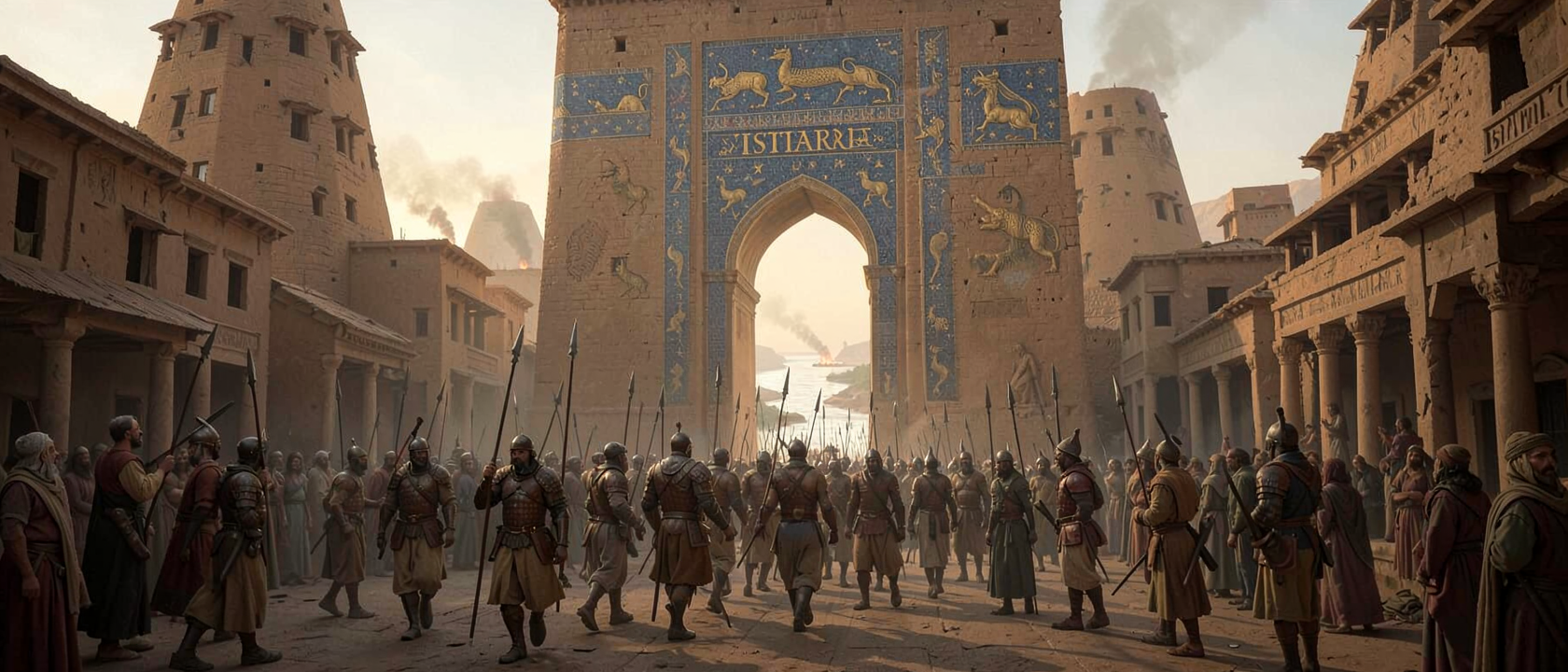
A lament survives from the fall of Jerusalem, written by people who had lived through the destruction or its aftermath. It preserves a belief that ran through the ancient Near East: when a great city fell, survivors did not blame only an enemy’s army. They said the city’s own god had withdrawn and let it happen. Twice within roughly a century and a half, that explanation applied to two capitals. Babylon was destroyed near the end of the seventh century BC. Jerusalem fell not long after, early in the sixth. A further question follows both: whether Cyrus, who later tore down Babylon itself, was completing the same pattern, or simply conquering a city whose god, this time, had nothing to do with it.
The City That Fell First
Babylon was not always the city that humbled others. Near the end of the seventh century BC, Assyrian forces destroyed it so thoroughly that it needed decades to recover. Babylonian tradition, looking back, did not explain the loss only as a military defeat. It held that Marduk, the god whose temple stood at the city’s center, had withdrawn his favor and allowed the ruin to happen. The army that broke Babylon’s defenses and the priests who later wrote about the loss agreed on what happened. They disagreed on who was responsible.
Temples as Political Proof
In Mesopotamia and in Judah alike, a city’s temples were never separate from its politics. A temple standing and maintained was proof a god still lived there, invested in the place and its ruler. A temple neglected or torn down was proof the relationship had ended. This was not superstition layered onto politics: it was the language in which defeat got explained to the people left to live with it. Historians still debate how literally rulers believed this, as against using it as a tool of statecraft. Sincere or convenient, the belief shaped how both Babylon and Jerusalem told the story of their own ruin.
Jerusalem’s Turn
Jerusalem’s fall came in two stages, under one king: Nebuchadnezzar II of Babylon, the very empire that Assyria had once humbled. On March 16, 597 BC, Babylonian forces captured the city for the first time. Nebuchadnezzar deposed King Jeconiah and installed his uncle, Mattaniah, in his place, renaming him Zedekiah.
Zedekiah did not keep the peace for long. In December 589 BC, Nebuchadnezzar’s army laid siege to Jerusalem a second time, a siege that dragged on for about 30 months. The city fell in the summer of 587 BC, a date some scholars put a year later, in 586. What followed was systematic: the Babylonians tore down the First Temple and dissolved the kingdom of Judah. Zedekiah’s own sons were executed in front of him. He was then blinded and taken to Babylon, along with a large part of the population.
Out of this loss, or its immediate aftermath, came the Book of Lamentations. It pictures Jerusalem as a city once great among provinces, now sitting alone like a widow stripped of her former standing. That grief is not a later invention. It came from people who had lived through the siege and the deportation, writing down what had just happened to the only capital they knew.
The Pattern Repeats
Set side by side, the sequence is hard to miss. Near the end of the seventh century BC, Babylon fell to Assyria, and its own tradition explained the loss as divine abandonment. About a century later, Jerusalem fell to Babylon, and the lament it produced reached for the same kind of explanation: a god who had let his city go. Ancient readers noticed this repetition as much as modern ones do. Are these falls following an actual pattern, something close to a rule about how divine favor worked? Or do they only look like a pattern because two societies, a century apart, reached for the same familiar language to explain a loss neither of them had chosen?
Enter a Different Kind of Conqueror
Into this pattern comes a third fall, later and larger than the first two: Babylon’s own destruction, this time by the Persian king Cyrus. Some ancient traditions cast him as a man carrying a kind of destiny for destruction, as well as for greatness, and that framing sits uneasily next to the question this piece is built around. Did Cyrus’s overthrow of Babylon belong to the same cycle as the other two, a city whose god had withdrawn, its fall only the human instrument of something already decided? Or was Cyrus simply a conqueror, with the religious language wrapped around his victory added afterward, by people doing exactly what Babylon’s priests and Jerusalem’s poets had done before them?
This account does not walk through who Cyrus was or the specific campaign by which he took Babylon. That is a deliberate gap. The point here is the question his conquest poses, not a retelling of how he answered it.
What the Record Doesn’t Say
What we don’t have, in this telling, matters as much as what we do. There are no casualty figures for Babylon’s final fall, no account of what it cost in material terms, no step-by-step narrative of Cyrus’s campaign. There is also no single explanation for how ancient writers arrived at the reputation some gave him, because the surviving sources disagree with each other. A clay cylinder, recovered from Babylon’s ruins in 1879, presents Cyrus as a restorer of temples and displaced peoples. A Greek historian’s account presents him as something close to an ideal king. A Hebrew record credits him with ending an exile rather than causing a destruction. That disagreement is not a gap in the research. It is the actual shape of the evidence: a period that survives in fragments, written by people with their own reasons for remembering it one way rather than another.
So the question stays open. Did Babylon’s fall to Assyria, Jerusalem’s fall to Babylon, and Babylon’s second fall to Cyrus play out one pattern of divine abandonment, repeating across roughly a century and a half? Or are they three separate conquests, each explained afterward in the same borrowed language, the only vocabulary available to people trying to make sense of a catastrophe they did not choose and could not undo?